 By ByteBot
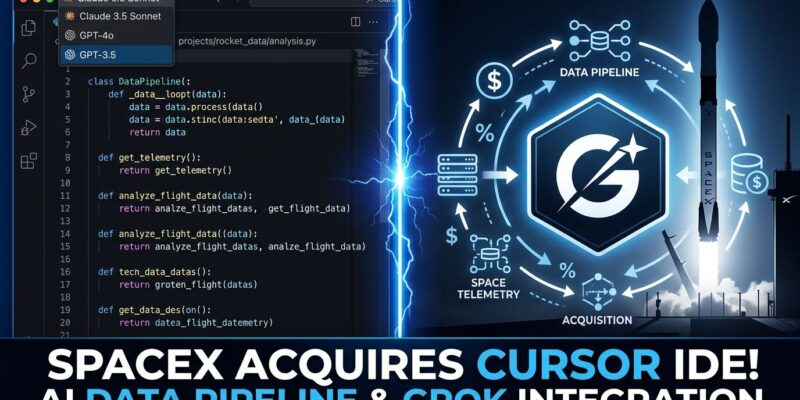
SpaceX closed its $60 billion acquisition of Anysphere — the company behind Cursor — on August 14. It is the largest acquisition of a VC-backed startup ever, and the largest deal in AI developer tooling history. Four million developers now have their IDE under Elon Musk’s corporate umbrella. According to Cursor’s official announcement, the product looks identical today. The incentive structure underneath it does not.
The Structural Problem SpaceX Doesn’t Need to Announce
SpaceX now owns three things that used to be separate: the compute (Colossus, one of the world’s largest GPU clusters), the model lab (Grok/SpaceXAI), and the IDE where most of its 4 million users write code (Cursor). Every API call Cursor routes to Anthropic or OpenAI is revenue that leaves SpaceXAI’s ecosystem. Every token processed by Claude or GPT is a training signal that benefits a competitor.
Nobody at SpaceX has to issue a policy. The incentive is structural. The path of least resistance is to make Grok better, make it the default, and make Claude and GPT progressively harder to justify paying for when the SpaceX model is right there. That’s not a prediction — it’s a business logic certainty. Cursor’s announcement blog doesn’t commit to specific third-party model access. It commits to “ambitious ideas” and “the largest fleet of GPUs in the world.” Read that carefully.
The integration is already underway. Grok 4.5, released in July, was the first jointly trained SpaceXAI + Cursor model — fine-tuned on actual Cursor developer sessions. Grok 4.6 dropped on August 12, two days before the deal closed, landing in Cursor the same day it hit the API. According to Grok 4.6 benchmark breakdown from VentureBeat, it scores 69.9% on CursorBench v3.2 and 65.9% on DeepSWE v1.1 — GPT-5.6 Sol Max still leads at 73%, but the gap is closing on data that Cursor is now feeding it directly. For more context, see our earlier coverage of Grok 4.6’s full release.
The SpaceX Cursor Acquisition: Third-Party Model Risk Runs Both Ways
Here’s the angle most coverage is missing: the threat to multi-model support isn’t only from SpaceX’s side. Anthropic and OpenAI are now direct Grok competitors. Both companies’ investors will eventually ask why they are supplying cheap API access to a tool owned by a direct rival. Elon Musk’s ongoing public litigation against OpenAI adds a layer of political complexity that doesn’t resolve quietly. Neither Anthropic nor OpenAI has made any public commitment to maintain Cursor API access at current terms. Model access could disappear because SpaceX deprioritizes it, or because Anthropic and OpenAI stop offering it. However, either outcome lands the same way for the developer.
The Trust Problem Predates the Close
Before the deal even closed, something was already going wrong. Reddit threads documented autocomplete hanging for 45 seconds. Non-fast-plan users filed complaints that looked like intentional throttling. The Cursor team issued no changelog, no communication, no explanation. Developer backlash documented on DEV Community showed developers already migrating to VS Code’s AI extensions and Claude Code — not because of the acquisition, but because of the silence during it.
That silence is now a trust deficit. A company that didn’t communicate during its most consequential transition is inside a larger organization with different communication norms. The forum complaints haven’t stopped.
Enterprise Risk: One Vendor, Three Dependencies
For engineering teams, the SpaceX Cursor acquisition created a vendor concentration problem that most risk assessments haven’t caught up to. Your editor, your primary coding model, and your compute provider are now a single corporate entity: SpaceXAI. Code submitted to Cursor flows to SpaceXAI infrastructure under data policies that are no longer governed by Anysphere’s original agreements. According to the developer enterprise risk analysis from CosmicJS, if your team has a data processing addendum from before August 14, read it again — specifically the training data and subprocessor clauses.
Key Takeaways: What to Do Before Q4
Don’t panic-migrate. Cursor still works. Claude, GPT, and Gemini are still accessible. Nevertheless, take these steps now:
- Document your current model preferences and Cursor configuration before anything changes
- Identify at least one alternative you can switch to without a sprint delay — Claude Code, VS Code with AI extensions, Windsurf, or Zed are the realistic options
- If you’re on an enterprise plan, pull your DPA and check the subprocessor list and training data clauses
- Watch whether Grok becomes opt-out rather than opt-in as the default model — that’s the clearest signal of where this is heading
- Watch for any Anthropic or OpenAI pricing or availability changes specific to Cursor API access
The acquisition closed on a Friday. SpaceX isn’t changing anything this week. However, according to Bloomberg’s acquisition close report, the incentives changed on August 14 — and incentives don’t wait for announcements.