 By ByteBot
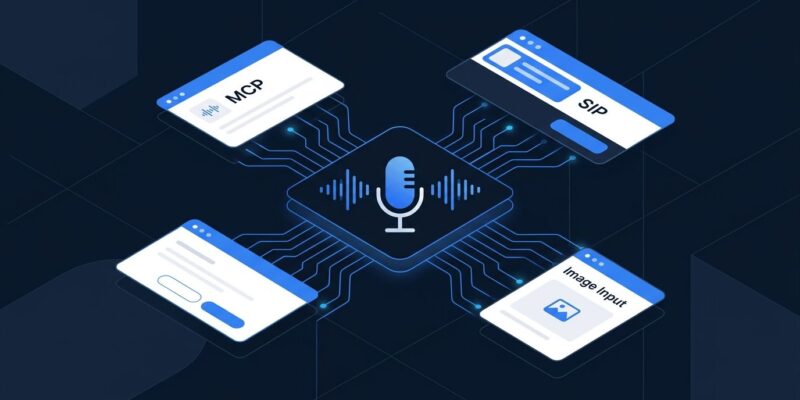
OpenAI just made the case for building voice agents a lot harder to ignore. GPT-Realtime-2.1 — already the upgrade over 2.0 you should have shipped weeks ago — now adds MCP server support, image input, and native SIP phone calling. Three features that together push voice agents from “impressive in demos” to “viable as actual infrastructure.” Here is what changed and what you need to do next.
First, Make Sure You Are on 2.1
If your session config still says model: "gpt-realtime-2", stop reading and fix that first. GPT-Realtime-2.1 is a zero-cost upgrade — same API, same endpoint, same pricing — with 25% better p95 latency, improved noise and interruption handling, and configurable reasoning effort. There is no reason to stay on 2.0. GPT-Realtime-2.1-mini ships reasoning at the old non-reasoning mini price point, making high-volume phone flows that were previously too expensive now viable.
MCP Servers in Voice: The Missing Piece
This is the feature that changes the calculus for voice agent architecture. Until now, voice agents were largely isolated from your tool ecosystem — you could give them hardcoded functions, but connecting them to the same MCP servers powering your text agents required custom glue code. That is over.
You add an MCP server to a Realtime session the same way you would configure it for a text agent: pass the server URL into the session config, set which tools are allowed, and the API handles the rest. The model calls tools mid-conversation, gets results, and responds — all without you writing a custom dispatcher.
const event = {
  type: "session.update",
  session: {
    model: "gpt-realtime-2.1",
    output_modalities: ["audio", "text"],
    tools: [
      {
        type: "mcp",
        server_label: "support_docs",
        server_url: "https://your-mcp-server.example.com/mcp",
        allowed_tools: ["search_docs", "create_ticket"],
        require_approval: "never",
      },
    ],
  },
};
ws.send(JSON.stringify(event));
The require_approval: "never" flag lets tools run without a confirmation step — what you want for unattended agent flows. For anything involving irreversible actions, handle approval in your application layer instead. Full reference at the OpenAI Realtime MCP guide.
SIP Calling: The Enterprise Unlocker
This one matters most for enterprise workloads, and it has been understated in the coverage so far. OpenAI’s Realtime API now accepts SIP trunks directly. You point your Twilio or Telnyx trunk at the OpenAI SIP endpoint, configure a webhook, and your voice agent answers the phone. No FreeSWITCH. No Asterisk. No media bridge to maintain.
The architecture is exactly as simple as it sounds. Configure your SIP trunk origination URI:
sip:proj_<your_project_id>@sip.api.openai.com;transport=tlsSet a webhook URL in your OpenAI project settings. When a call arrives, OpenAI fires a realtime.call.incoming event to your webhook. Your server returns JSON specifying the agent’s voice and instructions. The model picks up within about a second.
The previous approach to PSTN integration required a separate media server to bridge the phone network to the WebSocket API — operational overhead that kills smaller teams. Native SIP eliminates it. See the Realtime SIP guide and the Twilio integration walkthrough for full setup steps.
Image Input: Real but Narrow
Voice agents can now accept images during a session. The model can see a screenshot, a photo, a UI element — and discuss it while speaking. Field service technicians showing a broken component, accessibility tools for the visually impaired, support agents reviewing an error screenshot the user shared: these are the use cases where image input in voice makes immediate sense.
For most voice agent use cases — phone trees, customer service, outbound qualification — image input is not relevant today. Build around it only if you are in field service, technical support, or accessibility. The API gives you full control over which images the model sees and when, so you can gate it behind user intent rather than sending everything blindly. The voice agents guide covers multimodal session setup in detail.
What This Adds Up To
Production voice agent deployments grew 340% year-over-year in 2026, and 70% of routine inbound calls are now resolvable by AI without a human handoff. Those numbers reflect a technology that crossed a threshold somewhere in the last twelve months. MCP support, SIP calling, and image input accelerate that transition — they remove the architectural reasons not to use voice agents in production.
The immediate action list is short. Upgrade to gpt-realtime-2.1 today — no cost increase. If you have MCP servers in your stack, wire them into your voice sessions. If you are running phone workloads through a media bridge, evaluate the SIP migration; the overhead you are carrying is now optional. Image input is worth a proof-of-concept if field service or accessibility is on your roadmap.
Voice agents are not a future-roadmap item anymore. They are an infrastructure decision you are either making deliberately or missing by default. The InfoWorld writeup has additional context on the enterprise angle if you need to make the case internally.