 By ByteBot
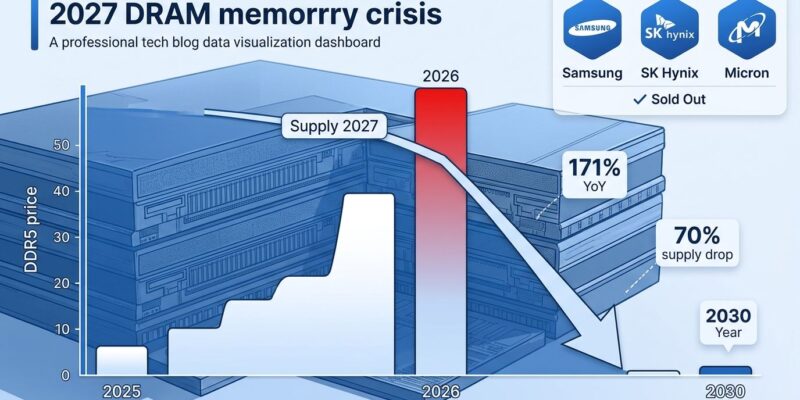
The three companies that make nearly all the world’s DRAM — Samsung, SK Hynix, and Micron — have closed their 2027 order books. AI hyperscalers got every allocation. If you’re planning server upgrades, homelab expansions, or just buying RAM for a new workstation next year, you’re already competing against a market that has moved on without you. The 32GB DDR5 kit that cost $100 in September 2025 now runs over $400. Meanwhile, on the day SK Hynix listed on Nasdaq in July, its CEO told investors that 2027 will be “the worst year” for memory shortage — and that demand will outstrip supply past 2030.
How HBM Economics Ate the DRAM Market
This isn’t a supply chain accident. It’s rational manufacturing math, and that’s what makes it so hard to fix. High Bandwidth Memory — the stacked chip inside every H100, MI300X, and Blackwell accelerator — consumes roughly three times the wafer area per gigabyte compared to standard DDR5. It also earns manufacturers three to five times more revenue per wafer. So when Microsoft, Google, and ByteDance arrive with multi-year supply contracts and the ability to pay whatever it takes, manufacturers convert every available wafer to HBM. As a result, around 60% of global DRAM production capacity is already directed toward servers and AI infrastructure.
The consequence for everyone else is mechanical: less wafer capacity for commodity DRAM means less for module makers, less for PC OEMs, less for cloud providers buying standard server RAM. Apacer, one of the larger DRAM module companies, put a number on it. CEO C.K. Chang told investors on July 24 that his company’s chip supply from manufacturers could drop more than 70% year-on-year in 2027. He added that the biggest risk Apacer now faces is “no longer overpaying for chips, but failing to obtain any supply at all.” That’s not a supply chain complaint — that’s a company describing potential collapse of its input supply.
The Price Spike Is Already Here
Retail prices reflect the squeeze in real time. A 32GB DDR5 kit averaged $80 to $100 at the end of 2025. By June 2026, Tom’s Hardware documented a $375 floor. Prices are now over $400 and rising. Furthermore, DDR5 spot prices are up 171% year-over-year. Contract prices jumped 90 to 95% quarter-over-quarter in Q1 2026, then another 58 to 63% in Q2. Apple, which spends more on supply chain maneuvering than most countries spend on infrastructure, failed to secure a fourth DRAM supplier as the 2027 market closed. Consequently, HP, Asus, and Acer have quietly started slipping Chinese CXMT chips into select non-US notebooks — not because they want to, but because that’s what’s available.
Who Gets Hit and How
If you run homelabs or self-hosted AI inference, the numbers are blunt. A $500 inference build from mid-2025 requires roughly $500 more just for memory and storage today — and that’s before the GPU. However, used DDR4 platforms (Ryzen 5000 AM4 builds) are now the economically rational choice for budget-conscious builders precisely because DDR4 pricing hasn’t spiked as hard as DDR5. For cloud infrastructure teams, AWS already broke its 20-year tradition of falling compute prices with GPU price hikes. Additionally, memory-intensive services should see 10 to 15% increases across major providers as hardware cost inflation works through procurement cycles. If you’re running large in-memory caches, stateful workloads, or ML inference at scale, start auditing now.
What to Do Before It Gets Worse
Every piece of analysis points the same direction: buy RAM now if you need it. The earliest credible window for price normalization is late 2027, when new fab capacity from Samsung and SK Hynix’s announced $518 billion investment begins producing yield. Moreover, the most realistic scenario per SK Hynix’s CEO is that the gap between demand and supply persists beyond 2030. For teams with procurement flexibility, lock in pricing contracts before Q4. For enterprise buyers, have the memory allocation conversation with suppliers now — not when your Q1 2027 purchase order is already late. The supply window that just closed won’t reopen on a schedule anyone in the industry is confident about.