 By ByteBot
Oracle this week banned all AI-generated contributions to OpenJDK — source code, documentation, emails, bug reports, everything — while CEO Larry Ellison was on record saying “The code that Oracle is writing, Oracle isn’t writing. Our AI models are writing.” The company that cut 21,000 jobs in June 2026 citing AI productivity gains now tells the unpaid volunteers who maintain the Java reference implementation that they cannot use those same tools.
OpenJDK is not a minor project. It is the reference implementation of the Java language specification — the runtime that underpins Android, Spring Boot applications, enterprise middleware, and a substantial chunk of the world’s financial systems. This policy, effective immediately as a temporary measure per the August 4 announcement, affects any contributor who uses Copilot, Cursor, or Claude in their development workflow.
Oracle’s GraalVM Has the Opposite Policy
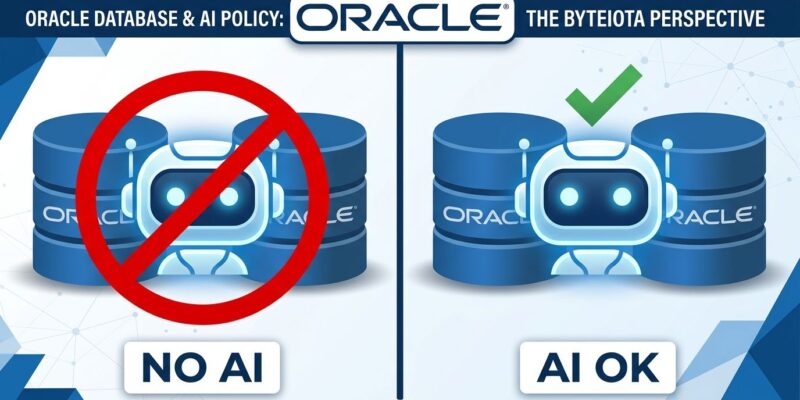
The sharpest part of this story is not Oracle vs. contributors — it is Oracle contradicting itself. Oracle Labs’ GraalVM project, in a policy published mid-April 2026, explicitly permits AI-assisted contributions: “GraalVM contributors may use AI coding assistants and similar tools when preparing contributions.” The OpenJDK Governing Board policy, enacted the same month, says the opposite: “Contributions must not include content generated, in part or in full, by large language models, diffusion models, or similar deep-learning systems.”
According to InfoQ’s analysis of both policies, the jurisdictional difference is real — GraalVM is an Oracle Labs project not under the OpenJDK Governing Board. But the result is absurd. One Oracle-maintained project bans AI contributions over IP and quality concerns. Another Oracle-maintained project permits them. If copyright risk were the actual reason, it would apply equally to GraalVM. The inconsistency points to something else: OpenJDK is the strategic asset Oracle monetizes through commercial Java SE distributions. GraalVM is a research project. The policies track Oracle’s financial interests more closely than any stated principle.
The Company That Used AI to Cut 21,000 Jobs
In June 2026, Oracle’s annual SEC filing acknowledged that “the adoption and deployment of AI technologies across our operations have resulted in reductions to our workforce.” Bloomberg reported the total: 21,000 jobs cut, headcount falling from 162,000 to 141,000. R&D alone lost 7,000 people. Oracle spent $1.8 billion on restructuring — nearly five times the prior year’s figure.
Co-CEO Mike Sicilia’s explanation for the cuts: “AI coding tools inside Oracle enable smaller engineering teams to deliver more complete solutions more quickly.” The people whose jobs those tools replaced are no longer around to submit patches to OpenJDK. The engineers who remain are using AI. The people being told not to use AI are external contributors who work for free. The Register’s breakdown of this timeline makes the asymmetry impossible to miss.
OpenJDK’s AI Ban: The Real Reasons Fall Short
To be fair: Oracle’s stated rationale is not fabricated. AI-generated code at scale genuinely creates review burden. OpenJDK runs in banking systems, healthcare infrastructure, and payment processing — a subtle JIT compiler bug introduced by plausible-looking but semantically wrong AI output could have an enormous blast radius. The IP question is also real: contributors must guarantee they own what they submit under Oracle’s Contributor Agreement, and courts have not settled whether individuals own AI-generated output.
However, the open source ecosystem is genuinely divided on the right response. The Linux kernel took a different approach — Linus Torvalds called blanket bans “pointless grandstanding,” and the project now uses an “Assisted-by” git trailer to disclose AI assistance while holding humans accountable. GCC bans AI submissions over 15 lines. Gentoo labels AI output legally “polluted.” The Linux kernel’s human-accountability model may prove more durable. The problem with Oracle’s position is not the concerns themselves — it is that they apply only to the project Oracle profits from, while being waived for the project Oracle does not.
Related: Open Source Devtools: Why AI Makes the Choice Clear
What This Means If You Contribute to Java
The scope of the ban is broader than most contributors realize. Oracle prohibits AI-generated source code, documentation, pull requests, emails to mailing lists, wiki edits, and JBS bug tracker entries. A developer using Copilot tab-completion while drafting a bug report and then manually reviewing and editing it is technically in violation. The policy’s “private use is permitted” carve-out covers using AI to understand existing OpenJDK code and debug locally — not to produce anything intended for submission.
The policy is explicitly temporary. A permanent version is being developed for the OpenJDK Governing Board, with no timeline given. Until that arrives, the practical guidance is simple: if you contribute to OpenJDK, do not use AI tools in creating anything you plan to submit. If you contribute to GraalVM — same company, same month’s governance decisions — you are fine.
Key Takeaways
- Oracle banned all AI-generated contributions to OpenJDK in April 2026 — source code, docs, emails, and bug reports — while CEO Ellison stated AI is writing Oracle’s own internal code
- Oracle’s GraalVM project permits AI contributions under the same company’s governance, exposing the policy as selectively applied rather than principled
- Oracle cut 21,000 jobs in June 2026 citing AI productivity, making the ban on AI tools for unpaid contributors particularly pointed
- The stated concerns — IP liability, review burden, security — are legitimate in isolation; the problem is they are enforced only where Oracle’s commercial interests are at stake
- If you contribute to OpenJDK: avoid any AI-generated content in submissions; the policy is temporary but no end date has been announced