 By ByteBot
On July 31, DeepSeek quietly updated every existing deepseek-v4-flash API integration. Same endpoint. Same model name. Same price. What changed is that the model now beats DeepSeek’s own V4-Pro-Preview on all nine agent and coding benchmarks the company published. If you were already calling Flash, you already got the upgrade.
What Changed in the 0731 Build
This is not a new model. DeepSeek-V4-Flash-0731 is the same April Preview architecture — a 284B-parameter Mixture-of-Experts model with 13B active parameters per token and a 1M-token context window. What changed is the post-training pipeline.
DeepSeek rebuilt post-training around four targets: coding, AI agents, reasoning, and tool use. No extra parameters. No architectural changes. Just better supervised fine-tuning and reinforcement learning on the right tasks. The result is a model that scores significantly higher on every agentic benchmark while running at the same latency and cost as before.
MIT-licensed weights landed on Hugging Face at 07:30 UTC the same day, making this the most significant open-weight agent model release in weeks.
The Numbers
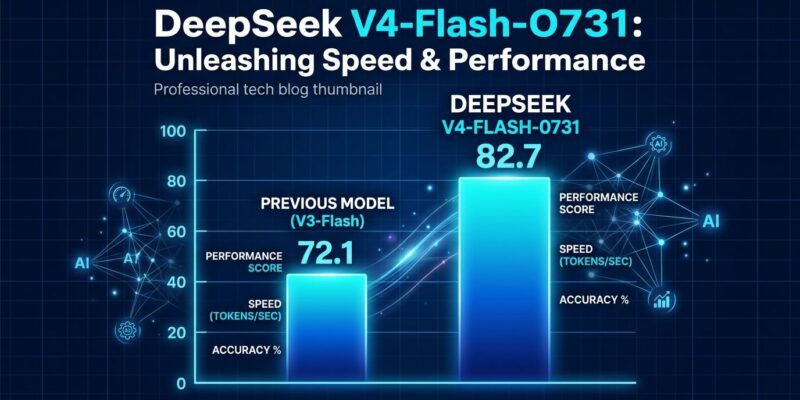
The headline is Terminal-Bench 2.1: Flash 0731 scores 82.7 against V4-Pro-Preview’s 72.1 — a 14.7% win for the budget model over the flagship on a real-world terminal agent benchmark that measures multi-step tool use across a shell environment.
| Benchmark | Flash Preview | Flash 0731 | V4-Pro-Preview |
|---|---|---|---|
| Terminal-Bench 2.1 | 61.8 | 82.7 | 72.1 |
| DeepSWE | 7.3 | 54.4 | ~45 |
| DSBench-FullStack | 37.0 | 68.7 | ~55 |
DeepSWE is the starkest number: the same model went from 7.3 to 54.4 in one post-training cycle. Flash 0731 also leads on Cybergym (76.7), Toolathlon verified (70.3), NL2Repo (54.2), Agent Last Exam (25.2), and DSBench-Hard (59.6). Nine benchmarks, nine wins over the Pro model.
One honest caveat: all scores are measured with DeepSeek’s proprietary Harness, which isn’t open-sourced yet. Independent verification is pending. The preview-to-0731 delta, though, is measurable on external stacks — and it’s not subtle.
What You Need to Do
If you’re already calling deepseek-v4-flash: nothing. The 0731 build is live at the same endpoint. Your existing calls already hit the new model.
If you want to add Codex support — Flash is the only DeepSeek model that natively supports the Responses API format Codex uses. Point any OpenAI-compatible SDK at DeepSeek’s base URL:
from openai import OpenAI

client = OpenAI(
    base_url="https://api.deepseek.com",
    api_key="YOUR_DEEPSEEK_KEY"
)

response = client.responses.create(
    model="deepseek-v4-flash",
    input="Refactor this function to handle edge cases..."
)
One limitation: DeepSeek’s Responses API implementation is stateless. previous_response_id, conversation, and store are not supported. Send the full conversation history as input items on every call. The full setup walkthrough is in DeepSeek’s Codex integration docs.
Why This Matters Beyond the Benchmarks
The cost gap is real. Flash runs at $0.14 per million input tokens and $0.28 per million output — against $5/$25 for Claude Opus 5 and $5/$30 for GPT-5.6 Sol. Flash is 35 to 100 times cheaper than flagship models and it’s outperforming DeepSeek’s own flagship on agent tasks.
The broader point: targeted post-training on the right tasks can unlock more performance than adding parameters. Scale remains important, but training quality is now the lever worth watching. DeepSeek’s official release post describes the post-training methodology in detail — the approach is transferable and other labs are likely already replicating it.
The budget model era is not coming. It’s here.