 By ByteBot
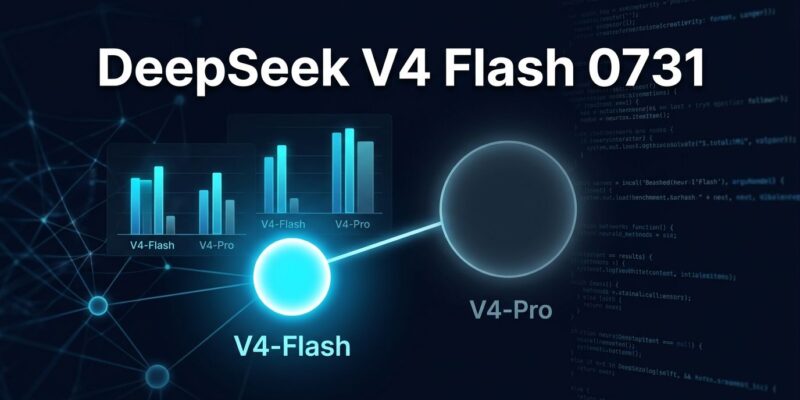
DeepSeek shipped the official V4-Flash-0731 build on July 31, and its own benchmarks show a retrained model with 13 billion active parameters outscoring the company’s own V4-Pro-Preview on all nine agent tasks it tested. Terminal Bench 2.1: 82.7 for Flash, 72.1 for Pro. DeepSWE: 54.4 for Flash, 12.8 for Pro. The model comes with an MIT license, costs $0.14 per million input tokens, and now supports OpenAI’s Codex API natively. None of the agent benchmark results have independent third-party validation yet — but the pricing and open weights are real, and that’s worth your attention regardless.
Same Architecture. Completely Different Model.
The 0731 designation matters because nothing changed in the architecture. DeepSeek kept the identical 284-billion-parameter Mixture-of-Experts design — 13 billion parameters active per forward pass — and re-post-trained it. No new layers, no bigger model, no architectural redesign. Just targeted retraining on agentic and coding task distributions.
The result is a 645% improvement on DeepSWE (7.3 in the preview, 54.4 now) and a Terminal Bench 2.1 score of 82.7, up from 61.8. DeepSeek also added the DSpark speculative decoding module, contributing to a reported 122.7 tokens-per-second output speed. This is the real signal buried in the release: post-training specialization is producing bigger gains than parameter scaling. A 13B-active model outperforming a 1.6-trillion-parameter flagship on agent tasks is not a fluke narrative — it’s a data point that should make you rethink how you evaluate coding agents on the Terminal Bench 2.1 leaderboard.
The Benchmark Numbers (With the Necessary Caveat)
Here is what DeepSeek published across the nine evaluated tasks:
| Benchmark | V4-Flash 0731 | V4-Pro-Preview | Opus 4.8 |
|---|---|---|---|
| Terminal Bench 2.1 | 82.7 | 72.1 | 85.0 |
| DeepSWE | 54.4 | 12.8 | 58.0 |
| DSBench-FullStack | 68.7 | 41.8 | 71.6 |
| Cybergym | 76.7 | 52.7 | 83.1 |
The caveat is not small: all nine scores are vendor-stated, run on an unreleased harness. The only independent data point is from Artificial Analysis, which confirmed approximately a 10-point improvement on their intelligence index compared to the previous Flash version — meaningful corroboration, but not the same as an independent run of the agent benchmarks. Treat these numbers as directional until reproduced by a third party.
Price and Open Weights: The Part You Can Act On Today
Whatever you think of the agent benchmark claims, the economics are not in dispute. At $0.14 per million input tokens and $0.28 per million output tokens, V4-Flash-0731 costs roughly 35 times less in output than GPT-5.6 Sol at $30 per million. Cache hits come in at $0.0028 per million — a 98% discount that makes repeated repository-prefix access extremely cheap. A 20-million-token agent run with decent cache utilization costs around $3.50.
The MIT license means you can deploy this in production without legal friction. Native support for OpenAI’s Responses API means Codex CLI, the Codex desktop app, and the VS Code extension all work with a single edit to ~/.codex/config.toml. The broader API is OpenAI-compatible — change the base URL in your existing SDK client, and that’s the migration. No middleware, no rewrite.
Self-hosting is possible but harder than it sounds. Official FP8 mixed-precision weights require approximately 170GB of VRAM — two H200s or two RTX Pro 6000 Blackwells. Community INT4 quantizations reduce that to around 90-100GB (four RTX 4090s), with measurable quality degradation on math and multi-step reasoning. The hosted API at $0.14/M makes more operational sense for most teams. If you need self-hosting, vLLM exposes an OpenAI-compatible endpoint and is the standard deployment path.
Who Should (and Should Not) Use This Now
Clear fits for V4-Flash-0731 today: repository triage, batch code migrations with human review checkpoints, high-volume internal test generation, and workloads where you verify outcomes programmatically before they touch production. These are tasks with deterministic verification — the code either compiles or it does not.
Where you should wait: production incident response, security automation, and anything with irreversible consequences. An ORCA-bench evaluation placed Flash-class models at 10-25.3% accuracy on realistic incident diagnosis scenarios. The economics are compelling enough that you will be tempted to over-deploy. Do not.
Bottom Line
DeepSeek V4-Flash-0731 is the most interesting cheap coding agent available right now — and “cheap” is doing serious work in that sentence. The benchmark numbers may or may not survive independent scrutiny, but the price, the MIT license, the Codex integration, and the open weights are facts. Add it to your eval queue this week. Do not swap your production agents until you have run your own representative workloads through it. The economics make the test worthwhile; the missing third-party validation makes the test mandatory.