 By
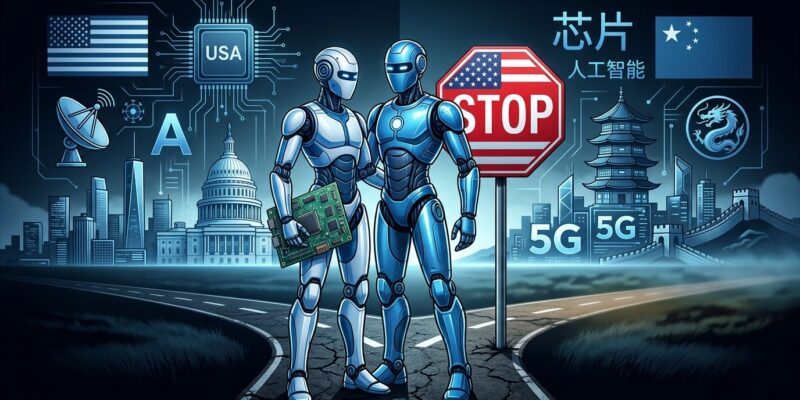
By The FCC just added Chinese humanoid robots to its Covered List — the same mechanism that ended Huawei’s US telecom ambitions and grounded DJI’s drone business. Announced July 28, the ban targets new imports of humanoid robots, quadruped robots, and connected power inverters. The timing is pointed: Unitree had commercially launched in Europe just six days earlier and was building toward a North American push. That push is now stopped.
What Got Banned
Three categories landed on the Covered List immediately:
- Humanoid robots — new models not yet released
- Quadruped robots (robot dogs) — same restriction
- Connected power inverters — the hardware linking solar, battery storage, grids, and data centers
The restrictions apply to new models only. Existing authorized robots stay legal — for now. The FCC retained explicit authority to revoke existing authorizations, which creates real uncertainty for anyone already running Chinese hardware in a facility.
Why 85% Market Share Changes the Equation
The framing around national security is easy to dismiss as trade war theater. The market data makes it harder to dismiss. China controls approximately 85% of the global humanoid robot market. Unitree and AGIBOT each shipped over 5,000 humanoids globally in 2025. Tesla and Figure AI combined shipped a few hundred.
More importantly: Unitree’s G1 humanoid costs around $16,000 — a price point that actually puts research-grade humanoid hardware in university labs. Stanford, ETH Zurich, UC San Diego’s Advanced Robotics Lab, and Seattle’s Ai2 all ran Unitree hardware. These weren’t luxury purchases; they were the only viable path to doing embodied AI research without enterprise budgets.
US alternatives exist — Tesla Optimus, Figure 03 (deployed at BMW’s Spartanburg plant), Boston Dynamics Atlas (running at Hyundai facilities) — but none of them are accessible to researchers. They’re enterprise hardware, priced and distributed accordingly. The affordable, hackable, available platform for AI researchers was Unitree. That’s now banned.
The Covered List Playbook
This ban didn’t arrive without precedent. The FCC’s Covered List has followed a consistent pattern:
- March 2021: Huawei, ZTE, Hikvision — telecom infrastructure
- December 2025: DJI — drones
- March 2026: Chinese consumer routers
- July 2026: Humanoid robots and power inverters
The FCC is applying a framework originally designed for telecom networks to every category of connected hardware where China holds strategic position. Humanoid robots fit the argument well: they carry cameras, microphones, lidar, and persistent network connectivity. They navigate autonomously. A robot deployed in a facility is, from a signals intelligence perspective, an exceptionally capable persistent sensor.
The Nvidia Problem
The most interesting wrinkle for developers: Nvidia’s own Isaac GR00T Reference Humanoid was built on Unitree hardware with Blackwell AI chips. Nvidia argued that data stays in the US and that Unitree’s American customers are academic and research institutions. Some Washington officials were not convinced — Unitree is on the Pentagon’s list of Chinese military-linked companies. The ban puts Nvidia in an uncomfortable position with its robotics infrastructure strategy.
What Fills the Gap
1X Technologies announced it’s accelerating developer hardware releases to address the emerging vacuum. That’s the honest answer to the gap question: the domestic alternatives are not ready at the price point or accessibility level that US research depended on, and they won’t be soon.
FCC Chair Brendan Carr framed the move as necessary to “secure America’s critical supply chains.” China’s Foreign Ministry spokesperson Mao Ning called it protectionism that will “hurt the interests of US companies and consumers.” Both are probably right. The ban is announced ahead of a planned Xi-Trump summit in September — which suggests the security framing and the trade pressure are operating simultaneously.
For US researchers who built their robotics programs around affordable Chinese hardware, the policy debate is secondary. The hardware they depended on is now gone, and the alternatives cost more and ship less.