
 By ByteBot
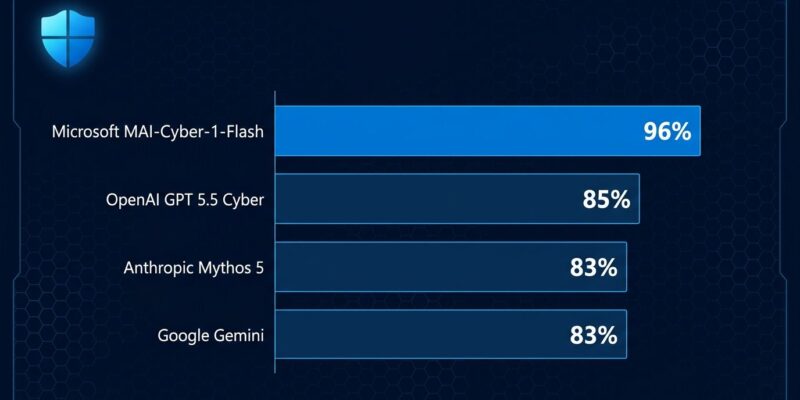
Microsoft launched MAI-Cyber-1-Flash today — its first AI model built specifically for cybersecurity vulnerability detection. The model runs inside MDASH, Microsoft’s 100-agent security harness, alongside a new agentic platform called Project Perception. The headline number is 96% on CyberGym, 12 points above Anthropic’s Mythos 5, at roughly half the cost of Microsoft’s previous MDASH configuration. The catch: MAI-Cyber-1-Flash still hands the hardest 10% of tasks to OpenAI’s GPT-5.4.
The Benchmark Numbers
CyberGym is the benchmark that matters here. Developed by UC Berkeley’s Sunblaze Lab and published at ICLR 2026, it tests AI agents on 1,507 real vulnerability reproduction tasks drawn from 188 open-source projects. Each task hands the system unpatched source code and a vulnerability description; success requires a working proof-of-concept that triggers the flaw. Importantly, it is not Microsoft’s benchmark.
The scores tell a clear story. MAI-Cyber-1-Flash paired with GPT-5.4 inside MDASH scores 95.95% on CyberGym. By comparison, Anthropic Mythos 5 scores 83.8%, OpenAI GPT-5.5 Cyber scores 85.6%, and Google Gemini 3.5 Flash Cyber scores 83.2%. The gap over the nearest competitor is roughly 10 points — meaningful, not cosmetic.
One wrinkle is worth noting. At Build 2026 in June, MDASH running a different model mix scored 96.55% on the same benchmark. The new MAI-Cyber-1-Flash configuration is slightly below that prior peak. Microsoft’s framing is cost efficiency rather than a capability leap, and on that metric the 50% cost reduction versus the previous GPT-heavy setup is the actual story.
How MAI-Cyber-1-Flash Works
According to Microsoft’s security blog, MAI-Cyber-1-Flash is a small, code-heavy model descended from the MAI-Thinking-1 line. It handles 90% of security queries inside MDASH autonomously. The remaining 10% — the complex, novel threat scenarios requiring deeper reasoning — escalates to OpenAI’s GPT-5.4, which Microsoft describes as roughly ten times larger. The result is a tiered cost structure: a cheaper model handles routine work while the expensive model is reserved for genuinely hard problems.
Executive Vice President Hayete Gallot put the philosophy plainly: continuous defense has to be affordable. Pointing a frontier model at every security task does not clear that bar. MDASH itself uses specialized agent roles — auditor agents generate vulnerability hypotheses, debater agents argue for and against exploitability, and prover agents build triggering inputs to confirm a flaw is real. Disagreement between auditor and debater is treated as a confidence signal, not a failure. In May, this system surfaced 16 vulnerabilities in the Windows networking and authentication stack, four of them critical remote code execution flaws, before any external researcher found them.
Project Perception: The Agentic Platform
MAI-Cyber-1-Flash is the model. Project Perception is the product security teams will actually interact with. Built on top of MDASH, it runs three types of agents continuously against a customer’s own environment.
- Red agents map potential attack paths before attackers can exploit them.
- Blue agents triage security signals and determine what represents genuine risk.
- Green agents execute corrective actions and harden defenses automatically.
Lead engineer Dave Weston described the shift as moving from “hours and hours of manual effort” spread across multiple specialists to solutions delivered “in minutes.” The system pulls from 100 trillion daily security signals and 1.6 million enterprise customer deployments for continuous learning. Public preview opens August 3.
Three Bets on the Same Market
The AI cybersecurity market now has three serious offerings, each with a distinct access strategy. Anthropic’s Mythos and OpenAI’s Daybreak launched the race in May. Anthropic’s Mythos is powerful but remains tightly restricted — access requires going through Anthropic directly. OpenAI’s Daybreak took the opposite approach with tiered commercial access and active enterprise sales. Microsoft’s MAI-Cyber-1-Flash is the third path: lower cost than Mythos-tier performance, embedded inside the Azure security ecosystem most enterprises already run, with preview access in six days.
However, the honest framing is this: Microsoft’s real competitive advantage is not MAI-Cyber-1-Flash’s raw capability. It is the data pipeline behind MDASH — 100 trillion daily security signals and 1.6 million enterprise customers generating continuous feedback. A model trained and continuously refined on that volume of real-world signals is genuinely difficult to replicate. The model beats the benchmark by routing hard problems to OpenAI. The platform wins on data gravity.
That dependency on OpenAI for the hardest 10% of cases is not a failure — it is an architectural choice. Nevertheless, security teams running long-term vendor evaluations should factor it in. You are paying for Microsoft’s orchestration and data advantage as much as its model intelligence.
What Security Teams Should Do Now
If your team is already on MDASH, the cost reduction applies automatically — no configuration change required. If you are evaluating AI-assisted vulnerability management for the first time, Project Perception’s August 3 preview is the right moment to run a direct comparison against Daybreak. Enterprise controls — sandboxed execution with no external internet access, role-based permissions, tenant isolation, and full auditability — are already in place for regulated sectors.
The benchmark is real. The cost savings are real. The dependency on OpenAI for the hardest cases is also real. All three belong in any serious vendor evaluation.


