 By ByteBot
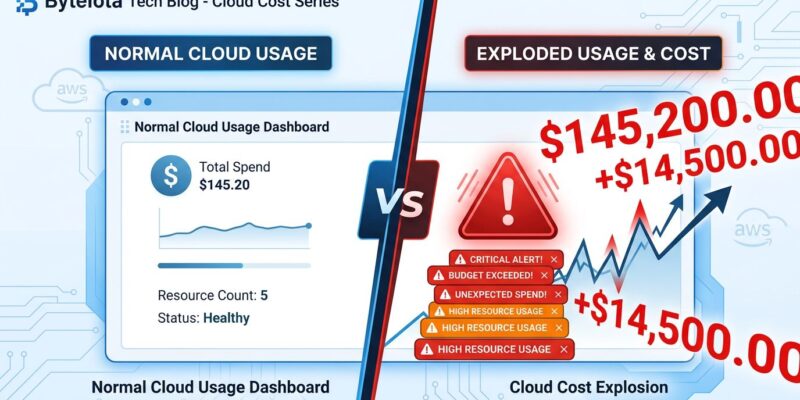
AWS’s Cost Explorer started showing customers billing estimates in the billions and trillions of dollars on Thursday night, July 16. Developers with normal monthly AWS bills of $5–$15 saw estimates of $1.7 billion. One customer’s projection hit $2.5 billion. Some reached $1.5 trillion. Amazon confirmed the numbers are wrong and no actual charges are affected — but the bug triggered budget alerts, automated shutdown scripts, and a wave of developer panic that reveals something deeper than a unit pricing glitch.
What the AWS Billing Bug Actually Did
The AWS billing bug began at approximately 7:38 PM PDT on July 16 and stems from “an issue with unit pricing within the estimated billing computation subsystem.” A recent change introduced incorrect unit-price values into the estimation layer — the component that projects your end-of-month spend from current usage. The underlying metering system (what you actually used) and the invoicing system (what you’re actually charged) were untouched. AWS identified the root cause at 3:03 AM PDT on July 17 and began recomputing affected accounts.
Your actual invoice is safe. However, a safe invoice and zero operational disruption are not the same thing — and that distinction matters more than AWS’s communications acknowledged.
The Automation Risk Behind AWS Cost Explorer
AWS billing estimates don’t just live in the Cost Explorer dashboard — they feed automated systems. Budget Actions, AWS’s feature for enforcing spending guardrails, can automatically apply IAM policies, attach Service Control Policies to organizational units, or stop EC2 and RDS instances when a cost threshold is crossed. Cost Anomaly Detection sends ML-triggered alerts to PagerDuty, Slack, and email. If any of those systems were configured to respond to estimated cost data, they may have activated based on completely fabricated numbers during the bug window.
One Hacker News user captured the experience directly: “I got 3 consecutive emails warning that my budget crossed its $18 threshold… cost was 78 million… EMOTIONAL DAMAGE.” That’s not just an annoyance — in a tightly automated environment, those alerts can kick off real operational responses. Any developer running infrastructure automation tied to AWS billing data should audit what fired between July 16 and July 17.
AWS Spending Limits: The Structural Gap This Exposed
This bug landed on years of accumulated frustration. AWS Budgets can alert you and trigger automated actions, but AWS explicitly states it is “not a hard spending cap.” Billing data is not real-time — alerts can lag by hours. And as Thursday night proved, the data those alerts are based on can simply be wrong. The community has requested hard limits for years. AWS’s counterargument is that stopping a production workload mid-transaction would cause more harm than a high bill. That’s a reasonable position. It doesn’t explain why opt-in hard caps for development and sandbox accounts still don’t exist.
The Hacker News thread reflected structural discontent more than situational anger. Developers debated migration to self-hosting, proposed opt-in hard caps, and made pointed jokes about “vibe coding billing systems” — a dig at AWS job postings advertising AI agents for billing infrastructure. Billing is critical infrastructure. It should be treated with the same rigor as any production system that downstream services depend on. A unit pricing error in the estimation layer exposed exactly what happens when developers can’t trust the numbers their automation depends on.
What to Do Right Now
If you’re seeing inflated estimates in Cost Explorer, they’re fake — your invoice is safe. Before you move on, check three things:
- Audit Budget Actions and automated alerts. Review anything that fired between July 16–17. IAM restrictions, SCP attachments, or stopped instances triggered during that window are likely false positives. Re-enable anything incorrectly shut down.
- Treat July 16–17 FinOps alerts as noise. Slack notifications, PagerDuty pages, or cost anomaly reports from that window are unreliable. Do not use them as the basis for operational or financial decisions.
- Decouple critical automation from billing estimates. Use AWS Cost Anomaly Detection for alerting and build automation around actual CloudWatch usage metrics where operational stakes are high. Estimates should inform — not trigger — responses.
Key Takeaways
- AWS Cost Explorer showed billing estimates in the billions and trillions on July 16–17, 2026. Actual invoices are unaffected — this was an estimation layer bug, not a metering or invoicing failure.
- Automated systems tied to billing data — Budget Actions, Cost Anomaly Detection, custom alert pipelines — may have fired on false positives. Audit anything that activated during the bug window.
- AWS has no hard spending caps. This bug is a symptom of a broader architectural gap: billing estimates are treated as reliable enough to trigger automation, but they aren’t.
- Decouple critical infrastructure automation from Cost Explorer estimates. Use real usage metrics for anything that triggers operational responses.