 By ByteBot
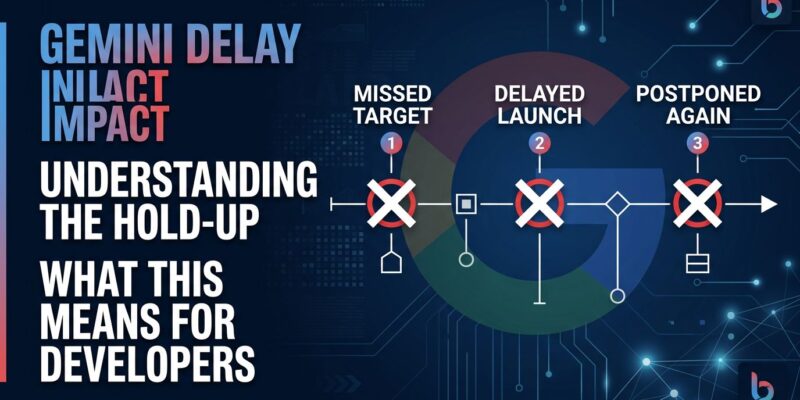
Google’s Gemini 3.5 Pro has now missed three consecutive launch targets. Bloomberg confirmed on July 16 that the rebuilt model still cannot clear Google’s own internal coding benchmarks. Quietly, Google has registered model names for “Gemini 3.6 Flash” and “Gemini 3.5 Flash Light” — a clear stopgap signal. If you were waiting on Gemini 3.5 Pro to finalize your AI stack, it’s time to stop waiting.
Three Delays, Three Different Failure Modes
This is not one problem getting worse. Each delay has involved a different failure mode — which matters for how you read what’s happening inside Google DeepMind.
Delay 1 (June): Google promised Gemini 3.5 Pro at I/O in May, with Sundar Pichai telling developers to “give us until next month.” June closed without a launch. The stated reason: quality refinements after limited Vertex AI enterprise preview testing, specifically around token efficiency and multi-step reasoning.
Delay 2 (early July): Google scrapped the original model entirely and ran a new pre-training cycle from scratch. Engineers found structural failures in two areas: generating complex multi-layered SVG scenes, and maintaining consistency across recursive tool-calling chains — the kind of multi-step agentic loops where a model calls one tool, uses the result to call another, and continues for dozens of sequential steps.
Delay 3 (July 16): The rebuilt model cleared the SVG and tool-calling bars and then hit different problems entirely: hallucinations and reliability gaps in real-world workflows. Google updated Gemini’s training data in late June specifically to close the coding gap. Results, per sources cited by Bloomberg, were disappointing.
Three delays, three distinct root causes. This is a development crisis, not a polish delay.
Google’s Stopgap Strategy
Google has registered “Gemini 3.6 Flash” and “Gemini 3.5 Flash Light” as model names. Separately, 9to5Google reports that Google is currently testing an upgraded Flash model with external partners alongside the 3.5 Pro work.
Model name registrations don’t guarantee shipping products. But when combined with the partner testing report, this reads as a clear intent to release incremental Flash improvements rather than sit on an empty roadmap while Pro development continues.
The strategic logic tracks. Gemini 3.5 Flash is production-ready, competitively priced, and broadly capable. An upgraded Flash keeps developers in the Google ecosystem without requiring the frontier-level reliability that the current rebuild hasn’t achieved. Expect a Gemini 3.6 Flash or equivalent before 3.5 Pro ships.
Where Google Stands Right Now
Google is the only major AI lab without a released flagship frontier model in this cycle. Alphabet shares dropped on the news, erasing roughly $225 billion in market cap. The announcement landed alongside significant talent losses: Noam Shazeer (Transformer co-author, Gemini co-lead) to OpenAI, and Nobel laureate John Jumper plus two other senior DeepMind researchers to Anthropic.
The current frontier model picture:
| Model | Available | SWE-Bench Pro | Context Window |
|---|---|---|---|
| Claude Fable 5 | Yes (since July 1) | ~80% | 200K tokens |
| GPT-5.6 Sol | Yes (since July 9) | 64.6% | 1M tokens |
| Gemini 3.5 Flash | Yes (since May 19) | 55.1% | 1M tokens |
| Gemini 3.5 Pro | No — delayed | Unknown | 2M tokens (planned) |
What Developers Should Do Now
Use gemini-3.5-flash for production work. It’s stable, generally available, and priced at $1.50/$9 per million input/output tokens. For workloads with repeated context or shared system prompts, prompt caching drops input costs to $0.15 per million tokens — a 90% reduction worth configuring if you haven’t already.
Build a model abstraction layer. Teams navigating the current AI model landscape best are those who route specific task types through specific models and swap at the routing layer. When 3.5 Pro eventually ships — or when 3.6 Flash appears — a proper abstraction layer means adoption in days rather than quarters.
If you need the 2M context window, plan without it. Gemini 3.5 Pro was supposed to be the only production model with a 2M token context window. No public alternative exists. If your architecture genuinely requires that scale, you need a chunking or retrieval strategy that doesn’t depend on a model with no confirmed ship date.
For frontier coding tasks, look at your alternatives. GPT-5.6 Sol scores 88.8% on TerminalBench 2.1. Claude Fable 5 leads SWE-Bench Pro at around 80%. Gemini 3.5 Flash scores 55.1% on SWE-Bench Pro — capable for many tasks, but not the best option for the hardest coding workloads.
The Bottom Line
Gemini 3.5 Pro has no confirmed release date and no public ETA. Google’s best near-term move appears to be releasing an upgraded Flash model to hold developer attention while the Pro rebuild continues its third iteration. That’s a reasonable response to a difficult situation — but it means Gemini 3.5 Pro is not a planning input for any timeline that matters this quarter.
Build around what’s actually available. The stopgap will arrive before the flagship does.