 By
By etcd v3.7.0 shipped July 8, 2026 — the most consequential release for Kubernetes cluster operators since v3.6. The headline feature is RangeStream, a new streaming RPC that finally kills the memory-buffering bottleneck that has caused OOM crashes on large clusters for years. It is already wired into Kubernetes v1.37 (GA: August 2026) via the EtcdRangeStream feature gate. That is the good news. The bad news: v2store is completely gone, deprecated --experimental-* flags are removed, and architecture-tagged container images no longer exist. If your CI/CD pipeline pulls etcd:3.7.0-amd64, it will fail.
RangeStream: The Feature Everyone Wanted
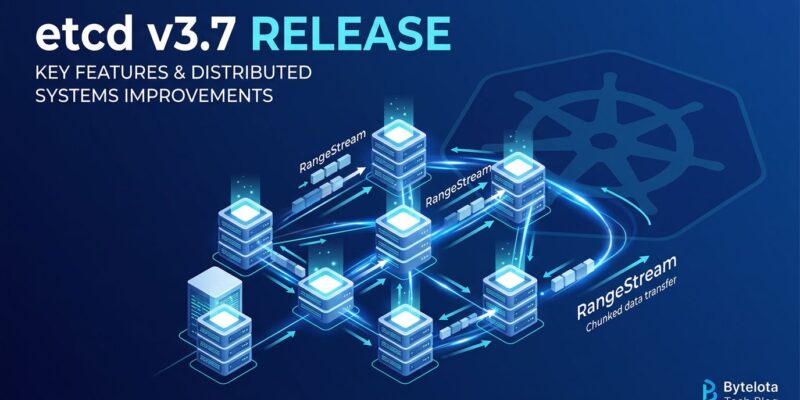
On large Kubernetes clusters, etcd’s old approach was a liability: buffer the entire key-value result set in memory before sending it to the client. On a cluster with thousands of nodes and objects, that single buffer would spike memory usage unpredictably, occasionally triggering OOM kills on the etcd process itself — the store holding all your cluster state. Not ideal.
RangeStream fixes this by streaming the response as a sequence of chunks. The server splits the result set and sends chunks one at a time — same data, far lower peak memory on both ends. There is a secondary benefit rooted in how etcd’s storage engine (bbolt) works: each chunk completes its own short transaction, avoiding the long-running read transaction that previously held a bbolt lock while the full result was assembled. That lock blocked write transactions. It was a known production pain point. Now it is gone.
Kubernetes v1.37 adds the EtcdRangeStream feature gate as a beta feature. With it enabled and etcd 3.7 backing your cluster, kube-apiserver‘s watch cache initializes via a single RangeStream call instead of paginated Range requests — a meaningful reduction in startup I/O. If your cluster is still on etcd 3.6, the apiserver falls back automatically. RangeStream is always on in etcd 3.7; no server-side flag required.
Performance Wins Worth Noting
RangeStream gets the headlines, but three other improvements will quietly make day-to-day operations faster:
- 2x lease throughput: SharedBufReadTxMode improves lease and user/role operation performance by up to 2x. Any application that uses etcd leases for distributed locks, session management, or service registration benefits immediately after upgrading.
- FastLeaseKeepAlive: Lease renewals no longer wait for the applied index. That synchronization delay existed to ensure consistency but was unnecessary in practice. It is gone.
- Keys-only range optimization:
etcdctl get --keys-onlynow reads from etcd’s in-memory index only, never touching bbolt. For operators running inventory-style queries on large clusters, this eliminates unnecessary value deserialization and backend reads. One exception: sorting by VALUE still requires a bbolt read.
LeaseRevoke requests are also now prioritized during overload. Previously, a cluster under heavy write pressure could delay lease expiration, leaving zombie lease holders in a permanently active state. That race condition is addressed.
What Breaks — Read This Before Upgrading
Four things will break in production if you upgrade without checking:
- v2store is dead. v2 discovery, v2 request support, and v2 client support are all removed. If any part of your stack still touches the v2 API surface — including some legacy etcd clients — do not upgrade until you have migrated.
--experimental-*flags are gone. Scan your etcd startup configuration for any--experimental-prefixed flags. Migrate to feature gates or stable CLI arguments before touching v3.7.grpc.WithBlockis no longer honored. If your etcd client code uses this gRPC dial option for blocking connection behavior, consult the grpc-go anti-patterns documentation for the migration path.- Container image tags changed. Architecture-specific tags (
amd64,arm64) are gone. v3.7 ships multiarch containers only. Any CI/CD pipeline or Kubernetes manifest that pins a platform-specific image tag will break silently or fail to pull.
How to Upgrade Safely
etcd’s upgrade guidance is straightforward: one member at a time, health-check between each. The more important step is the pre-flight audit. Run this before you touch anything:
# Check for experimental flags in your etcd config
grep -r "\-\-experimental" /etc/etcd/

# Verify cluster health after each member upgrade
etcdctl endpoint health \
  --endpoints=http://etcd1:2379,http://etcd2:2379,http://etcd3:2379
If you have any v2 data remaining, be aware that write-only-drop-data behavior (wiping v2 data on startup) is now enforced. Back up before upgrading if there is any ambiguity. The full upgrade guide lives at etcd.io/docs/v3.7/upgrades/.
The Bottom Line
etcd v3.7 is not a checkbox release. RangeStream addresses a real production failure mode, the lease performance improvements are material, and the removal of v2store is long overdue — that API surface should have been retired two major versions ago. The breaking changes are real but were telegraphed well in advance across beta and RC releases. If you have been running a disciplined upgrade path and are not using deprecated flags or v2 clients, the upgrade is straightforward. For Kubernetes operators targeting v1.37, etcd 3.7 is now the recommended backing store. Read the full announcement and check the CHANGELOG before scheduling your maintenance window.