 By ByteBot
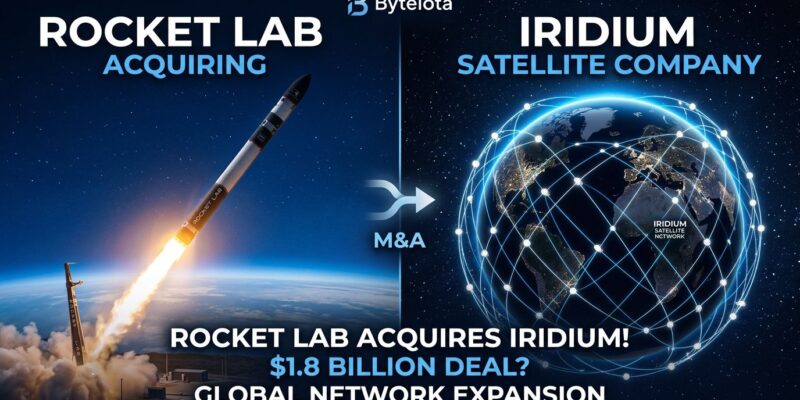
Rocket Lab announced on June 29 it will acquire Iridium Communications for $8 billion in a cash-and-stock deal — the satellite industry’s second mega-merger in three months, after Amazon’s $11.6 billion Globalstar purchase in April. The acquisition hands Rocket Lab a 66-satellite LEO constellation, globally-harmonized L-band spectrum, 2.55 million active subscribers, and a 500+ partner IoT ecosystem underpinning connected devices across aviation, maritime, logistics, and remote industrial operations worldwide. This is now a three-player market, and developers building on satellite connectivity need to understand what changed.
Iridium’s L-Band Spectrum Is the Real Prize
The $8 billion price tag isn’t for 66 metal boxes in orbit — it’s for the L-band spectrum those satellites use. L-band is globally harmonized, meaning a single Iridium-certified device works anywhere on Earth without country-by-country licensing. That’s an extraordinary regulatory moat. SpaceX’s Starlink uses Ku/Ka-band spectrum, which requires negotiating local approvals market by market. Iridium built its coverage once and it works everywhere, including the poles and open ocean where no terrestrial network reaches.
The financials confirm the value: Iridium posted $871.7 million in revenue in 2025 at a 57% OEBITDA margin, with 2.55 million paying subscribers. These aren’t consumers streaming video — they’re maritime safety systems, aviation navigation services, oil pipeline sensors, and military communications under U.S. DoD contracts. That revenue base is sticky. According to the official Rocket Lab press release, the transaction is expected to close in mid-2027, pending shareholder and regulatory approval.
Three Players Now Own the Satellite Connectivity Stack
This deal completes a consolidation that started moving fast in early 2026. Amazon bought Globalstar for $11.6 billion in April. Now Rocket Lab is taking Iridium. Add SpaceX, which has been vertically integrated since day one, and you have three players that each control their own launch capability, satellite constellation, and spectrum licenses end to end. As TechCrunch reported, Rocket Lab describes the move as positioning itself as “a fully vertically integrated space powerhouse” alongside Amazon and SpaceX.
For developers and enterprises, this matters because the era of mixing and matching satellite service providers is narrowing fast. A few years ago, you could negotiate between Iridium, Orbcomm, Inmarsat, and others for satellite IoT services — each competitor constrained the others’ pricing power. However, with three integrated players controlling launch, orbit, and spectrum simultaneously, pricing dynamics will shift in their favor, especially as demand for satellite connectivity increases. The satellite internet market now has three owners. Negotiating leverage for enterprise buyers will not improve.
Related: Agility Robotics IPO: $2.5B Humanoid SPAC Unpacked — another hardware-adjacent company making big moves in 2026.
What Developers Should Actually Do Right Now
The practical answer is straightforward: nothing yet. The deal won’t close until mid-2027 and no changes to Iridium APIs, device modules, certification requirements, or partner pricing have been announced. IoT Business News was direct on this: “The deal has not yet closed, and the companies have not announced new device specifications, module programs or pricing changes. Device makers should maintain current designs until post-closing announcements.” If you’re using Iridium Short Burst Data (SBD), CloudConnect, or any certified Iridium module today, keep building.
Moreover, the partner ecosystem question deserves monitoring. Iridium’s 500+ partners — module makers including Quectel and Digi, cloud ingestion platforms, antenna suppliers, and regional integrators — have built certified integrations that took years and significant cost to complete. Any disruption to that ecosystem would force re-certification across the supply chain. Rocket Lab’s CEO Peter Beck said the goal is to “unlock entirely new markets,” not to cannibalize existing ones. Subscribe to SpaceNews coverage and Iridium’s partner portal for post-close updates in 2027.
The Direct-to-Device Race Is the Long-Term Developer Story
Iridium NTN Direct — the standard that lets smartphones connect to Iridium satellites without specialized external hardware — is explicitly listed as a strategic priority for the combined company. If this matures under Rocket Lab’s accelerated launch cadence, it could eventually give developers a single NTN SDK enabling global satellite fallback for mobile apps, without requiring users to buy dedicated Iridium hardware. That’s the same race SpaceX is running with Starlink Direct to Cell and T-Mobile’s satellite SMS partnership. Furthermore, 3GPP NTN standards enabling D2D across multiple operators are advancing — meaning the technology foundation is being built regardless of which company wins the commercial race.
Key Takeaways
- Rocket Lab is buying Iridium for $8 billion — the asset that matters most is Iridium’s globally-harmonized L-band spectrum, which provides true pole-to-pole coverage under a single regulatory umbrella
- Satellite connectivity now has three vertically-integrated owners: SpaceX, Amazon (Globalstar), and Rocket Lab (Iridium). Fewer competitors means reduced pricing pressure on enterprise IoT buyers over time
- No immediate changes for developers using Iridium services — the deal closes mid-2027. Maintain current device designs and API integrations until post-close roadmap announcements
- The direct-to-device race (Iridium NTN Direct vs Starlink Direct to Cell) is the long-term developer opportunity — global mobile coverage without specialized satellite hardware
- Watch Iridium’s 500+ partner ecosystem announcements after deal close in 2027 — partner ecosystem stability is the real signal for API and SDK continuity