 By
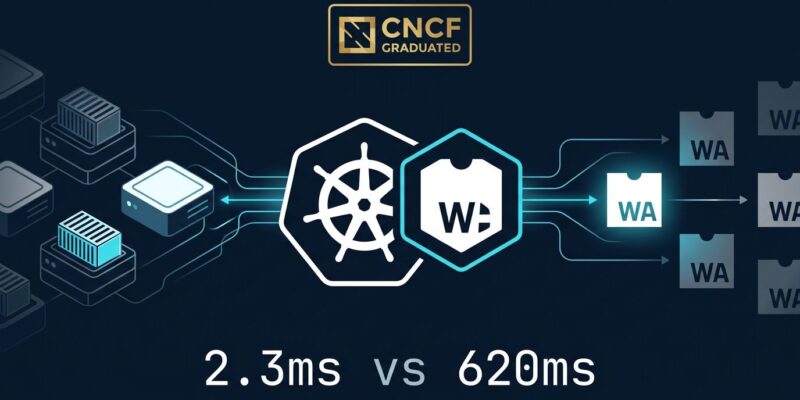
By The CNCF Technical Oversight Committee has provisionally approved Kube-Wasm for graduated status — the foundation’s highest maturity tier — pending a security audit due to complete in Q2 2026. That matters beyond routine housekeeping. Kube-Wasm is the project that makes WebAssembly modules schedulable directly inside Kubernetes clusters as first-class compute, with average cold starts of 2.3 ms versus 620 ms for standard runc containers. Graduated status signals to platform teams that this is ready for serious evaluation, not just conference demos.
How It Fits Into Your Cluster Without Touching Your Tooling
Kube-Wasm does not replace containers or containerd. It extends containerd via runwasi — a shim authored by the Bytecode Alliance and donated to the CNCF in 2024. The trigger is a single Pod spec field:
# RuntimeClass for Wasm workloads
apiVersion: node.k8s.io/v1
kind: RuntimeClass
metadata:
  name: wasmtime
handler: wasmtime
---
apiVersion: v1
kind: Pod
metadata:
  name: hello-wasm
spec:
  runtimeClassName: wasmtime
  containers:
  - name: app
    image: ghcr.io/example/hello-wasm:latest
Set runtimeClassName: wasmtime and the rest follows: kubelet hands off to containerd, containerd routes through the runwasi shim to the Wasm runtime, and your .wasm module executes. Same kubectl. Same Helm. Same Kubernetes APIs. The Wasm runtime is swapped in at the very bottom of the stack.
Three certified runtimes ship with Kube-Wasm: Wasmtime (the Bytecode Alliance reference implementation, leading on WASI and the Component Model), WasmEdge (well-adopted in CNCF circles), and WAMR (the WebAssembly Micro Runtime, designed for embedded and edge nodes with extreme resource constraints). Pick based on workload and deployment target.
The Numbers Behind the Graduation Narrative
Kube-Wasm benchmarks show average cold starts at 2.3 ms versus 620 ms for runc, with p99 latency of 4.8 ms versus 1,240 ms. That is not a marginal improvement — it is a category difference that changes what is practical to run as a serverless function or event-driven handler. Memory tells a similar story: Wasm instances run at roughly 3 MB each where equivalent Docker containers land around 64 MB, a 20x gap that compounds fast at density.
The consolidation math is straightforward. Running 500 microservices on standard Kubernetes requires around 40 compute nodes at steady state. Migrate Wasm-compatible services and you are looking at 4 to 6 nodes. That is not a hypothetical — it is the benchmark published by the Kube-Wasm project, and it is the number that tends to get infrastructure teams to take a meeting.
Where Wasm Wins — and Where It Still Does Not
The honest version of the Kube-Wasm pitch starts with the use case fit. Cold-start-sensitive workloads are the clear target: FaaS handlers, edge functions, event-driven pipelines, secure multi-tenant plugin execution. The production evidence is real: Fermyon handles 75 million requests per second on their Wasm-based edge platform, Fastly’s Compute@Edge has more than 10,000 active users, and American Express built an internal FaaS layer on wasmCloud.
Threading is where the story hits a wall. Wasm threading support is still incomplete, which rules out compute-heavy server workloads and anything that relies on parallelism at the module level. Nobody is running a general-purpose microservices backend on Wasm in production at scale. The right frame — the one KubeCon EU 2026 kept returning to — is to use Wasm where containers are too heavy, too permissive, or too expensive to operate at density. Not as a replacement. As a precision tool.
Why the Timing Is Right Now
The WebAssembly ecosystem stack finally closed its gaps this year. WebAssembly 3.0 went official in June 2026. WASI 0.3.0 shipped native async, removing the polling boilerplate that made I/O workloads awkward. The Component Model reached stable, enabling Wasm modules to compose without shared memory. WasmCon Europe 2026 ran co-located at KubeCon EU, and the conversation shifted — less about whether Wasm is ready, more about where to start.
CNCF graduation, once the security audit closes, puts Kube-Wasm in the same tier as Kubernetes, Prometheus, and Envoy. The v1.0 release targeting KubeCon NA 2026 will lock in stable APIs for the scheduler extensions and RuntimeClass admission webhook. If you are evaluating runtime diversity on your clusters, that is the version to wait for — or to test now in non-production environments.
What to Do This Week
Start with an audit of your cold-start-sensitive services — FaaS handlers, lightweight API endpoints, event processors. Those are the immediate candidates. Deploy a test node pool with the wasmtime RuntimeClass following the CNCF’s Kubernetes-Wasm integration guide, and benchmark your actual workloads before committing to a migration path. Track the Kube-Wasm project documentation for the security audit completion — that is the signal for teams waiting on the formal graduated badge.
The Kubernetes-as-OS framing that Kube-Wasm introduces — control plane as kernel, .wasm modules as processes — describes a real architectural shift in how compute density and workload isolation get handled at the cluster level. Graduation makes it official. The question now is how quickly teams running cold-start-sensitive workloads will move from evaluation to deployment.