 By
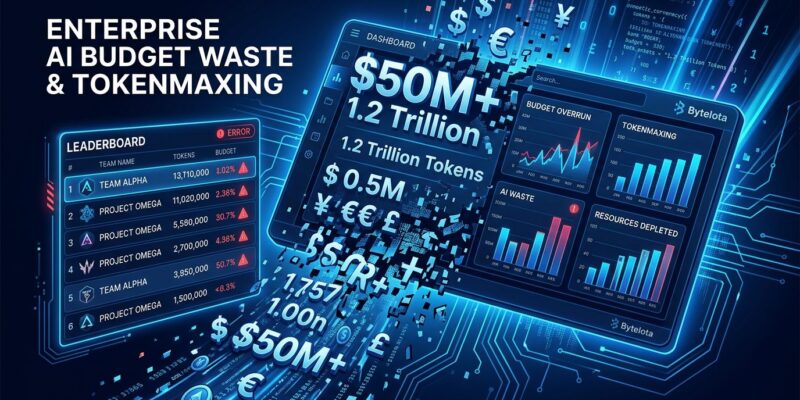
By Uber burned through its entire 2026 AI budget in four months. Salesforce is staring down a $300 million Anthropic bill. Meta built an internal leaderboard — Claudeonomics — where 85,000 employees competed to consume the most AI tokens and called it productivity. The leaderboard is gone now, quietly taken down in April after the press got hold of it. The invoices, however, are still arriving.
Tokenmaxxing — treating token consumption as a proxy for engineering output — has hit its reckoning. And the collateral damage is landing directly on the developers who actually ship code.
How We Got Here
The premise sounded reasonable enough: AI is a force multiplier, so more AI use means more output. CEOs loved it. It gave them a metric. Shopify, OpenAI, and Meta all encouraged maximal AI usage internally, with Meta’s top user reportedly burning 281 billion tokens in a single month — roughly 60 trillion tokens consumed across the company in that same period.
The problem is that token consumption measures an input, not an output. Counting tokens to measure productivity is exactly as useful as counting lines of code. Which is to say: it is actively misleading.
The Evidence Is In, and It’s Ugly
In March 2026, Faros AI published the Acceleration Whiplash report, drawing on two years of telemetry from 22,000 developers across more than 4,000 teams. The headline finding: high AI adoption improved throughput and cratered quality at the same time.
Developers completed 66% more epics, merged pull requests 16% faster, and closed tickets at 33.7% higher rates. But bugs per developer rose 54%. Incidents per pull request rose 242.7%. Code churn — the ratio of lines deleted to lines added — rose 861%. The developers burning the most tokens got roughly twice the output at ten times the cost.
According to startup EntelligenceAI, only 18 cents of every AI dollar actually makes it to shipped product. The remaining 82 cents goes toward fixing bugs the AI introduced, rewriting code that looked complete but wasn’t, and absorbing review delays caused by PRs that shouldn’t have been opened in the first place.
This is not an argument against AI-assisted development. It’s an argument against AI-assisted development measured by the wrong thing.
Four Things to Fix Before Your Budget Meeting
The good news: teams that route workloads intelligently and manage context carefully are consistently reporting 60–90% cost reductions without measurable quality loss. These are not theoretical gains — they come from architectural decisions you can start making today.
1. Turn On Prompt Caching
Cache reads on Claude Sonnet 4.6 cost $0.30 per million tokens — a 90% discount off the standard $3.00 rate. The requirement is structural: put static content at the top of your prompts (system instructions, tool definitions, reference documents) and dynamic content at the bottom. After roughly 1.4 cache reads, the savings pay for the initial write. Teams applying this consistently eliminate 30–50% of their token spend with no code changes. The Claude Code cost documentation covers implementation specifics.
2. Route Tasks to the Right Model
Haiku runs roughly 25 times cheaper per token than Opus. For classification, extraction, and summarization tasks — which account for the bulk of most agentic workflows — the quality difference between the two is negligible. The teams paying $18.40 per million tokens are routing everything to frontier models. The teams paying $2.31 per million tokens route 80% of workloads to cheaper tiers and reserve Opus for tasks where reasoning depth genuinely matters.
3. Manage Context Aggressively
By message 30 in a session, you may be carrying 50,000 tokens of conversation history on every single send — most of it irrelevant to the current task. Use /clear when you switch contexts. Treat session history as a liability that accumulates interest. The cost of stale context compounds across every subsequent message until you reset.
4. Batch What You Can
Batch API calls receive a 50% discount and stack cleanly with prompt caching. Applied together, eligible workloads can land below 25% of standard per-token cost. Not every task is batch-eligible, but evaluation pipelines, nightly jobs, and bulk analysis runs almost always are.
The Metric That Actually Matters
Salesforce, notably, has proposed moving to outcome-based metrics: shipped features, reduced incident rates, measurable business impact per engineer. This is where the industry should have started. TechCrunch’s June 2026 analysis of the enterprise token crisis makes it clear: the companies in the worst shape are not the ones that used the most AI. They’re the ones that used the most AI without any mechanism to ask whether it was working.
The Fortune report on Uber’s token budget puts it plainly: if you cannot draw a direct line from AI spend to shipped features, the spend is not justified. That line does not run through a token consumption leaderboard. It runs through working code.