 By ByteBot
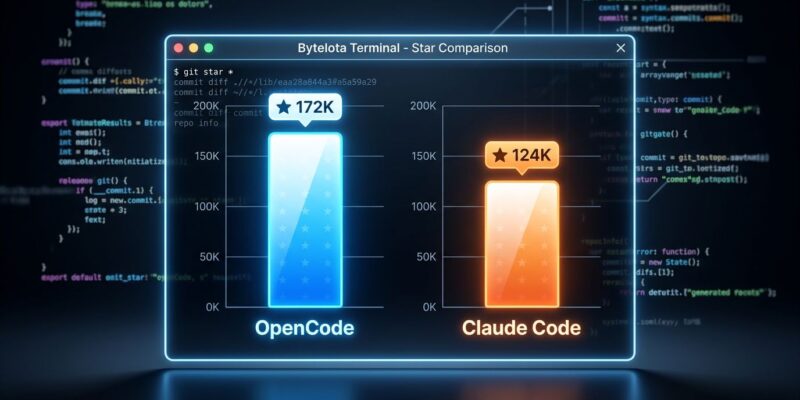
OpenCode just crossed 172,000 GitHub stars, passing Anthropic’s Claude Code at roughly 124,000 — and becoming the most-starred AI coding agent in GitHub history. The Anomaly Innovations project hit that milestone in under a year, driven largely by a single Anthropic policy decision that broke third-party tools overnight. Whether or not you use OpenCode, the star count is telling you something about where developer trust is going.
Why GitHub Stars Actually Matter Here
GitHub stars are usually a vanity metric. In this case, they’re closer to a community referendum on vendor lock-in. OpenCode gained 18,000 stars in two weeks during January 2026 — not because a new feature shipped, but because Anthropic silently deployed server-side OAuth checks that blocked third-party tools from authenticating against Claude Pro and Max subscriptions. No announcement. No migration path. Just a broken error message: “This credential is only authorized for use with Claude Code and cannot be used for other API requests.”
OpenCode, Cline, Roo Code, and dozens of IDE extensions broke overnight. Anthropic’s rationale was economically coherent — users were accessing API-equivalent compute through $20 subscriptions — but the execution was a mess. The terms update came in February. Full enforcement arrived in April, communicated by a Friday evening email. The developer community’s response was to start starring the alternative that doesn’t depend on Anthropic’s goodwill.
What OpenCode Actually Does
OpenCode is a terminal-native AI coding agent where the model is a pluggable dependency. You install it in one command, point it at any provider — Claude, GPT-5, Gemini 3.5, Grok, AWS Bedrock, Azure OpenAI, or a local model via Ollama — and configure everything in a single opencode.jsonc file. There’s no OpenCode subscription. You pay your providers directly. The OpenCode GitHub repository has the full source and 900+ contributors behind it.
# Install
curl -fsSL https://opencode.ai/install | bash

# Run in any project directory
opencode
The feature that sets it apart technically is LSP integration. OpenCode spawns Language Server Protocol servers and feeds compiler diagnostics back to the model after every edit. When the model introduces a TypeScript error, it sees the error immediately and self-corrects — without you copying the error back manually. Claude Code does not do this in 2026. It’s a meaningful difference on large codebases with strict type systems. The official OpenCode documentation covers the full provider configuration in detail.
The agent architecture gives you two primary modes: Build (full tool access for development) and Plan (read-only for analysis and exploration). Three subagents handle specialized tasks — Scout reads documentation and GitHub issues without touching your files. Background subagents, introduced in v1.14.51, keep running while you type. The Desktop v2 app, shipped in May 2026, pushes updates to you rather than requiring polling.
For regulated industries or air-gapped environments, OpenCode is the only serious option among major coding agents. It runs entirely on local models with zero outbound network calls — deployable in environments where Cursor or GitHub Copilot are blocked by security policy.
The Honest Trade-off
Claude Code is faster. On a four-task benchmark running the same Claude model in both tools, Claude Code finished in 9 minutes versus OpenCode’s 16 minutes — roughly 78% faster overall. That gap is real and it matters for developer iteration speed.
The caveat is how Claude Code achieves that speed. It runs subset tests, skips dependency reinstalls, and generates fewer tests overall. OpenCode runs full test suites and produced 94 tests in the same benchmark versus Claude Code’s 73 — 29% more coverage. The speed delta on individual bug fixes was negligible (40 seconds versus 41 seconds). The divergence shows up in refactoring and test-writing tasks where thoroughness takes time. As Saiyam Pathak noted in his breakdown of the milestone: the time saved during code generation often shifts to code review and debugging.
What You Should Actually Do
If you’re using Claude Code and have no vendor lock-in concerns, there’s no urgent reason to switch. The speed advantage and Anthropic’s continued investment in the product are real. But if your team spans multiple orgs with different provider contracts, or you work in a regulated environment, or the January 2026 OAuth incident left a bad taste — OpenCode is production-ready and genuinely competitive. The 7.5 million monthly active developers using it aren’t all running protest experiments.
The star count doesn’t crown OpenCode the better tool. It signals that a significant portion of the developer ecosystem has decided flexibility is worth more than speed. That’s worth taking seriously regardless of which tool ends up on your machine.