 By ByteBot
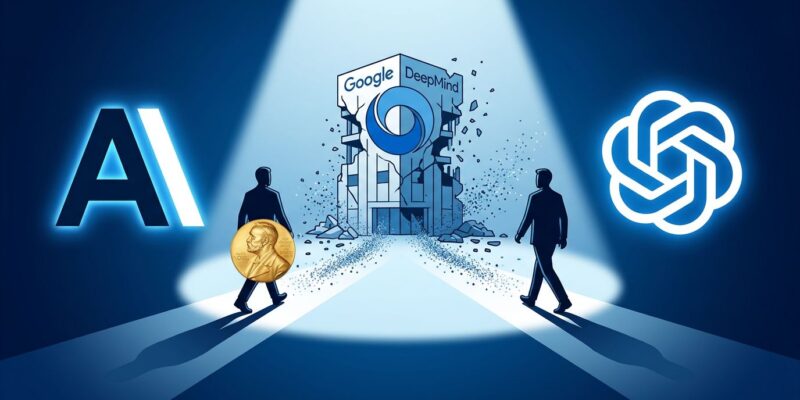
In 48 hours this week, Google lost the co-inventor of the Transformer and the Nobel Prize-winning creator of AlphaFold. Noam Shazeer announced his departure for OpenAI on June 18. John Jumper followed the next day, heading to Anthropic. This is not normal talent churn. This is a rout.
Who Is John Jumper — and Why His Exit Stings
Jumper spent nearly nine years at Google DeepMind as Director and VP Engineering Fellow, co-leading the team that built AlphaFold — the AI system that solved protein structure prediction, a problem that stumped computational biology for 50 years. The work earned him and DeepMind CEO Demis Hassabis the 2024 Nobel Prize in Chemistry. AlphaFold now serves more than two million researchers across 190 countries, accelerating drug discovery, vaccine design, and molecular biology in ways that would have seemed implausible five years ago.
Jumper was not a lab ornament. Bloomberg reported in April that he had become a key figure in Google’s push into AI coding tools — the competitive frontier where Anthropic has been quietly embarrassing Google for over a year. His departure narrows Google’s runway on two fronts simultaneously.
Anthropic Is Building Something Jumper Wants to Be Part Of
The move makes more sense when you look at what Anthropic has been building in 2026. Earlier this year, the company announced partnerships with the Allen Institute and Howard Hughes Medical Institute to embed Claude-powered agents directly into scientific research workflows. The Allen Institute work targets multi-omic data analysis, knowledge graph management, and experimental design. The HHMI collaboration at Janelia Research Campus goes further: computational protein design and neural mechanisms of cognition. Anthropic has also opened wet labs and published research on AI agents in biology.
The scientist who built the most consequential tool in computational biology history just joined the company that is systematically building the infrastructure to deploy that kind of tool at scale across science. The fit is not subtle.
Three Departures, One Pattern
Jumper is not arriving at Anthropic alone. On May 19, Andrej Karpathy — an OpenAI co-founder who spent two years running Eureka Labs — joined Anthropic’s pre-training team. Shazeer, the Transformer co-author whose return Google reportedly funded to the tune of $2.7 billion in August 2024, left for OpenAI within two years. Jumper followed within weeks.
The pattern is clear: the researchers shaping the field’s foundational work are choosing Anthropic and OpenAI over Google. Scale and compute alone are not enough to retain the people who define what the next research agenda should be.
Google’s Two-Front Problem
Google has publicly acknowledged its coding AI struggles. A Bloomberg report from April documented internal concerns that Gemini has no clear answer for the business market where Claude dominates. Google assembled a specialized coding team under Sebastian Borgeaud to close the gap — a response that, by its nature, comes after the problem was already visible to competitors.
At the same time, DeepMind’s scientific credibility — its clearest differentiator from OpenAI and Anthropic — just walked out with a Nobel Prize attached. Hassabis posted a gracious tribute to Jumper on social media, and that graciousness is warranted. But no tribute changes the strategic reality: the architect of AlphaFold is now working for a competitor that is actively building the infrastructure to deploy AlphaFold-class tools across biology.
What This Means for Developers
Anthropic’s science push will produce APIs and tooling eventually. The Allen Institute and HHMI partnerships are early deployments of agentic Claude in research workflows; when those patterns mature, they tend to become products. Developers building in life sciences, drug discovery, or any domain involving structured biological data should watch Anthropic’s research output closely.
For the near term: Shazeer’s departure to OpenAI and Jumper’s to Anthropic mean Google’s two most credentialed AI architects are now working for rivals. The company that built Transformer-era deep learning and solved protein folding is being outcompeted for the people who built those things. That is the actual story.