 By ByteBot
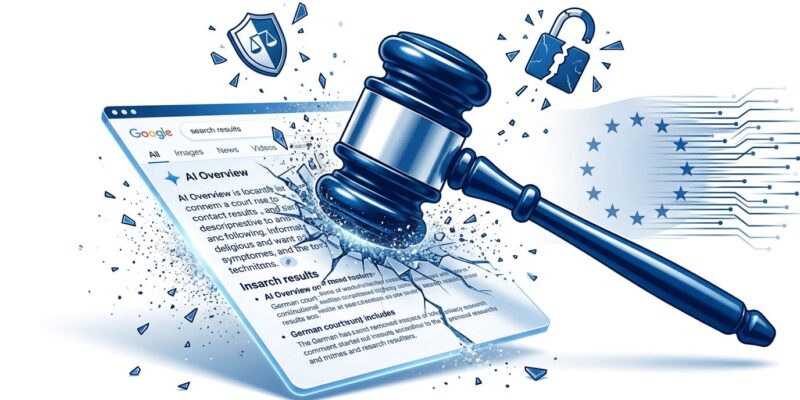
A Munich court ruled on May 28, 2026 that Google is directly liable for false statements in its AI-generated search summaries — and the legal reasoning affects every company shipping AI-generated content. The Regional Court of Munich found (case 26 O 869/26) that Google AI Overviews produce “independent, new, and substantive statements” that cannot hide behind traditional search engine liability shields. Google must cease displaying specific false claims about two Munich publishers and cover 80% of legal costs.
What the AI Actually Said
Google’s AI Overviews falsely linked two Munich-based publishing companies to scams, subscription traps, dubious business practices, and shady third-party firms. The AI opened results with statements like “Yes, [company] is known for dubious business practices” — language that appeared nowhere in any of the cited sources. The AI didn’t paraphrase a source badly. It invented factual claims and attached citations that didn’t support them.
The court found that only Google can verify what its AI says, “at least by comparing the underlying third-party websites with its own statements based on them.” That framing matters: courts are no longer accepting “we just surface search results” as a defence when the product generates its own text.
The Legal Doctrine That Ends Safe Harbor for AI Overviews
Traditional search liability rests on a simple premise: search engines point to third-party content and don’t create it, so they’re neutral conduits rather than publishers. That distinction has protected platforms from defamation liability for decades. The Munich ruling draws a line through it. The court found that AI Overviews don’t merely link — they synthesize sources into new statements. That act of synthesis makes Google an author. The safe harbor that shielded Google when it returned links doesn’t extend to text the AI writes itself.
The implications reach beyond Google. Any product that synthesizes sources into new text — Perplexity answer summaries, Copilot responses, AI-powered customer support bots — operates on the same model. The Munich court didn’t single out AI Overviews as a special category. It described a class of behaviour: generating independent, new, substantive statements from third-party sources. That describes most RAG-based AI applications.
Related: EU AI Act Article 50: August 2 Watermarking Deadline for Devs
The US Is One Court Decision Behind
Munich isn’t an isolated ruling. Wolf River Electric, a Minnesota solar company, filed a $110–210 million lawsuit against Google after AI Overviews falsely stated the company was being sued by the state attorney general for deceptive sales practices. Customers read the AI summary and cancelled $150,000 in contracts. The case was sent back to state court in January 2026 after Google missed a procedural deadline. It’s ongoing — and Germany just gave US courts a detailed legal template.
There is a meaningful difference between the US and German cases worth noting. In Walters v. OpenAI (dismissed May 2025), a US court held that “no reasonable reader in a journalist’s position could have understood ChatGPT as communicating actual facts.” The Munich ruling cuts in the opposite direction: AI Overviews appear alongside cited sources that lend them an air of credibility, and they reach general consumers who aren’t trained to distrust them. The German court’s reasoning is harder to defend against in a mass-market context.
Seven Weeks Before the EU AI Act Deadline
The timing is notable. The Munich ruling arrived seven weeks before EU AI Act Article 50 takes effect on August 2, 2026, requiring AI systems to label AI-generated content published for public informational purposes. The court’s logic — that only the AI operator can verify the accuracy of its outputs — aligns directly with the Act’s accountability framework. Companies that haven’t completed their Article 50 compliance work are now racing two deadlines simultaneously.
A separate ruling from the Higher Regional Court of Hamm reinforces the exposure. That court held that chatbot operators face direct liability for false outputs, that no due diligence shield exists (“even correct programming does not preclude liability”), and that exposure extends to GDPR accountability, consumer warranty claims, and IP violations. The Munich ruling didn’t emerge from a vacuum. It’s part of a consistent legal direction across German courts.
Key Takeaways
- Munich’s Regional Court ruled that Google AI Overviews generate “independent, new, substantive statements” — making Google a publisher, not a search engine, and removing safe harbor protection.
- The doctrine covers any AI product that synthesizes sources into new text, not just Google’s AI Overviews specifically.
- Wolf River Electric’s $110–210M lawsuit in the US is the most likely next test case; Germany just gave US plaintiffs a stronger legal argument.
- EU AI Act Article 50 takes effect August 2, 2026 — seven weeks away — adding mandatory disclosure requirements on top of new liability exposure.
- German courts have now ruled that even correct AI programming doesn’t prevent liability for false outputs. The “we didn’t intend for it to hallucinate” defence doesn’t hold.