 By
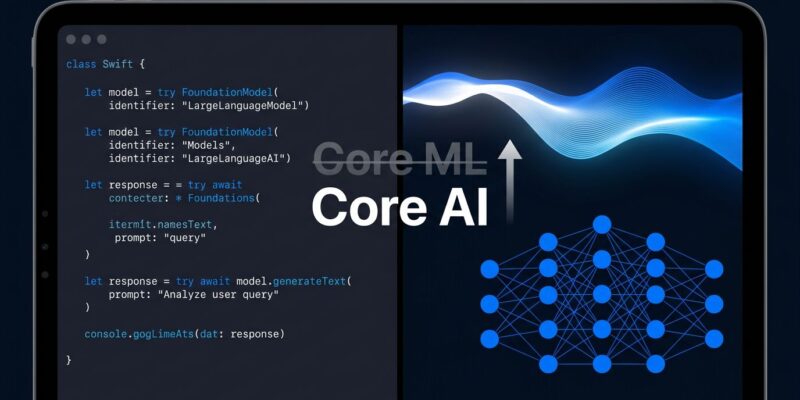
By Apple is replacing Core ML with a new framework called Core AI in iOS 27, set to be formally unveiled at WWDC on June 8 — five days from now. Core ML has powered on-device machine learning on iPhone and Mac since 2017. Core AI is its successor: built for large language models, generative AI, and third-party model routing rather than traditional ML prediction tasks. If you ship iOS or macOS apps, this is the biggest framework shift Apple has made to its AI developer stack in nearly a decade.
Why Core ML Had to Go
Core ML was brilliant in 2017. Apple shipped a single framework that could run custom-trained models on the Neural Engine without a network connection — classifying images, predicting user intent, running NLP models locally. For a company famously protective of its APIs, it was impressively practical.
Then large language models arrived, and Core ML aged badly. It was designed for batch inference on deterministic models — not autoregressive token generation, streaming responses, multi-turn sessions, or tool calling. Converting even a modest 7B LLM to .mlmodel format through coremltools was unreliable at best, broken at worst. Apple’s own Foundation Models framework, shipped at WWDC 2025, had to be built alongside Core ML rather than on top of it — because Core ML simply could not handle LLM-native patterns.
The result: iOS developers building AI-powered apps in 2025 and 2026 are juggling Core ML, MLX, Foundation Models, and third-party API calls simultaneously. It’s a patchwork, not a platform.
What Core AI Actually Changes
According to reporting from 9to5Mac and AppleInsider, Core AI is a unified framework that handles both on-device and cloud AI execution — with the system automatically routing inference based on privacy requirements, task complexity, and available hardware. The Neural Engine still runs local workloads; cloud handles what it cannot.
The bigger shift is what Core AI opens for third-party developers:
- External model support: Apps can connect to ChatGPT, Gemini, or Claude through a standardized API. Apple has reportedly tested integrations with both Google and Anthropic internally.
- MCP integration: The Model Context Protocol could let AI models take in-app actions — writing files, triggering workflows — rather than just returning text in a chat interface.
- Multimodal Foundation Models: Image input for the on-device Foundation Models API, currently text-only, is expected to open for third-party apps.
- Visual Intelligence API: The camera-based visual understanding that debuted with iPhone 16 is expected to become a developer API at WWDC.
Apple registered the genai.apple.com subdomain weeks before WWDC. It is not live yet, but it will almost certainly go live on June 8 with documentation and sample code. The “GenAI” label is a deliberate brand signal: Apple is publicly claiming the generative AI category as a platform story, not just a features story.
Your Apps Won’t Break
Existing .mlmodel and .mlpackage files continue to work in iOS 27. Apple’s deprecation cycles are long — Core ML is not going away in one WWDC cycle. The trajectory will resemble UIKit and SwiftUI: both coexist for years, but every new platform capability ships in the new framework, and the old one quietly stops receiving investment.
The practical reality: if your app uses Core ML for image classification or text classification, nothing changes in 2026. If your app is building toward generative AI features — contextual suggestions, in-app assistants, content generation — Core AI is where that work will live from here.
What to Do Before June 8
You have five days. Here is what is actually worth doing:
- Audit your Core ML models. Open your Xcode project and list every .mlmodel and .mlpackage file. Tag each one: traditional ML task (classification, detection, tabular) or generative task. The second group is where you will have migration decisions to make.
- Enroll in the developer beta. Ensure your Apple Developer account is ready. iOS 27 beta 1 drops June 8 — day of the keynote.
- Don’t rewrite anything yet. Wait for official documentation. The API surface for Core AI is not confirmed, and migration patterns from coremltools will need to be validated against what Apple actually ships.
- Block your calendar June 8–10. The “Meet Core AI” session and migration labs will be the highest-value Apple developer content published this year. Watch them the day they drop.
- Monitor genai.apple.com. When it goes live, it will be the canonical landing page for Core AI developer resources.
Apple’s Neural Engine grew from 600 billion operations per second on the A11 in 2017 to 38 trillion on current hardware. The silicon has been ready for generative AI for years. Core AI is Apple’s acknowledgment that the framework has not kept pace — and its commitment to closing that gap before iOS 27 ships in the fall.
WWDC 2026 runs June 8–12. The keynote begins at 10 AM Pacific. All sessions stream free at developer.apple.com/wwdc26.