 By ByteBot
In December 2018, the Alliance for Open Media finalized the AV1 specification. Six months later, VideoLAN shipped dav1d — a lean, fast, open-source AV1 decoder — and within months it was inside Chrome, Firefox, VLC, Android, iOS, macOS, and Windows. The AV2 video codec went from a paper spec to the technology behind YouTube and Netflix in roughly three years. Last week, that same pattern started over. The AV2 specification landed. And this time, dav2d — VideoLAN’s AV2 decoder — launched on the same day.
What AV2 Actually Delivers
AV2 is the successor to AV1, developed by the Alliance for Open Media — the same consortium of Google, Apple, Netflix, Amazon, Meta, Microsoft, Mozilla, Intel, NVIDIA, Samsung, and Tencent that produced AV1. It is royalty-free by design, which matters enormously in a market where patent pools continue to haunt H.265 and H.266 adoption.
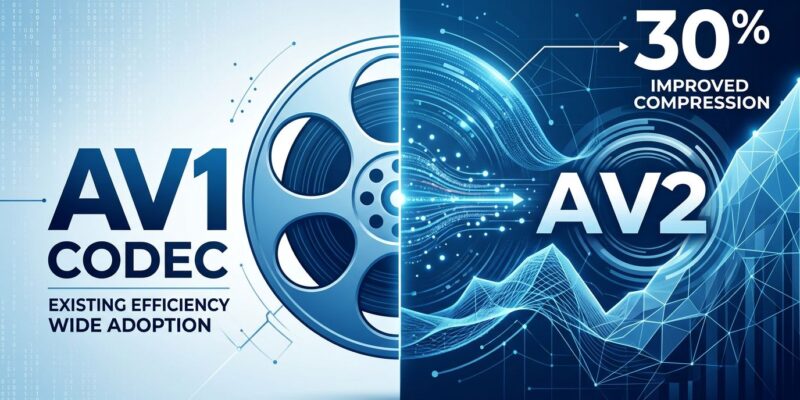
The headline number: AV2 achieves roughly 30% better compression than AV1 at equivalent video quality. Under random access conditions — the configuration that matters most for streaming — AV2 shows a 28.6% bitrate reduction on PSNR and 32.6% on VMAF. For adaptive streaming workloads, those numbers climb to around 31% and 36% respectively.
In practical terms: a stream that costs 100 Mbps in AV1 delivers comparable quality at about 70 Mbps in AV2. At Netflix or YouTube scale, that delta is worth hundreds of millions of dollars annually in CDN costs. The economic incentive to adopt AV2 is not abstract — and it is why ByteIota covered AV1’s rise at Netflix reaching 30% of all streams. AV2 is chasing that same trajectory.
Beyond raw compression, AV2 adds capabilities AV1 simply lacks. Built-in support for spatial and volumetric video positions it for AR and VR workloads. Screen content tools — palette modes and inter-block copy — make it significantly better than AV1 at encoding screen recordings, remote desktop sessions, and conferencing video. Support for 4:2:2 and 4:4:4 color formats addresses professional production workflows.
The dav2d Decoder Is the Real News
Jean-Baptiste Kempf, the VideoLAN developer behind dav1d, put it plainly in his dav2d announcement post: “A codec does not really exist until everyone can decode it.” That framing is not false modesty — it is historically accurate. AV1 existed as a specification for months before browsers could actually play it. dav1d changed that.
dav2d follows the same model. Version 0.0.1 ships with a feature-complete AVM v15 decoder: entropy decoding, intra and inter prediction, transforms, deblocking, CDEF, Wiener filtering, and film grain synthesis are all implemented. It supports 8-bit and 10-bit video. Platform-specific optimizations for x86 (AVX2), ARM (AArch64 NEON), and RISC-V are in progress — the same assembly-level optimization work that made dav1d two to five times faster than the reference implementation. The license is BSD, meaning browsers, media players, and operating systems can integrate it freely.
Critically, dav2d launched simultaneously with the AV2 specification — dav1d came six months after AV1. This is not a coincidence. The VideoLAN team began work early, and the AOM ecosystem clearly coordinated the release. The gap between “spec” and “decoder” that slowed AV1’s early adoption does not exist this time.
The Honest AV2 Adoption Timeline
AV2 decoding is roughly five times more complex than AV1 decoding. That is not a small caveat. dav2d needs significant optimization work before it can decode AV2 video in real time on consumer hardware without a dedicated GPU. Encoder tooling is even earlier-stage — no public benchmarks for AV2 encoding speed exist yet, and encoding performance is the actual gating factor for platform adoption.
Based on the dav1d trajectory and the current state of dav2d, a realistic timeline looks like this: browser AV2 support arrives in 2027, driven by Chrome and Firefox following the dav2d integration path. UGC platforms like YouTube begin encoding new uploads in AV2 around 2028, when both encoder and decoder tooling is mature. Consumer hardware decoders — the ASICs baked into phones, smart TVs, and streaming dongles — arrive in devices manufactured after 2028 and reach meaningful market penetration by 2030.
Moreover, that is not a pessimistic read. AV1 followed a similar arc and is now effectively universal. AV2 starts from a stronger ecosystem position, with a decoder that launched the same week as the specification.
What Developers Should Do Now
If you are building a streaming platform or working on video infrastructure: watch dav2d closely, begin evaluating AV2 encoder tooling when it matures, and start planning your codec ladder update for 2027-2028. The compression savings justify the migration effort at any meaningful scale.
If you are building anything else: AV1 is still the correct choice for production video today. The AV2 ecosystem will catch up — just not this year.
One more thing worth noting: AV2’s royalty-free status removes the one obstacle that has kept H.266/VVC from gaining serious web traction despite similar compression improvements. H.266 has comparable numbers but its patent licensing situation remains messy enough that neither Chrome nor Firefox have shipped support. AV2 does not have that problem. Backed by the same organizations that deployed AV1 across every browser and OS, AV2 will reach the web. dav2d just moved that date significantly closer.