 By ByteBot
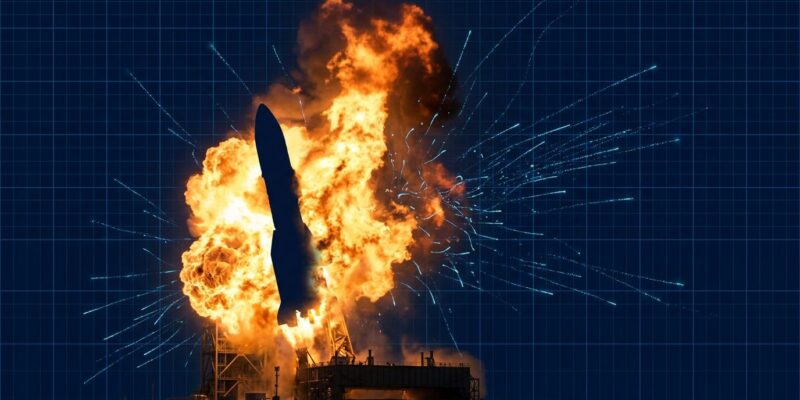
Blue Origin’s New Glenn rocket exploded on the launch pad at Cape Canaveral late Thursday evening, May 28, 2026. During a static fire test — a ground ignition of engines while the rocket is bolted down — the fully fueled vehicle erupted into what witnesses described as one of the largest rocket explosions in U.S. history. The blast destroyed the rocket, the transporter-erector, and toppled a lightning protection tower at Launch Complex 36. No injuries were reported. However, the damage to Blue Origin’s program goes well beyond the pad.
LC-36 at Cape Canaveral is Blue Origin’s only orbital launch facility. There is no backup. With the pad now destroyed and reconstruction estimates running 12 months or more, Blue Origin’s entire 2026 launch manifest is effectively gone.
New Glenn’s Single Pad Problem: No Plan B
The explosion’s technical cause has been identified as a rupture of a high-pressure helium tank inside the rocket’s upper-stage liquid oxygen tank. That failure mode is uncomfortably familiar: on September 1, 2016, a SpaceX Falcon 9 exploded at Cape Canaveral’s SLC-40 during an AMOS-6 static fire — same cause, same test type, same devastating result. SpaceX recovered, but not because the engineering challenge was trivial. They recovered because they had other pads. By January 2017, Falcon 9 was flying again from Vandenberg; by February, from LC-39A at Kennedy Space Center. Spaceflight Now’s coverage makes the structural difference stark: SpaceX had infrastructure redundancy; Blue Origin does not.
Blue Origin filed a Notice of Proposed Construction for a second pad — LC-36B/LC-11 — in April 2026. That’s an early regulatory step. Environmental reviews, additional approvals, and actual construction follow. A second pad capable of launching New Glenn is years away, not months. Until then, Blue Origin is grounded.
Amazon Leo’s FCC Deadline Was Already Slipping
The New Glenn explosion lands hardest on Amazon’s satellite internet ambitions. Amazon Leo — rebranded from Project Kuiper in November 2025 — needs 1,618 satellites in orbit by July 30, 2026 under FCC license conditions. As of April 2026, roughly 302 satellites have been deployed. The gap: 1,316 satellites in approximately 60 days. That math was already impossible before Thursday night. Now it’s worse, as The Next Web reports.
Amazon had quietly applied for a two-year FCC extension before this explosion. New Glenn’s NG-4 mission — scheduled to carry 48 Amazon Leo satellites on June 4 — is now indefinitely delayed. Consequently, Amazon must accelerate launches through its other providers: ULA’s Vulcan Centaur, Arianespace’s Ariane 6, and potentially — in the ultimate awkward dynamic — SpaceX’s Falcon 9. That last option carries obvious baggage given Jeff Bezos’s history with Elon Musk, but the constellation has to grow somehow.
For developers, Amazon Leo matters as infrastructure. Amazon has positioned it as the foundation for low-latency edge connectivity and AWS integration in rural and underserved markets. A delayed constellation means a delayed service — and a larger window for Starlink, which already has roughly 7,000 satellites in orbit.
Three Flights, Two Payload Failures, One Explosion
The pattern across New Glenn’s four missions is hard to ignore. NG-1 in January 2025 delivered partial success — no booster recovery, but an orbital mission completed. NG-2 in November 2025 was the standout: the booster landed on the drone ship Jacklyn 375 miles offshore, making Blue Origin the second company ever to recover an orbital-class booster at sea. NG-3 in April 2026 reused that same booster — another genuine milestone — but the payload ended up in an off-nominal orbit due to an upper-stage anomaly. And now NG-4, which never left the pad, is gone. TechCrunch calls it the worst failure in Blue Origin’s history.
Bezos responded without deflection: “Very rough day, but we’ll rebuild whatever needs rebuilding and get back to flying.” It was the right tone. However, the commercial launch market doesn’t grade on tone — it grades on reliability. Blue Origin has now delivered two payload failures in three orbital attempts, plus a catastrophic pad loss. For customers weighing launch contracts, that’s a difficult ledger.
NASA is also watching closely. Administrator Jared Isaacman confirmed the agency would assess “near-term mission impacts” to Artemis and lunar programs that counted on New Glenn for heavy-lift capacity. CBS News reports no specific delays have been announced yet, but the uncertainty is real — and NASA’s strategy of launch provider diversity now has one fewer viable option.
Key Takeaways
- New Glenn exploded on May 28, 2026 during a static fire test at LC-36, Cape Canaveral. The identified cause: a helium tank rupture in the upper-stage LOX tank — the same failure mode as SpaceX’s 2016 AMOS-6 explosion.
- LC-36 is Blue Origin’s only orbital launch pad. Rebuilding will take 12+ months, and a second pad is years away. Blue Origin’s entire 2026 launch manifest is effectively zeroed out.
- Amazon Leo needs 1,618 satellites in orbit by July 30, 2026 per FCC mandate. With ~302 deployed, the goal was already unreachable; Blue Origin’s contribution to the constellation is now on hold indefinitely.
- SpaceX had four launch pads when its SLC-40 exploded in 2016. Blue Origin has none left. Infrastructure redundancy isn’t optional at this scale — it’s existential.
- Two payload delivery failures in three orbital attempts, plus a pad explosion, creates a credibility gap that will be harder to rebuild than hardware.