 By ByteBot
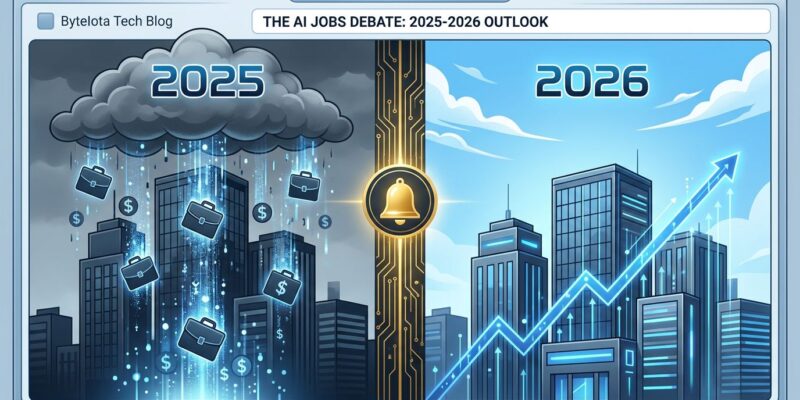
On May 26, Sam Altman told the Commonwealth Bank of Australia CEO he was “delighted to be wrong” about AI-driven job displacement — a direct reversal of his June 2025 warning that entire categories of entry-level white-collar work were about to vanish. That same week, Dario Amodei, who spent 2025 predicting AI would eliminate half of all white-collar jobs, appeared onstage with JPMorgan CEO Jamie Dimon and reached for a 19th-century economic paradox to reframe mass automation as a productivity multiplier. Both CEOs flipped their most headline-grabbing claims in the same news cycle. Both companies are preparing trillion-dollar IPOs in 2026.
The Reversal, Word for Word
A year ago, Altman warned publicly that “a lot of jobs will go away” and described entry-level knowledge work as highly vulnerable to rapid displacement. Amodei went further — claiming AI could eliminate 50% of white-collar roles within years and forecasting unemployment of 10–20%. These were not casual predictions. They became the primary arguments fueling AI regulation debates and workforce planning decisions across industries.
On May 26, Altman walked it back explicitly: “I’m delighted to be wrong about this. I thought there would have been more impact on entry-level white-collar jobs being eliminated by now than has actually happened.” What changed his mind? He says attempting to delegate his own email and Slack responses to AI revealed how difficult human interaction is to replace. Amodei, meanwhile, invoked the Jevons paradox: “If you automate 90% of the job, then everyone does the 10% of the job. And the 10% kind of expands to be 100% of what people do and kind of 10-times their productivity.” Automating tasks lowers their cost, which expands demand — so total work doesn’t shrink, it transforms.
Follow the Money
OpenAI is targeting a September 2026 IPO at approximately $1 trillion valuation. Anthropic is on a similar timeline, with a late-2026 public listing at comparable figures. Fortune framed both reversals plainly: they arrived as both companies “eye blockbuster IPOs.” Public market investors don’t want to own equity in companies whose CEOs are predicting mass unemployment — that’s a regulatory and public perception liability worth billions.
None of that makes the reversal wrong. However, developers and tech workers deserve to process these reassurances knowing they were issued during IPO roadshow season, not during the period when both executives were loudest about displacement risk. The credibility question is real. You can simultaneously acknowledge that the data supports a less catastrophic view and that the timing is extraordinarily convenient.
What the AI Jobs Data Actually Shows
Here is where the reversal gets more defensible. Yale Budget Lab has tracked AI’s labor market impact monthly since ChatGPT launched. Their conclusion through March 2026: no substantial acceleration in the rate of change in occupational composition since late 2022. All metrics lie within historical ranges. Shifts in employment among writers and coders were already underway in 2021 — before generative AI tools existed. The macro picture is stable. Goldman Sachs CEO David Solomon points to a longer arc: U.S. civilian employment grew 145% since 1962 through every major technological disruption.
However, the macro picture coexists with a company-level reality that looks very different. Tech layoffs in 2026 have already passed 150,000, with AI cited as the leading cause in Q1 — 47.9% of layoffs attributed to AI and automation per Nikkei Asia. Cloudflare cut 1,100 workers — 20% of its workforce — citing AI agents now handling HR, marketing, finance, and engineering after internal AI usage surged 600% in three months. Revenue was at a record high when those workers were cut. These things are not contradictions. An economy can absorb 150,000 tech layoffs and still show aggregate occupational stability. That is, however, cold comfort to the individuals involved.
What This Means for Developers
The Jevons paradox is a real historical pattern. Steam engines, fuel-efficient cars, and computing all generated more demand for human labor, not less. It may apply to AI coding too — more automation could mean more software demand, not fewer engineers. Nevertheless, the paradox didn’t protect the 1,100 people Cloudflare cut last month. The macro trend and the individual experience can diverge sharply, especially during transition. The honest read is this: aggregate stability doesn’t mean individual roles are safe. Risk is concentrated in specific functions — HR, recruiting, content, and marketing within tech companies. Engineering roles building AI systems remain in demand, for now.
Key Takeaways
- Sam Altman and Dario Amodei publicly reversed their AI job displacement predictions on May 26, 2026 — both said they were wrong, both companies are preparing trillion-dollar IPOs
- Yale Budget Lab data genuinely supports a more optimistic view: no significant occupational shift at the macro level since ChatGPT launched in late 2022
- The company-level picture contradicts macro stability: 150,000+ tech layoffs in 2026, with AI cited as the leading cause in Q1
- Roles most at risk are HR, recruiting, content, and marketing within tech companies — not software engineering, at least not yet
- The Jevons paradox may ultimately prove right — automation could expand demand — but historical patterns don’t immunize individual workers during the transition