 By ByteBot
Google spent nearly a year accepting open-source contributions from hundreds of developers — more than 6,000 merged pull requests, 100,000 GitHub stars — then on May 19, 2026, announced it was pulling the plug on Gemini CLI and replacing it with a closed-source product. The deadline is June 18. The community has a word for this. Several, actually.
What Just Happened
Gemini CLI launched in June 2025 as a TypeScript project under the Apache 2.0 license. It brought Gemini AI directly into the terminal and quickly became one of the more useful AI coding tools available — partly because it was genuinely good, and partly because it was free, with a 1,000-request-per-day limit that actual developers could use without watching a token meter.
In under a year, the community built it into a 100,000-star repository with more external contributions than most Google projects see in their entire lifespan. That’s not a footnote. That’s the story.
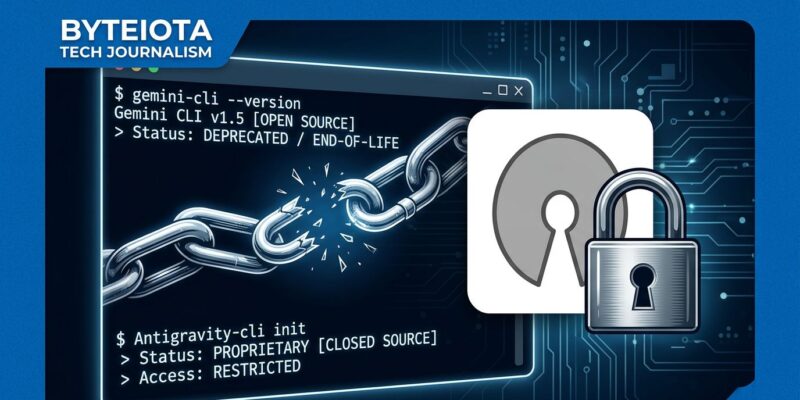
At Google I/O on May 19, the team announced they were transitioning Gemini CLI to something called Antigravity CLI. On June 18, free access ends. So does access for Google AI Pro and Ultra subscribers. Individual Gemini Code Assist users are also out. The only people who keep Gemini CLI are organizations on Gemini Code Assist Standard or Enterprise licenses.
The Open-Source Problem
The replacement, Antigravity CLI, is closed-source. If you visit the Antigravity CLI GitHub repository right now, you will find a changelog, a readme, and a demonstration GIF. No source code. Google accepted thousands of contributions to an Apache 2.0 project, then handed the future of that project exclusively to enterprise customers behind a product that does not let you see the code.
Developer Andrea Alberti had a 27-commit pull request merged to Gemini CLI on the same day as the shutdown announcement. Her response was direct: “Essentially working for free on a code base that will only be used in enterprises?” On Hacker News, the summary that resonated most was blunt: “So, basically, we’re making the project closed source. That’s it.”
The framing the community settled on — bait-and-switch — fits. Open-source release to attract community labor, community improves the product, enterprise captures the value, community gets a closed replacement it cannot inspect or fork. The Apache 2.0 code still exists and can be forked. But the API backend disappears June 18, and there is no indication Google intends to let anyone else run it.
Antigravity CLI Is Not a Drop-In Replacement
Google’s official transition announcement notes that “there won’t be 1:1 feature parity right out of the gate.” Antigravity CLI is a Go rewrite, not a fork. Agent Skills, Hooks, and Subagents carry over. Extensions become Antigravity Plugins. Everything else requires manual migration.
The quota situation is worse. Gemini CLI’s 1,000-request daily limit has been replaced with a compute-based quota system that refreshes every five hours until hitting a weekly ceiling. Users are reporting they hit that ceiling within roughly 2,000 lines of generated code — a steep downgrade for anyone who relied on Gemini CLI for daily work.
There’s also the partner problem. Dynatrace, Elastic, Figma, Shopify, and Stripe had built integrations into the Gemini CLI ecosystem. They have four weeks to migrate. For teams with CI/CD pipelines that invoke Gemini CLI, the timeline is tight.
The Double Standard
What makes this particularly frustrating is the double standard baked into the announcement. Google frames the migration as a technical imperative — a necessary consolidation into the Antigravity platform. Except enterprise customers on Gemini Code Assist Standard and Enterprise licenses are explicitly exempt from that imperative. They get to keep Gemini CLI. The “technical necessity” evaporates when a large enough contract is involved.
This is not the first time a large company has relicensed or killed an open-source project after the community did the hard work. HashiCorp moved Terraform to a Business Source License. Redis went proprietary. The difference here is that Google built community engagement into the product strategy from day one, extracted value from it at scale, and then framed the closure as a service improvement.
What to Do Before June 18
You have options, and the window is short.
- Migrate to Antigravity CLI if you are on an enterprise plan or willing to work within the degraded free tier. Install it now, convert Extensions to Antigravity Plugins, and update any CI/CD invocations. Do not leave this to the last week.
- Switch to Claude Code if you want an open-source AI coding agent that is not at risk of being folded into an enterprise product. It is Apache 2.0, actively maintained, and carries a different risk profile.
- Watch the fork discussion on GitHub. The Apache 2.0 license means the Gemini CLI codebase can be forked and continued by the community. Whether someone steps up to maintain an independent backend is an open question, but the conversation is happening.
Whatever you choose: act now. June 18 arrives faster than it looks on a calendar.
The Bigger Problem
This situation is a stress test for open-source trust in the AI tooling era. When AI companies release developer tools under permissive licenses, there is an implicit contract: we are building this together, and you can rely on it. When that contract breaks — on a four-week timeline with no feature-equivalent replacement — developers have to recalibrate how much they trust the next Apache 2.0 release from a company that also sells enterprise software.
Google’s Graveyard has a long memory. This entry is going to sit near the top for a while.