 By ByteBot
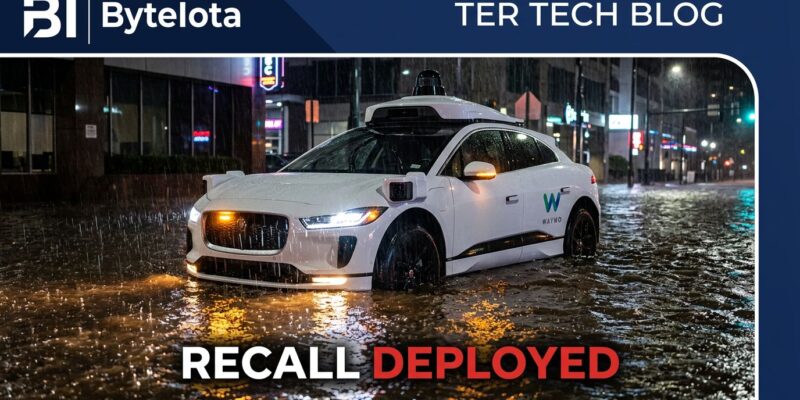
A reporter for the Atlanta Journal-Constitution was trapped in a Waymo robotaxi last Wednesday night as it drove into flooded Atlanta streets — not once, but multiple times. Roadside assistance was an hour out. She left in an Uber driven by a human. The part that stings: Waymo had issued a software recall for 3,791 robotaxis nine days earlier to fix exactly this problem.
What Happened in Atlanta
During heavy rains on the evening of May 20, at least two Waymo vehicles drove into flooded roads in Atlanta. Reporter Rachael Knudsen documented hers on Instagram in real time.
“It happened again, the Waymo just drove into a flooded street and gave up.”
— Rachael Knudsen, Atlanta Journal-Constitution reporter, stranded in Waymo
A second Waymo stalled on North Avenue during the same storm. Waymo has since paused service in Atlanta. San Antonio has been paused for weeks — the same flooding issue surfaced there in April, when an unoccupied Waymo was swept into Salado Creek in San Antonio during heavy rains.
On May 12, Waymo issued a voluntary NHTSA recall covering its entire 5th and 6th generation fleet. The defect: vehicles were slowing down at flooded roads but not stopping. Waymo deployed an over-the-air update that restricted access to high-risk areas during certain weather conditions. The problem is that “certain weather conditions” was defined by external signals — specifically, National Weather Service flood alerts.
Why Waymo’s Recall Didn’t Work
Atlanta’s May 20 storm produced rainfall intense enough that flooding began before the NWS issued any flash flood warning, watch, or advisory. The vehicles had no trigger to engage restrictions — so they drove into standing water as if conditions were normal.
Waymo acknowledged as much: they attributed the incident to “storm intensity exceeding National Weather Service warning capabilities.” However, what they didn’t say clearly is that the recall fix was never a real solution to begin with. Waymo told NHTSA at the time of the recall that it had not yet developed the “final remedy.” NHTSA sent a second document request on May 15, flagging the incomplete fix. The Atlanta incident came six days later.
The deeper issue isn’t the timing of weather alerts. It’s that Waymo’s autonomous system apparently cannot reliably detect standing water through its own sensors. LiDAR — the primary ranging technology in AV systems — has known difficulty with flat, reflective water surfaces; laser pulses scatter or absorb at water interfaces rather than returning clean distance readings. Camera-based flood detection is an active research area but not a solved production problem. The patch Waymo deployed was essentially a geofence tied to an external API — not flood perception, but flood avoidance by proxy.
This Is a Pattern, Not an Edge Case
It’s tempting to frame this as a freak weather event. It isn’t. Waymo has a consistent cycle: incident surfaces → recall filed → OTA fix deployed → same class of problem recurs.
In December 2025, Waymo recalled software after robotaxis illegally passed stopped school buses in Austin. Austin ISD logged over 20 violations. The recall was filed. The violations continued after the recall. In January 2026, Waymo struck a child near a Santa Monica elementary school. In March, vehicles stopped past lowered railroad crossing gates on two separate occasions. In April, a San Antonio vehicle was swept into a creek. Now Atlanta.
On May 21 — the same day Atlanta made headlines — Waymo also halted freeway rides in San Francisco, Los Angeles, Phoenix, and Miami after robotaxis struggled with highway construction zones. One vehicle reportedly blew through traffic cones and was chased by police.
Five distinct failure modes. Multiple recalls. Several of the same failure modes recurring after fixes were filed. This isn’t a company polishing rough edges — it’s a pattern that deserves a harder look, particularly regarding how much oversight remote operators in AV fleets actually provide.
What Developers Building Safety-Critical Systems Should Take Away
For developers, there are sharper lessons here than “autonomous vehicles aren’t ready.”
- External signals are not safety guarantees. A system that routes around danger only when a weather API says to is not a system that perceives danger — it outsources perception to an external dependency. In any safety-critical architecture, onboard sensing must be the last line of defense, not a downstream consumer of someone else’s alert feed.
- Production scale finds every edge case. A fleet of 3,791 vehicles across multiple cities with different weather patterns will encounter scenarios no test track generated. The long tail is real, and it’s long. The question isn’t whether edge cases will appear in production — it’s whether the system fails safely when they do.
- Graceful degradation means stopping, not slowing. The original defect — slowing down but proceeding into flooded roads — was worse than stopping outright. When a safety-critical system is uncertain, the conservative action is a hard stop, not a compromise between “go” and “stop.”
- The deploy-and-fix model doesn’t work for ML capability gaps. OTA recalls work for configuration bugs and rule-based logic. They don’t fix the absence of a perception capability. That requires retraining, data collection, and real-world validation — not a geofence config push.
Waymo says it’s “working to implement additional software safeguards.” They’ve been saying that since May 12. Atlanta suggests the timeline is optimistic — and the pattern suggests this won’t be the last city to learn that the hard way.