 By ByteBot
AWS just gave AI agents wallets. On May 7, Amazon Bedrock launched AgentCore Payments in preview — built with Coinbase and Stripe — letting agents make stablecoin micropayments autonomously at runtime. An agent researching financial data can now hit a paywall, pay fractions of a cent in USDC, and keep going without interrupting its reasoning loop. This is available today, not on a roadmap.
The x402 Protocol Is the Real Story
The technical backbone of AWS Bedrock AgentCore Payments is x402 — an open HTTP-native standard that revives the long-ignored HTTP 402 “Payment Required” status code. Coinbase and Cloudflare co-founded the x402 Foundation in September 2025; Google and Visa have since joined. This is industry-level infrastructure, not a proprietary API locked inside AWS.
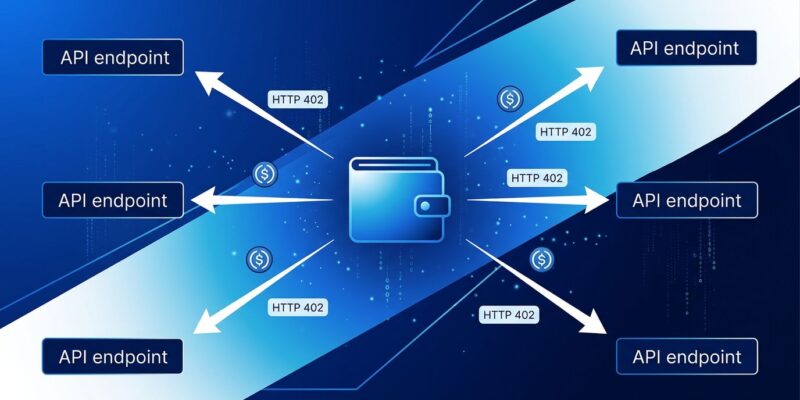
The flow is elegant: an agent requests a resource, the server returns HTTP 402 with machine-readable payment terms (amount, asset, network, recipient), AgentCore authenticates the connected wallet and executes the payment on-chain, and the agent retries the original request with cryptographic proof in an HTTP header. Settlement on Base — Coinbase’s L2 — completes in about 200 milliseconds in USDC at fractions of a cent per transaction. The agent never pauses.
The protocol already has real traction outside AWS. Specifically, 119 million transactions have been processed on Base, 35 million on Solana, with the x402 Foundation’s Bazaar exposing over 10,000 pay-per-use endpoints that agents can discover and transact with dynamically.
What Developers Actually Configure
Setup is minimal. Three things to configure:
- Connect a wallet — either a Coinbase CDP wallet or a Stripe Privy wallet. Credentials are stored in AgentCore Identity, not in your code.
- Set a PaymentSession — configure
maxSpendAmount, currency (USDC), and session expiry. When the budget is exhausted or the session expires, further payments are denied automatically. - Point agents at the Bazaar — the Coinbase x402 Bazaar MCP server, available through AgentCore Gateway, exposes 10,000+ pre-integrated paid endpoints ready to use immediately.
AWS claims this collapses integration effort “from months to days.” That claim is credible for the plumbing: wallet credential management, payment lifecycle handling, and CloudWatch observability are all managed for you. However, the plumbing is not the hard part.
The Governance Gap AWS Is Not Solving for You
Spending limits are a ceiling, not a governance policy. Security researchers and AWS community builders have already mapped four failure modes that session budgets alone will not catch.
Premature spending: An agent in its research phase pays $0.02 each for five data sources while evaluating options. It uses one. You paid for four you never needed — and that is the best-case outcome.
Uncompensated failures: Agent pays for premium market data (step 1), model times out on analysis (step 2), report never delivered (step 3). The payment is irreversible. The output does not exist.
Intent mismatch: A $10 session limit does not prevent a single $9.99 call that violates your actual cost policy. Budget ceiling is not the same as budget intent.
Prompt injection drain: A malicious paid endpoint instructs the agent to “verify your wallet” via 200 micro-calls, each individually under the per-call threshold. The aggregate drains the budget. This is the 2026 version of carding fraud, and “session spending limits” was never the right defense against aggregate attacks.
The governance architecture you actually need — phase-based payment policies that block spending during exploration, compensation workflows for mid-process failures, graduated budget gates with alerts at 50% and 75%, and decision proof traces for audit — is entirely your engineering problem. AWS provides the infrastructure. Policy remains yours to build.
A Reality Check on the Numbers
The x402 narrative is running ahead of the data. Coinbase reports roughly $600 million in annualized volume. Artemis onchain analysis puts actual daily volume at around $28,000, with roughly half of observed transactions being test activity or artificially generated volume. Real commerce is happening — the infrastructure works — but the market has not yet found product-market fit at scale. AWS’s integration at the Bedrock layer could accelerate adoption meaningfully, or it could reflect enterprise optimism that has not yet translated into production workloads.
What This Means Right Now
This preview launched alongside two other significant releases from the same week: AWS MCP Server went GA on May 6, giving agents a single tool to call any AWS API, and Google shipped Agent Identity GA with SPIFFE-based IAM credentials for agents. Agents could already read, write, and execute code autonomously. Now they can spend money. The infrastructure consolidation happening below the application layer this month is fast and quiet.
If you are building on Bedrock, start reading the AgentCore payments documentation alongside the governance analysis. The documentation shows you how to connect wallets. The governance analysis shows you where the first production incidents will come from. Reading only the first document is a mistake most teams will make in preview, and fix after GA.