 By ByteBot
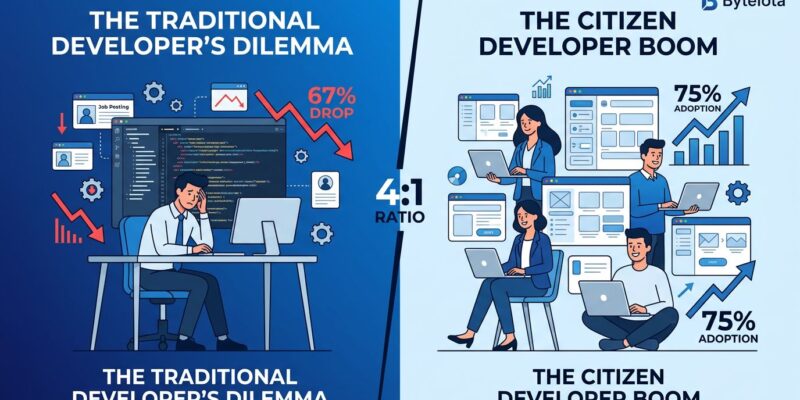
The low-code/no-code market hit $66.2 billion in 2026, with 75% of new enterprise applications now built using these platforms. More striking: Gartner forecasts citizen developers will outnumber professional developers 4:1 by 2029. Yet simultaneously, the U.S. faces a projected 1.4 million developer shortage. Here’s the paradox: while companies claim they can’t find enough engineers, they’re training business analysts and operations managers to build 70% of applications themselves.
The Numbers Don’t Add Up
The software industry is telling two contradictory stories. Story one: severe developer shortage—1.4 million unfilled U.S. positions by 2026, IT roles taking 41 days to fill, with 87.5% of tech leaders rating hiring as “difficult” or worse. Story two: explosive growth in citizen development, where non-technical employees build most enterprise applications using visual platforms.
However, both narratives can’t be fully true. If 75% of new enterprise applications genuinely require low-code platforms instead of professional developers, and citizen developers already outnumber IT staff 4:1 in platform usage, then calling this a “developer shortage” mischaracterizes the problem. What we’re witnessing isn’t scarcity of development capacity—it’s a fundamental shift in who’s doing the building and what kind of complexity requires professional expertise.
The market data is striking. Low-code platforms reached $66.2B in 2026, growing from $50.31B in 2025, with projections of $205.56B by 2030. That’s 32.7% compound annual growth. Meanwhile, Gartner reports that 80% of low-code users now come from outside formal IT departments, up from 60% in 2021. These aren’t developers using faster tools—these are accountants building expense approval workflows and operations managers creating inventory dashboards.
The Learning Pipeline Is Breaking
Junior developer jobs have collapsed 67% since 2022. The bootcamp-to-job pipeline that produced thousands of new developers is effectively dead. Moreover, this isn’t coincidental timing—it’s a direct consequence of what low-code platforms do best.
Low-code excels at simple CRUD applications, workflow automation, internal tools, dashboards, and form-based systems. These are precisely the projects where junior developers traditionally learned their craft. When a business analyst can build an employee onboarding workflow or expense approval system in FlowForma without writing code, that’s one less project for a junior developer to cut their teeth on.
The bar has risen dramatically. As one analysis put it, “the junior developer of 2026 needs the system-design understanding of a mid-level engineer of 2020, just to be useful.” Consequently, entry-level positions now require distributed systems knowledge, AI tool proficiency, and production experience shipping real applications. These aren’t junior developer requirements—they’re mid-level expectations rebranded.
Related: AI Coding Paradox: Experienced Developers 19% Slower
Low-Code Works Because Most Apps Are Boring
The uncomfortable truth: most business applications are boring. They’re CRUD operations, approval workflows, and data dashboards. Furthermore, low-code platforms hit scalability ceilings at approximately 10,000 concurrent users and struggle with complex algorithms, but most internal enterprise applications never reach those limits.
Shell deployed Microsoft Power Platform across the organization with dedicated VP oversight and hackathons for employees. Liverpool School of Tropical Medicine launched 65 workflows in 14 months using FlowForma, with 60 non-technical employees trained as citizen developers. Additionally, Chevron runs a four-month program combining instruction and hands-on coaching. These aren’t edge cases—they’re proof that for 70% of enterprise applications, traditional development is overkill.
The productivity numbers support this. Companies report 53% process efficiency gains and 51% productivity boosts from low-code adoption. Development time drops up to 90% for suitable use cases. When a business user can build and deploy a solution in days instead of waiting months for IT’s backlog to clear, the business case writes itself.
Nevertheless, low-code doesn’t replace mission-critical systems, high-performance applications, or complex algorithms. It doesn’t need to. It replaces the vast middle ground of internal tools and simple workflows—work that employed tens of thousands of developers who are now competing for fewer positions building the 30% of applications that remain genuinely complex.
Senior Engineers vs Everyone Else
“The software engineer shortage is a myth at the junior level, with the real shortage being exclusively senior.” This quote from industry analysis captures the bifurcation happening across the profession. In fact, the market is splitting: senior engineers who can architect complex systems are in extreme demand, while junior and mid-level developers face increasingly competitive conditions for fewer positions.
Low-code platforms don’t reduce demand for senior architects—they increase it. Someone needs to design governance frameworks for 100+ citizen developers building applications. Someone needs to architect the 30% of systems that are genuinely complex. Similarly, someone needs to handle security, performance optimization, and integration with legacy systems. These aren’t citizen developer skills—they’re senior engineering expertise, and companies are desperate for it.
The split is stark. DevOps and cloud infrastructure talent top shortage surveys. AI engineering roles have 3x more demand than supply. Meanwhile, bootcamp graduates with six months of training face a brutal job market where entry-level positions barely exist. Therefore, the industry isn’t short on developers—it’s short on architects, and it’s training citizen developers to handle the routine work that used to employ everyone else.
What Developers Should Actually Do
The optimistic narrative—”low-code frees developers for complex work”—is only true if you’re skilled enough to do complex work. For most developers, the answer isn’t panic. It’s strategic positioning.
The skills that matter: system architecture, distributed systems design, performance optimization at scale, security implementation, DevOps infrastructure, and platform governance. These aren’t threatened by low-code platforms because they’re what makes low-code platforms work at enterprise scale. Conversely, if your expertise stops at building CRUD apps and simple workflows, low-code platforms and AI tools are genuinely competitive alternatives. If you can architect distributed systems or govern 100+ citizen developers, you’re becoming more valuable, not less.
New roles are emerging: low-code architects who design platform strategy, developer-translators who bridge business users and technical systems, and citizen developer mentors who teach governance and best practices. Interestingly, job satisfaction data shows 42% of low-code developers report being “highly satisfied” versus 31% of traditional developers. Thus, the work shifts from writing boilerplate code to solving genuinely complex problems.
The industry is bifurcating. Choose which side you’re on: the routine 70% that’s being automated and democratized, or the complex 30% that requires genuine expertise. The middle ground—developer who can build standard web apps but not architect complex systems—is shrinking fast.