 By ByteBot
Chinese AI Chips Hit Day 0: NVIDIA’s Timing Advantage Just Vanished
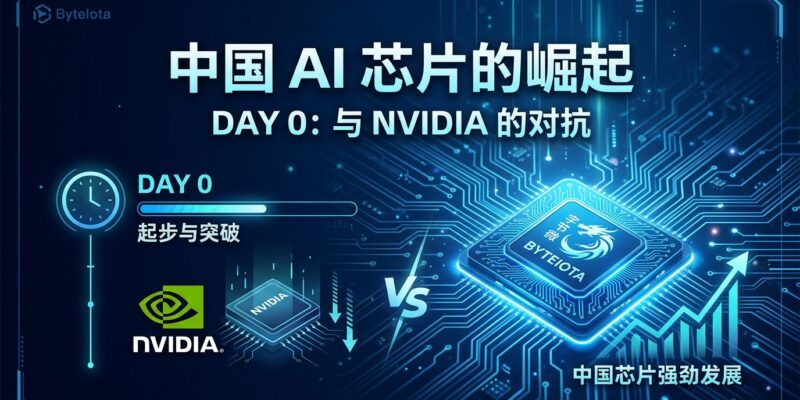
On April 29, Chinese AI chipmakers ran DeepSeek V4—a trillion-parameter model—on domestic chips the same day it launched. Huawei Ascend, Cambricon, Moore Threads, and Hygon achieved Day 0 adaptation, a capability previously exclusive to NVIDIA.
Day 0 readiness means Chinese developers can deploy cutting-edge models without waiting weeks for compatibility patches. With Beijing blocking NVIDIA H200 imports and $725 billion in global AI spending up for grabs, this could accelerate the shift from NVIDIA in China’s AI market.
What Day 0 Actually Means
NVIDIA’s advantage wasn’t just performance—it was timing. New models worked on NVIDIA GPUs from day one. Chinese chip vendors used to lag by weeks or months. By then, developers had committed to NVIDIA.
TrendForce reports the simultaneous support across Cambricon (vLLM framework), Moore Threads (MTT S5000), and Huawei (Ascend 950PR) shows Chinese AI chips reached technical maturity. Cambricon open-sourced their adaptation code on GitHub.
Chinese Chips Are Performance-Competitive
Huawei’s Ascend 950PR delivers 2.8x the performance of NVIDIA’s H20 (the only chip NVIDIA can sell in China) and includes CUDA-compatible software. Huawei holds 50% of China’s AI chip market, with Cambricon and Moore Threads gaining ground. NVIDIA’s share dropped below 50%.
The previous-generation 910C delivers 60-80% of H100 performance, and Chinese memory systems lag. But for training LLMs at scale, the gap is closing. Day 0 support, competitive performance, lower costs, and government backing make the value proposition obvious.
Beijing Blocks NVIDIA, $725B at Stake
The U.S. approved NVIDIA H200 sales to China in January. Four months later, NVIDIA sold zero. Beijing blocks imports to push domestic alternatives—only universities get limited H200 access.
Meta, Amazon, Microsoft, and Alphabet are spending $725 billion on AI infrastructure in 2026—77% more than last year. China’s portion now stays domestic.
Alibaba Cloud, Tencent Cloud, and ByteDance are shifting to Huawei, Cambricon, and Moore Threads. ByteDance ordered $5.6B in Huawei chips. Day 0 readiness removes any technical excuse to buy NVIDIA.
Outside China, NVIDIA dominates (80-90% share). Inside China, domestic chips take over. Two parallel ecosystems, and Day 0 drew the line.
Export Controls Backfired
U.S. export controls were meant to slow China’s AI progress. Instead, they accelerated domestic chip development. Day 0 proves the ecosystem thrives without NVIDIA.
Some controls work: chipmaking tool restrictions keep China on 7nm (NVIDIA uses TSMC 3nm). But Chinese AI models still advance. DeepSeek V4 scores 80.6% on SWE-bench (Claude: 80.8%), rates 3,206 on Codeforces (GPT-5.4: 3,168), and costs $3.48/MTok (Claude: $25).
NVIDIA CEO Jensen Huang said export controls “largely backfired.” A CFR report concluded “controls alone will not prevent China from developing advanced AI.” The policy created incentives to build an independent ecosystem. Day 0 validates it worked.
What It Means for Developers
If you’re building in China, Day 0 changes hardware decisions. Cambricon’s vLLM, Moore Threads’ turnkey solutions, and Huawei’s CUDA-compatible stack let you deploy new models on domestic chips immediately.
Outside China, NVIDIA dominates. But Chinese AI infrastructure is decoupling faster than expected. Day 0 wasn’t just technical—it proved Chinese chips compete on what matters: time to deployment.
The AI chip market split into two worlds. Day 0 drew the line.