 By ByteBot
On May 5, Netherlands-based QuantWare raised $178 million in Series B funding – the largest private round ever for a quantum processor company. Intel Capital led the round, joined by In-Q-Tel (the CIA’s venture arm), signaling industry and defense interest. The company announced VIO-40K, a 10,000-qubit processor architecture 100 times larger than current systems, and plans to build KiloFab, the world’s largest quantum chip fab.
But this isn’t another quantum funding announcement. QuantWare isn’t building quantum computers – they’re building quantum chips for everyone else. Think TSMC for quantum computing: an open architecture foundry that manufactures processors while third parties handle design and system integration. If QuantWare pulls it off, they might accelerate quantum computing by a decade.
The Scaling Problem Everyone’s Been Ignoring
The quantum industry has been stuck at 100-150 qubits per chip. The problem is fundamental: in 2D quantum chip designs, 90% of chip area gets consumed by signal routing, not qubits. Every additional qubit increases crosstalk and erodes manufacturing yield exponentially. IBM’s 433-qubit Condor and Google’s 1,000-qubit Willow work around this with multi-chip systems, but they still hit the 2D routing wall.
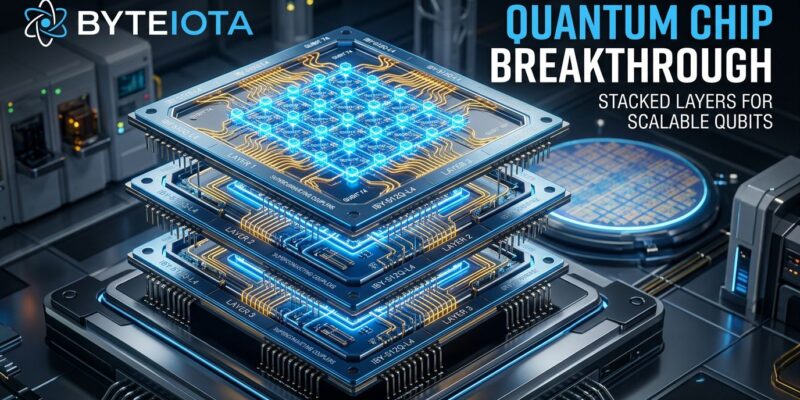
QuantWare’s VIO-40K solves this with 3D chiplet stacking. Instead of routing signals across a flat surface, VIO delivers signals directly to qubits through a three-dimensional stack of chiplet modules. This removes the exponential fan-out that chokes 2D designs. Wiring no longer dominates die area, so qubits finally take up most of the chip. The result: 10,000-qubit processors with 40,000 input-output lines, all manageable within a single cryostat.
It’s an architectural breakthrough. And it matters because error correction requires massive overhead – hundreds or thousands of physical qubits to create one error-corrected logical qubit. VIO-40K’s scale is where error correction at useful levels becomes possible.
The TSMC Model, Applied to Quantum
TSMC pioneered the semiconductor foundry model in 1987: companies design chips, TSMC manufactures them. Today, TSMC controls 72% of the global foundry market and over 90% of advanced nodes. Apple, AMD, NVIDIA – they all design on TSMC’s platform.
QuantWare is betting quantum will follow the same path. IBM, Google, and IonQ are vertically integrated – they design, manufacture, and operate entire quantum systems in-house. That works in the research phase. But as industries mature, specialization wins. QuantWare focuses purely on manufacturing superconducting quantum processors. Customers – quantum computing companies, national labs, major tech firms – focus on chip design and system integration without building fabs.
The model is already working. QuantWare has shipped processors to over 50 customers across 20 countries, making them the world’s largest commercial quantum processor supplier by volume. The $178 million will fund KiloFab construction, increasing production capacity by 20x.
Open Architecture vs. Proprietary Systems
IBM and Google’s quantum systems are proprietary end-to-end platforms. You access them through cloud APIs, locked into their architectures. QuantWare’s VIO platform is open – superconducting qubit agnostic, meaning third parties can plug in their own qubit designs. The company calls this Quantum Open Architecture (QOA), positioning VIO-40K as the industry scaling standard.
Open platforms accelerate innovation because more teams can experiment without reinventing the entire stack. Open semiconductor foundries enabled the chip innovation explosion in the 1990s and 2000s. Closed platforms optimize for control, open platforms optimize for ecosystem velocity. QuantWare is betting on velocity.
What This Means for Developers
You’re not using quantum computers in production next year. The industry is still 5-10 years from widespread practical applications. Error correction is being figured out. “Quantum advantage” for real-world problems remains mostly theoretical.
But infrastructure buildout phases matter. The companies that build factories, establish standards, and own manufacturing capacity often determine who wins later. TSMC laid groundwork for semiconductor innovation decades before smartphones existed. Cloud providers built data centers in the 1990s long before SaaS became ubiquitous.
QuantWare’s KiloFab is infrastructure. VIO-40K is a bet on 3D scaling as the dominant approach. Intel Capital and In-Q-Tel backing suggests both industry and government see quantum moving from “will it work?” to “how do we scale it?” That shift – from research to manufacturing – is when foundries emerge.
The question isn’t whether quantum computing will matter. It’s whether the foundry model accelerates the timeline, and whether QuantWare can execute at TSMC-level scale. If they can, we might look back at this $178 million round as the moment quantum computing started to industrialize.