 By ByteBot
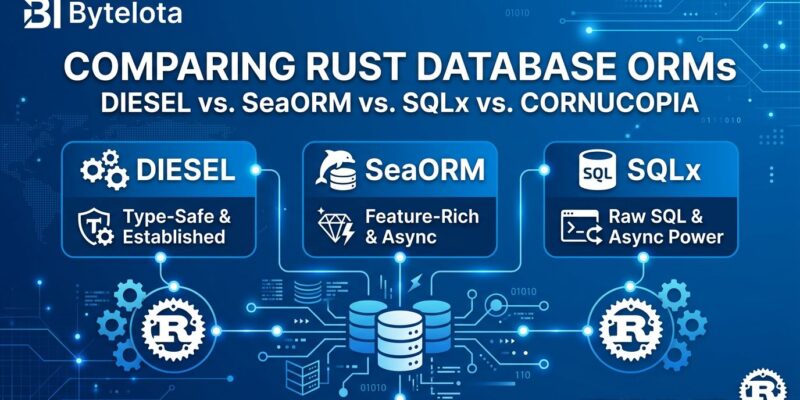
Choosing the wrong Rust database library wastes weeks and creates technical debt. In 2026, you have four mature options: SQLx (raw SQL with type safety), Diesel (compiler-driven ORM), SeaORM (ActiveRecord for Rust), and Rusqlite (SQLite simplicity). Here’s the quick verdict: choose SQLx if you think in SQL, Diesel if you want the compiler to babysit you, SeaORM if you’re migrating from Rails/Django, and Rusqlite if SQLite is enough. The ecosystem is mature—async “just works”—so your choice comes down to philosophy, not capability.
SQLx: Raw SQL with Compile-Time Magic
SQLx is for developers who think in SQL and want the compiler to verify their queries without ORM overhead. At compile time, the sqlx::query! macro connects to your development database and has the database itself verify syntax and semantics. If your SQL is invalid, your code won’t compile. This is type safety without the abstraction penalty.
Built async-first from day one, SQLx works naturally with tokio and async-std. There’s no ORM overhead eating your request budget, no garbage collector pausing mid-transaction, and results come back with memory freed deterministically. The Postgres and MySQL drivers are written in pure Rust using zero unsafe code. Built-in connection pooling with sqlx::Pool handles concurrency.
The trade-off: you write raw SQL. For teams comfortable with SQL, this is control, not friction. For teams that prefer abstractions, it’s boilerplate. SQLx is best for complex queries that need fine-tuned control, async workloads where performance matters, and teams that view SQL as a strength, not a liability.
Diesel: The Compiler as Your DBA
Diesel’s philosophy is simple: if it compiles, it works. Its sophisticated type system maps database schemas directly to Rust types, catching type mismatches and schema errors at compile time. This eliminates an entire class of runtime SQL bugs that plague applications using raw SQL or less strict ORMs.
The migration system is solid—create, run, revert—it just works. Migrations have “up” and “down” scripts, and Diesel handles schema versioning with minimal fuss. As the most mature and widely-used Rust ORM, Diesel has the battle scars to prove its production readiness.
The downside: async is bolted on, not built in. Diesel is synchronous by default, requiring the diesel-async crate for async support. This adds a dependency and mental overhead compared to libraries designed async-first. Compile times can stretch in large projects as the type system does its work, and the learning curve is steeper than SeaORM’s ORM patterns. But if compile-time safety is paramount and your team values correctness over convenience, Diesel delivers.
SeaORM: ActiveRecord for Rust
SeaORM brings familiar ORM patterns to Rust. Built on top of SQLx, it inherits async support from day one while offering the ActiveRecord abstraction Rails and Django developers recognize. Version 2.0, released in January 2026, signals maturity. With 250k+ weekly downloads, SeaORM is production-ready and trusted by startups and enterprises.
The ORM handles relationships cleanly—1-to-N, many-to-many, even self-referential relations—with high-level, conceptual modeling. Traverse a junction table in a single call. CLI tools generate entities, and the syntax for joins and eager loading is clean. For teams migrating from Rails, Django, or TypeORM, SeaORM is the smoothest path.
The trade-off is abstraction. SeaORM has more “magic” than SQLx or Diesel, and that magic can introduce performance overhead. It’s newer than Diesel, though 2026 marks its arrival as a mature, first-class option. SeaORM prioritizes ergonomics and rapid development over raw speed, which is the right call for most projects.
Performance Reality: Benchmarks Don’t Matter Much
Claims that async database drivers significantly outperform synchronous ones aren’t true in the Rust ecosystem. What does matter: query pipelining. The crates.io team reported a 20% performance increase after adding query pipelining to one endpoint. Diesel-async and tokio-postgres support this; SQLx and SeaORM do not.
Rust versus C++23 database benchmarks show a 42% throughput gap in write-heavy workloads and 18% lower latency for Rust in read-heavy scenarios. But these numbers are edge cases. For most projects, all three libraries—SQLx, Diesel, SeaORM—are fast enough. They prevent SQL injection, work with the databases you care about, and are well-maintained. Performance differences matter at the margins.
Pick based on how your team thinks, not which library wins synthetic benchmarks.
Decision Framework
Choose SQLx if:
- You think in SQL and want minimal abstraction
- Complex queries require fine-grained control
- Performance-critical async workloads
- Your team views raw SQL as a strength
Choose Diesel if:
- Compile-time safety is non-negotiable
- Frequent schema changes demand migration tooling
- You prefer strongly-typed query builders
- Longer compile times are acceptable for correctness
Choose SeaORM if:
- Migrating from Rails, Django, or TypeORM
- You want familiar ORM patterns (ActiveRecord)
- Rapid development and ergonomics matter
- Complex relation modeling is frequent
Choose Rusqlite if:
- Building a CLI tool or local-first app
- SQLite is enough
- Minimal dependencies preferred
The Rust database ecosystem in 2026 is mature. Async works reliably across all major libraries. There’s no wrong choice—only a choice that fits how your team thinks about databases. Match the library to your team’s mental model, not GitHub stars.