 By
By Platform engineering crossed the mandatory threshold in 2026. Gartner forecasts 80% of large software organizations will establish platform teams by year’s end, up from 55% in 2025. The industry is backing this mandate with money: median budgets doubled from $1M to $2M, while top-tier organizations allocate $5M-$10M. Platform engineering isn’t experimental DevOps evolution anymore. It’s mandatory enterprise infrastructure.
The Cognitive Load Crisis That Forced the Shift
For years, DevOps evangelized “shifting left” – pushing operational responsibilities earlier in the development pipeline. The idea sounded good. The execution created a nightmare.
Frontend engineers were forced to become Kubernetes experts. Backend developers navigated complex AWS IAM policies. IDEs turned into cockpits with 50 flashing warning lights. Shifting left shifted massive cognitive load onto individuals whose primary job was delivering business logic, not managing infrastructure.
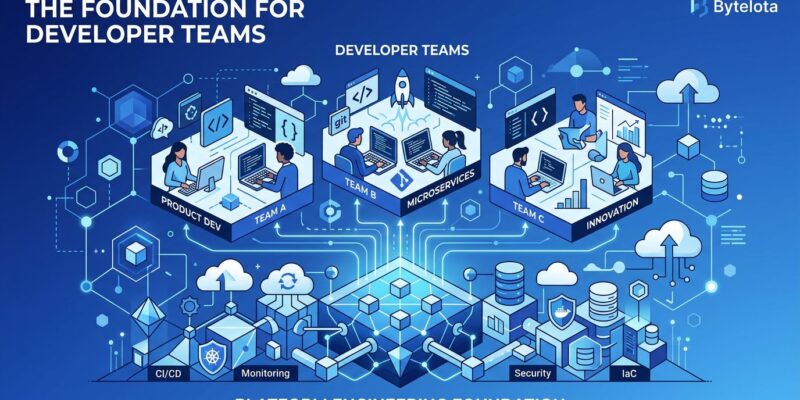
Google’s Richard Seroter introduced a better paradigm: shifting down. Instead of pushing complexity to developers, embed it in platforms. Dedicated platform teams provide self-service abstractions that hide infrastructure complexity. Developers focus on code. Platform engineers handle the operational substrate.
That’s not rebranding DevOps. That’s solving a real problem DevOps created at scale.
The Money Proves It’s Real
Budget numbers don’t lie. In 2025, 47.4% of platform teams operated on budgets below $1M – enough for reactive maintenance, not proactive innovation. By 2026, the median budget doubled to $2M, with top-tier organizations allocating $5M-$10M for comprehensive AI-augmented platforms.
This comes from the CNCF survey of 518 platform engineering practitioners. When median budgets double in a single year, that’s not hype. That’s enterprise CTOs committing serious resources to strategic infrastructure.
The interpretation is clear: Platform engineering transitioned from cost center to revenue enabler. Organizations recognize platforms as competitive advantages, not operational overhead. Gartner’s 80% adoption forecast isn’t optimistic projection – it’s industry reality backed by budgetary commitment.
AI and FinOps: The New Mandatory Stack
2026 platform engineering looks different than 2024 platform engineering. Two components moved from optional to mandatory: AI integration and FinOps.
On AI: 94% of organizations view AI as critical or important to platform engineering’s future. By 2026, AI proficiency became mandatory for platform engineers – not a specialization, but baseline competency. Teams face a dual mandate: augment platforms with AI capabilities while building platforms that enable AI workloads at scale. The challenge? 57% cite skill gaps as a barrier.
On FinOps: In 2026, FinOps is no longer optional – it’s a core component embedded into every stage of software delivery. 78% of FinOps practices report to CTO/CIO organizations, signaling FinOps is a technology capability tied to architecture and engineering, not finance reporting.
The paradigm shift matters: Instead of optimizing costs after bills arrive, organizations forecast costs before deployment. Infrastructure reviews include cost estimates alongside security reviews. Developers see cost estimates in Backstage or internal portals at decision time, not separate dashboards.
The impact is substantial. Organizations implementing complete FinOps frameworks achieve 30-50% cost savings. Yet 78% of companies still waste 21-50% of cloud spend. Platform engineering with embedded FinOps closes that gap.
Career Implications for Developers and DevOps Pros
Platform engineering roles are becoming some of the highest-paying and most strategic positions in 2026. DevOps professionals are transitioning. The skills required are evolving.
Must-haves: Kubernetes, Terraform or Pulumi, CI/CD knowledge, cloud platform expertise, Infrastructure as Code. Emerging requirements: AI literacy (survival-level competency), platform-as-product thinking, measurement literacy, data-driven decision making.
Platform engineering builds products for internal developers, while DevOps focuses on practices and culture. The role requires product management and user experience skills DevOps typically doesn’t emphasize. Platform engineering has distinct specializations now – no longer a monolithic “platform engineer” title.
For developers, this means reduced cognitive load and better tooling. For DevOps professionals, it means career evolution into higher-paying strategic roles. For organizations, it means competitive necessity.
Real-World Proof at Scale
This isn’t theoretical. Shopify’s platform supports millions of e-commerce businesses with flexible APIs and infrastructure handling peak traffic during major sales events. Uber’s platform processes real-time data matching riders with drivers using microservices architecture, Apache Kafka event streaming, and AI-driven demand prediction. Bell modernized its platform engineering and CI/CD infrastructure, delivering zero-downtime deployments with enhanced observability.
The pattern is consistent: Platform engineering abstracts infrastructure complexities, provides self-service capabilities, and lets developers focus on features instead of operational burden.
The Bottom Line
Platform engineering is DevOps 2.0, not just rebranding. 2026 marks mandatory adoption for enterprise competitiveness. The evidence is clear: Gartner’s 80% forecast, budgets doubling to $2M median, 94% viewing AI integration as critical, and FinOps embedded into software delivery lifecycles.
Developers benefit from reduced toil and better tooling. Platform engineers command higher salaries for strategic roles. Organizations gain competitive advantages through self-service platforms enabling faster delivery.
The challenges are real – 57% face AI skill gaps, smaller teams question $2M budgets, and the transition from DevOps to platform engineering requires new competencies. But the industry has spoken with budgetary commitment: Platform engineering is no longer optional infrastructure. It’s the new enterprise standard.