 By ByteBot
Maine became the first state to ban large data center construction on April 9, 2026, passing LD 307 to halt facilities over 20 megawatts until November 2027. Eleven more states are considering similar measures while Bernie Sanders and AOC’s federal bill would pause all AI data center construction nationwide. With $64 billion in projects already blocked by 140+ local opposition groups, this isn’t a fringe movement. It’s a coordinated infrastructure restriction that will reshape cloud pricing, compute availability, and where you can build.
The Restriction Wave Hits Three Levels
Data center bans aren’t isolated to one jurisdiction or political faction. They’re spreading systematically across federal, state, and local governments.
At the federal level, Sanders and AOC introduced the Artificial Intelligence Data Center Moratorium Act on March 25, 2026. It would pause all AI data center construction nationwide until Congress passes “comprehensive AI legislation” with safeguards for job displacement, utility rate protection, and union labor requirements. The bill faces bipartisan opposition in Congress, with Senator John Fetterman calling it a “surrender flag to China,” but it signals growing political pressure on tech infrastructure.
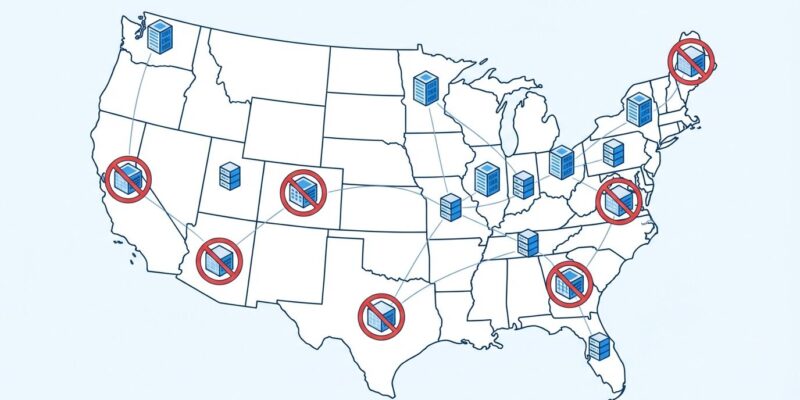
State restrictions are gaining more traction. Maine’s LD 307 passed the legislature with votes of 82-62 in the House and 19-13 in the Senate. The law bans data centers larger than 20 megawatts until November 2027 and creates a 13-member coordination council to develop long-term policy. Eleven more states are actively considering similar measures, including Georgia, Pennsylvania, Virginia, New York, South Carolina, Oklahoma, and Vermont. This crosses partisan lines: red and blue states alike are reassessing unlimited data center growth.
Local opposition moves fastest. More than 140 community groups have blocked or delayed $64 billion in data center projects. Between May 2024 and June 2025 alone, 36 facilities representing $162 billion in investment were stopped at the municipal or county level. Bangor, Wiscasset, and Lewiston in Maine all shut down proposals before the state passed its ban. Virginia counties are implementing their own restrictions despite being the largest data center market in the country.
Why Bans Have Bipartisan Momentum
The environmental and resource arguments aren’t abstract. Communities are experiencing real infrastructure strain.
U.S. data centers consume 176 terawatt-hours of electricity annually, about 4.4% of the nation’s total power. That figure is projected to hit 12% by 2028. In Loudoun County, Virginia—the world’s largest data center market—facilities account for 24% of power consumption compared to 18% for all residential use. A single AI-focused data center can draw as much electricity as 100,000 households.
Water consumption compounds the pressure. Direct water use by data centers is about 17 billion gallons per year, but indirect consumption from electricity generation reaches 211 billion gallons. That’s projected to double or quadruple by 2028 as AI workloads expand. Each AI data center can require 5 million gallons daily for cooling. In The Dalles, Oregon, Google’s water use increased 316% while the town’s population grew 12%.
Utility rate increases follow. Carnegie Mellon University research estimates data centers and cryptocurrency mining could increase average U.S. electricity bills by 8% by 2030, potentially exceeding 25% in high-demand markets like Northern Virginia. Residents in data center corridors are already seeing the impact. That creates durable political coalitions across the spectrum: environmental advocates, fiscal conservatives worried about subsidies, and residents facing higher bills all support restrictions.
The environmental justice angle matters too. A national review of roughly 700 data centers found nearly half are located in census tracts with above-median environmental burdens, including air pollution, water pollution, and reduced park access. These aren’t just NIMBYism complaints. They’re resource allocation conflicts in constrained infrastructure systems.
Developer Infrastructure Impact Is Already Here
Cloud providers are hitting capacity walls even as they pour hundreds of billions into expansion. Microsoft faces Azure capacity constraints extending into 2026, limiting new subscriptions in key U.S. hubs. The company acknowledged in filings that “community opposition, local moratoriums, and hyper-local dissent” now represent operational risks. Despite AWS allocating $200 billion in capital expenditure this year, Microsoft spending $37.5 billion per quarter, and Google raising 2026 capex guidance to $175-185 billion, infrastructure can’t keep pace with demand.
Pricing reflects the squeeze. OVH Cloud projects 5-10% price increases between April and September 2026. Colocation lease rates have surged 20-35% year-over-year. Hyperscalers now pre-lease 70-90% of new data center capacity before construction even begins, crowding out mid-market enterprises and startups. Developers rarely build on spec anymore—they sell properties after securing power allocation because zoning battles are too risky.
The GPU shortage compounds everything. Data center GPUs are sold out for months, with lead times stretching 36-52 weeks. HBM memory production is fully allocated through 2026. TSMC’s CoWoS packaging process, required to bond memory dies onto GPU substrates, is booked through mid-2027. GPU rental prices spiked 48% in just 60 days. Global AI operational expenditure is projected to exceed $500 billion in 2026, a 300% increase from 2024. Hyperscalers placed multi-billion-dollar forward orders for Blackwell GPUs that consumed most available allocation through 2027.
The bottleneck has shifted from software to hardware. Startups now compete on access to infrastructure, not speed of iteration. If you can’t get compute capacity, architectural decisions and code quality are irrelevant.
The Economic Arguments Don’t Add Up
Tech industry opposition focuses on jobs and tax revenue, but the math is complicated. Data centers generate substantial construction employment: about 1,500 workers per facility over a 1-5 year build period. Once operational, staffing drops to 100-200 permanent jobs for specialized trades and engineering roles.
Tax incentives undermine the economic development pitch. Virginia gave up $1.6 billion in sales and use tax revenue from data centers in 2025, an 118% increase year-over-year. Georgia is expected to lose at least $2.5 billion to data center sales tax exemptions in 2026, 664% higher than the state’s previous estimate. Across 16 states that report totals, nearly $6 billion in sales tax exemptions have been granted over five years. In some cases, subsidies reach $6.4 million per permanent job created.
States are reassessing whether that return justifies lost revenue, electricity demand, and environmental impact. The construction boom supports 4.7 million U.S. jobs currently, but the operational phase requires far fewer workers. That imbalance makes the “economic development” argument less persuasive to legislators facing constituent complaints about utility bills and water stress.
What Developers Should Do
This trend accelerates, it doesn’t reverse. The political coalition behind restrictions is too diverse and motivated by real resource constraints. Cloud infrastructure will fragment regionally, with permissive jurisdictions gaining investment while restrictive ones see capacity stagnation.
Infrastructure planning now requires regional strategy. Cloud pricing and availability will diverge based on local regulations. Multi-cloud approaches hedge against single-region constraints. Edge computing gains practical advantages as smaller, distributed facilities face fewer political obstacles than hyperscale concentrations.
Cost optimization becomes critical. The combination of restricted capacity growth and surging demand creates scarcity premiums. Budget for 5-10% annual cloud price increases and plan infrastructure around availability risk, not just technical requirements.
The federal-versus-state battle will continue through 2026-2027, but the momentum favors restrictions. Even if the Sanders-AOC bill fails, state and local bans are proliferating faster than federal preemption efforts. Cloud providers will shift investment to Texas, Arizona, Nevada, and international locations. Domestic capacity in restrictive jurisdictions will command premium pricing.
Infrastructure access is now a competitive advantage. If your startup’s success depends on scaling compute-intensive workloads, vendor relationships and regional planning matter as much as your architecture. The days of infinite cloud elasticity at commodity prices are ending. Adapt accordingly.