 By ByteBot
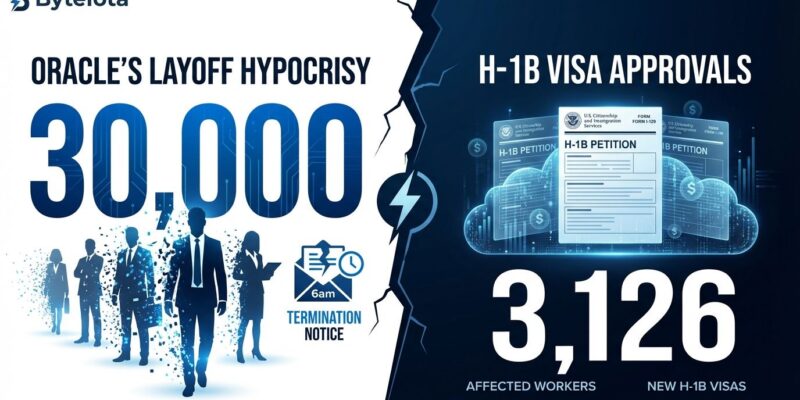
Oracle fired 20,000-30,000 employees on April 1, 2026, via a cold 6am email with zero warning. System access was revoked immediately. The same company filed 3,126 H-1B visa petitions across fiscal years 2025-2026, including 436 petitions in 2026 alone. If you’re firing 30,000 people, you don’t have a talent shortage. You have a cost-cutting strategy dressed up as immigration policy.
The contradiction exposes tech’s “talent shortage” narrative for what it is: corporate doublespeak. Companies claim they need foreign workers to fill critical gaps while simultaneously firing tens of thousands of existing employees. The math doesn’t lie. Oracle doesn’t need more workers—it needs cheaper workers.
The Numbers Expose the Lie
Oracle eliminated 18% of its global workforce—roughly 30,000 employees across the US, India, Canada, and Mexico. Meanwhile, the company filed 3,126 H-1B visa petitions during the same period, with 436 petitions submitted in 2026 alone. That’s not a talent shortage. That’s labor arbitrage.
Moreover, Oracle isn’t alone. Amazon filed 21,696 H-1B petitions while cutting 30,000 jobs across two layoff rounds. The pattern is clear across Big Tech: fire American workers, claim talent shortages, file H-1B petitions for cheaper replacements. The “talent shortage” myth crumbles when you look at the numbers. These companies don’t need more engineers—they need lower costs.
H-1B Is Wage Suppression, Not Talent Acquisition
Research from the Economic Policy Institute reveals the truth: H-1B workers earn 16% less than comparable Americans, saving employers nearly $100,000 over a six-year visa term. Furthermore, 60% of H-1B positions are paid below the local median wage. This isn’t about filling skills gaps—it’s about cutting labor costs.
The H-1B visa creates structural exploitation. It’s tied to the employer, so workers can’t easily quit or negotiate. Fired H-1B holders have 60 days to find a new sponsor or face deportation. That power imbalance gives companies enormous leverage to pay less while claiming they’re addressing talent shortages. As the Heritage Foundation documented, H-1B’s “exploitative features—from its arbitrary lottery system to its wage-level manipulations—were not design flaws, but deliberate mechanisms serving labor arbitrage.”
Consider this: The top 30 H-1B employers hired 34,000 new H-1B workers in 2022 while laying off more than 85,000 workers during the same period. That’s not talent acquisition. That’s wage suppression.
The 6am Email
Oracle’s execution was as cold as the numbers. Employees across multiple time zones received identical termination emails at 6am local time. The subject line read “Important information”—not “termination notice.” The message stated “Today is your last working day” with no prior warning, no meetings, no explanation. System access was revoked within minutes.
The email came from “Oracle Leadership”—not individual managers or HR representatives, just a faceless corporate entity. Thousands of workers woke up to find themselves unemployed. No respect, no humanity, just a 6am email. This is how tech companies treat workers they claim are their “most valuable asset.” The execution reveals the truth: workers are costs to be minimized, not people to be valued.
Both Workers Are Victims
American workers lose their jobs while H-1B holders face deportation. Oracle’s layoffs hit approximately 12,000 employees in India, many on H-1B visas. These workers have 60 days to find a new sponsor or leave the US. Families are uprooted, green card applications stalled, years of immigration backlog waiting lost in an instant.
The system pits workers against each other while corporations profit from both groups’ vulnerability. H-1B holders can’t negotiate effectively because their visas depend on their employers. American workers face wage pressure from cheaper H-1B labor. Both lose. Only the corporations win.
This isn’t “American workers versus immigrants.” It’s workers versus corporate exploitation. Tech companies have successfully deflected criticism by framing H-1B debates as immigration policy rather than labor policy. The real issue is companies using visa programs to suppress wages and treat all workers—American and foreign alike—as disposable resources.
The Real Reason: $8-10 Billion for AI
Oracle needs the money. According to TD Cowen analysis, these layoffs will free up $8-10 billion in cash flow—funds Oracle desperately needs to service debt from its aggressive AI infrastructure buildout. The company has borrowed heavily to compete in the AI arms race and needs to cut costs immediately.
This has nothing to do with performance or productivity. It’s pure financial engineering: fire workers, stop paying salaries, redirect cash to AI data centers. Oracle chose to invest in infrastructure while cutting the humans who built the company. The H-1B hypocrisy is just cost-optimization icing on top—replace expensive workers with cheaper alternatives while claiming it’s about innovation.
Key Takeaways
- Oracle fired 30,000 employees while filing 3,126 H-1B visa petitions during the same period—exposing the “talent shortage” claim as corporate doublespeak for wage suppression
- H-1B workers earn 16% less than comparable Americans, with 60% of positions paid below local median wages, saving employers ~$100,000 per worker over six years
- This pattern extends across Big Tech: Amazon filed 21,696 H-1B petitions while cutting 30,000 jobs, revealing systematic labor arbitrage disguised as talent acquisition
- Both American workers and H-1B holders are victims of corporate exploitation—the system pits workers against each other while companies profit from wage suppression and visa-dependent leverage
- Oracle’s 6am termination emails and immediate access revocation demonstrate how tech companies treat workers as disposable costs, not valued assets
Next time you hear a tech company claim “talent shortage,” ask how many people they fired last quarter. The contradiction tells you everything you need to know.