 By
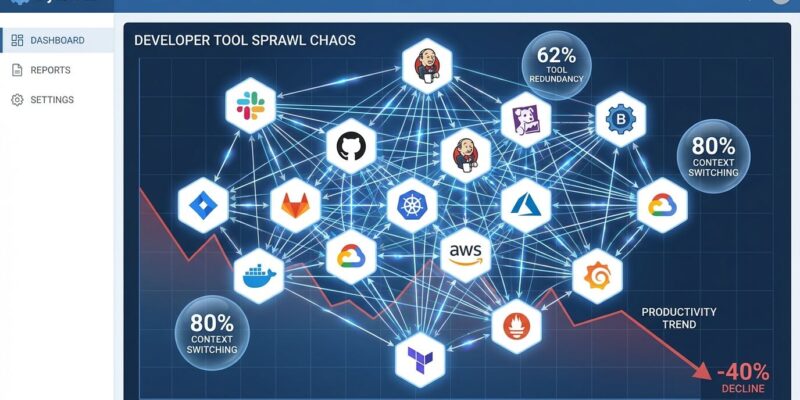
By Developers juggle an average of 14 tools daily—context switching between Slack, Jira, GitHub, Jenkins, Datadog, and a dozen others—costing up to 40% of productive time according to University of Michigan research. This developer tool sprawl has reached critical mass in 2026: 62% of executives now prioritize tool consolidation as a top business imperative, driving the software development tools market from $6.41 billion in 2025 to a projected $15.72 billion by 2031. Gartner predicts 80% of large organizations will establish platform engineering teams by year-end as the primary solution. However, the cure may be as complex as the disease.
The 40% Productivity Tax
The cost of tool fragmentation isn’t just annoying—it’s measurably destroying developer productivity. Research by David Meyer at the University of Michigan found that task switching costs up to 40% of productive time when switches are frequent. Moreover, nearly 1 in 5 workers now switch between apps or platforms over 100 times in a single workday.
For developers, this manifests as cognitive load compounded across every tool interface, notification stream, and context switch. According to Sweller’s cognitive load theory, each additional tool consumes cognitive resources without contributing to actual development work. Furthermore, the typical workflow looks like this: check Slack for notifications, pull tasks from Jira, write code in VSCode with GitHub Copilot, run tests in Jenkins, monitor logs in Splunk, track performance in Datadog, scan security in Snyk, deploy via Spinnaker, manage incidents in PagerDuty, update documentation in Confluence, review metrics in Grafana, and coordinate across Zoom or Teams. Consequently, that’s 100+ daily context switches, with 69% of engineering leaders reporting fragmented toolchains actively slow productivity.
The $7B Consolidation Wave Reshapes Development
The software development tools market reveals a paradox: it’s growing 16.12% annually from $6.41 billion in 2025 to a projected $15.72 billion by 2031, driven simultaneously by vendor proliferation AND platform consolidation. Executives are voting with their budgets—62% of C-level leaders now prioritize tool consolidation as a top business imperative.
Gartner predicts 80% of large software engineering organizations will establish platform engineering teams by the end of 2026, up from 45% in 2022. Additionally, over 65% of enterprises have already built or adopted Internal Developer Platforms (IDPs). Early adopters report compelling ROI: companies using IDPs deliver updates 40% faster and cut operational overhead nearly in half.
Real-world success stories back up the promise. A global pharmaceutical company consolidated over 6,000 CI/CD stages from TeamCity and Azure DevOps into just 300 pipelines within a unified Enterprise DevSecOps platform. Similarly, e-commerce company Klaviyo’s CTO Surabhi Gupta credited their Cortex IDP as a core part of their strategy for handling Black Friday Cyber Monday scale across hundreds of services. Meanwhile, a Fortune 500 company saw security incidents drop 55% in the first quarter after implementing Harness IDP with Open Policy Agent integration.
The market momentum is clear: platform engineering is becoming standard practice, not a trend.
Platform Maintenance Traps Nobody Discusses
Here’s the part vendor pitches skip: while 35.2% of organizations deliver measurable value within 6 months, 40.9% cannot demonstrate platform engineering ROI within 12 months. The consolidation promise hits reality hard.
Canva’s experience with Backstage, the open-source Internal Developer Platform, illustrates the hidden cost. Their platform team became “bogged down maintaining the platform itself” instead of shipping features. Indeed, building an IDP isn’t a one-time project—it’s a full-time product job requiring 2-6% of total engineering headcount. That’s not trivial for mid-sized organizations.
Migration reality adds another layer of complexity. Tool consolidation is slow in practice. Even when teams adopt new unified platforms for new services, legacy systems “rarely disappear overnight” and continue running critical pipelines for years. As a result, this creates hybrid sprawl—14 tools PLUS a platform to maintain.
Meanwhile, 86% of engineering leaders remain uncertain which tools provide the most benefit, and 40% lack data on adoption and impact to build a coherent ROI story. Platform engineering promises simplification but often trades 14-tool sprawl for platform complexity that requires its own dedicated team.
AI Tool Fatigue Accelerates the Crisis
Product Hunt now lists over 30 new AI tools daily, with 5-10 developer-focused launches every single day. GitHub Copilot’s revenue hit $400 million in 2025 with 248% year-over-year growth, illustrating how AI assistants shifted from novelty to core productivity layer. Nearly half of engineering leaders allocate 1-3% of their total budgets just for AI tools, with per-developer costs ranging from $500 to over $3,000 annually.
Developer sentiment tells the story bluntly: “Too many tools, too many dashboards, too many half-working automations.” Furthermore, the act of constantly evaluating new AI tools is itself a form of work nobody accounts for. The developers thriving in 2026 aren’t the ones trying everything—they’re the ones who picked something, committed to it, and spent their evaluation time actually building instead.
History suggests a pattern. JavaScript fatigue in 2016 led to consolidation around React, Vue, and Angular. NoSQL hype in 2013 ultimately drove developers back to Postgres. AI tool fatigue is following the same trajectory toward inevitable consolidation.
Build vs Buy: Platform Engineering Paths
Organizations face a strategic decision between building custom platforms, buying commercial IDPs, or leveraging cloud-native solutions. Each path carries distinct trade-offs.
DIY platforms using open-source frameworks like Backstage offer full control and customization but require dedicated platform teams to avoid the Canva maintenance trap. In contrast, commercial IDPs like Cortex, Port, and Humanitec provide faster time-to-value with vendor support, at the cost of subscription fees and potential lock-in. Meanwhile, cloud-native solutions from AWS, Azure, or GCP offer deep integration with managed services but create mega-vendor dependency.
Mid-sized organizations increasingly choose commercial IDPs for speed, while enterprises with over 1,000 engineers build custom platforms. A mid-sized fintech company’s phased approach illustrates the typical pattern: start with CI/CD automation using Spinnaker, add a service catalog, layer in governance tools, then integrate observability. The full migration takes 6-18 months, not weeks.
The decision criteria come down to team size, available resources, and customization requirements. Organizations under 500 engineers generally benefit from commercial platforms. Larger enterprises with unique workflows and platform engineering expertise can justify the 2-6% headcount investment for custom builds.
Simplification or Vendor Lock-In?
Platform engineering promises ruthless simplification, and the data shows it can deliver. However, the fundamental question remains: does tool consolidation solve developer productivity, or does it trade 14-tool sprawl for dependency on mega-vendors who control pricing, features, and roadmaps?
Cloud providers are building native IDPs—AWS App Runner, Azure DevOps, GCP Cloud Build. The consolidation is consolidating. As one platform engineering advocate put it, “Better output coming from ruthless simplification, not more tools.” True. Nevertheless, unified platforms improve developer experience through standardization while simultaneously creating single points of vendor control.
The observability space illustrates the trend: fragmented tools for logs, metrics, and traces are consolidating into unified platforms. CI/CD tools like CloudBees Unify are creating “single control planes” across enterprise toolchains. The pattern is consistent across every development category.
Platforms won’t eliminate tools—they’ll become abstraction layers over a fragmented landscape that persists underneath. The 14-tool problem gets hidden, not solved. Whether that’s worth the trade-off depends on your tolerance for vendor dependency and your confidence that platform ROI will materialize within 12 months.