 By ByteBot
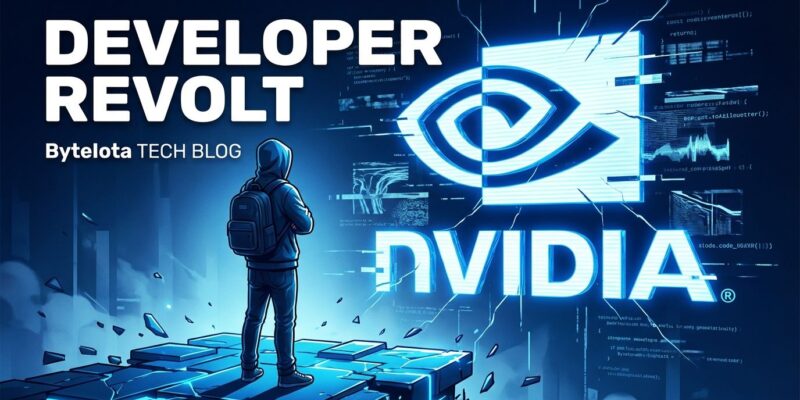
NVIDIA announced DLSS 5 at GTC 2026 on March 16, introducing “neural rendering” that uses generative AI to rewrite game graphics—altering lighting, materials, and even character faces. Game developers from Capcom, Ubisoft, and indie studios responded with universal condemnation. New Blood CEO Dave Oshry called for a boycott: “Cripple their sales, tank their stock price.” Gamers immediately labeled it “AI slop” and the “yassification of video games.” When NVIDIA CEO Jensen Huang dismissed critics as “completely wrong,” he proved exactly what developers feared: NVIDIA doesn’t understand that consent comes before control.
This isn’t about performance features like upscaling or frame generation. DLSS 5 crossed a fundamental line—it rewrites artistic vision without permission. This is gaming’s moment to join writers, artists, and musicians in fighting AI companies that see creative work as raw material to “improve.”
DLSS 5 Isn’t Performance Tech, It’s Artistic Override
DLSS 5 is fundamentally different from what came before. DLSS 1-3 did upscaling—render at low resolution, let AI upscale to high. DLSS 4-4.5 added frame generation—AI creates intermediate frames for smoother motion. Those are performance features. DLSS 5 introduces “neural rendering”—AI directly rewrites lighting, materials, textures, and character appearances in real-time. It’s not enhancing performance. It’s replacing artistic choices with AI’s idea of “photorealism.”
NVIDIA’s GTC demos showed the problem clearly. In Resident Evil Requiem, character Grace Ashcroft received AI-smoothed skin, poutier lips, and hollower cheeks. Hogwarts Legacy’s stylized fantasy lighting got replaced with photorealistic “studio photoshoot” lighting that creates uncanny valley. A Starfield character received what Futurism called a “grotesque giga-nostril.” All games start looking the same: smooth, shiny, generic.
Horror games use dark, moody lighting for atmosphere. Fantasy games use stylized lighting for wonder. DLSS 5 erases these deliberate choices and replaces them with AI homogenization. Artists spend years crafting visual tone—NVIDIA’s AI undoes that work in milliseconds. As PC Gamer documented, DLSS 5 clearly overwrites game characters with AI beauty standards.
Capcom and Ubisoft Devs Found Out When You Did
Capcom and Ubisoft developers learned their games were being used in NVIDIA’s DLSS 5 demos at the same time as the public. No one asked permission. No one told the artists their work would be rewritten by AI on a global stage. A Ubisoft developer stated bluntly: “We found out at the same time as everyone else.” Capcom developers were “shocked,” especially since Capcom is historically “anti-AI.”
Consent is not optional. You don’t rewrite someone else’s artistic work without asking first. NVIDIA’s approach shows they see games as raw material for AI enhancement, not as complete creative works deserving respect. Kotaku interviewed multiple game developers and the unanimous response was hatred: “We spoke to game devs and all of them hate DLSS 5: ‘What the f***, Nvidia?'”
Every single developer said they were offended by NVIDIA overwriting artists’ work without consent. This isn’t just technical disagreement—it’s a violation of professional respect and artistic integrity.
From Indie to AAA, Devs United: ‘Cripple Their Sales’
New Blood Interactive CEO Dave Oshry issued the most direct call to action: “The only thing we can do besides calling them out on it and making them feel bad is voting with our wallets. Cripple their sales, tank their stock price. Stop collaborating with them as developers.” He compared the fight to past battles against NFTs, crypto games, and predatory monetization—all of which the industry successfully pushed back against.
Indie developer Guselect warned: “Bad ending: now every game is AI slop.” Industry artist Karla Ortiz called NVIDIA’s approach “so disrespectful to the intentional art direction of devs. If devs wanted to lean in to hyper realism, they would.”
The backlash spans the entire industry spectrum—from indie developers to AAA studio teams, from artists to programmers. There are no public defenders of DLSS 5 among game developers. This is rare industry unity against a common threat: AI companies overwriting creative work without permission. When indie and AAA developers unite on something, it matters. As PC Gamer reported, this boycott isn’t just rhetoric—if major studios refuse DLSS 5 integration, NVIDIA’s fall 2026 launch could be a PR disaster.
Jensen Huang: ‘You’re Completely Wrong’ (He’s Wrong)
NVIDIA CEO Jensen Huang responded to the backlash by saying critics are “completely wrong” and claiming developers retain “artistic control” through fine-tuning settings. Later, he tried to soften the message: “I don’t love AI slop myself…that’s just not what DLSS 5 is trying to do.” But the damage was done—his initial dismissal confirmed exactly what developers feared.
Huang’s “completely wrong” response is a textbook corporate dismissal of creative workers’ concerns. Claiming developers have “artistic control” is meaningless when they weren’t asked if they wanted DLSS 5 applied to their games in the first place. Control after the fact is not the same as consent before public demonstration. Settings don’t matter if the premise is wrong.
This response reveals the core problem with AI companies and creative control. They don’t see rewriting art as requiring permission—they see it as offering a feature with settings. This attitude is why writers, artists, musicians, and now game developers are all fighting the same battle against the same corporate mindset. Tom’s Hardware covered Huang’s dismissive stance in detail.
Gaming’s AI Moment: Win This or Lose Artistic Control
Writers have been fighting AI companies training on books without permission. Visual artists have been fighting AI generators trained on their portfolios without consent. Musicians have been fighting AI music tools trained on their songs without licensing. Now game developers are joining this fight—because DLSS 5 follows the same pattern: AI companies see creative work as raw material to “improve,” not as art that deserves respect and requires consent.
The language gamers and developers are using—”AI slop,” “yassification,” “garbage AI filter”—is the same language other creative communities use. They recognize this as part of a broader battle over who controls creative work: the artists who made it, or the AI companies selling “enhancement” tools.
If NVIDIA wins this battle—if DLSS 5 ships widely and becomes normalized—it sets a precedent for all creative industries. Your art is not yours to control once it’s public. AI companies can “enhance” it without asking. As EarlyMeta’s analysis argues, this controversy isn’t about the tech—it’s about who decides what your games look like.
This is why the developer boycott must succeed. This moment matters beyond gaming.
What Needs to Happen
The path forward is clear. Developers should refuse DLSS 5 integration and stick with DLSS 4.5’s performance features—upscaling and frame generation without artistic override. Gamers should disable DLSS 5 in settings and voice opposition through reviews and social media. The industry needs to establish standards: consent is mandatory before AI alters creative work.
NVIDIA should listen to developers or face boycott consequences. The fall 2026 launch is still months away. There’s time to reverse course, make DLSS 5 strictly opt-in, and respect that artistic decisions are final. But if NVIDIA proceeds as planned, the revolt is justified.
The developers are right. The revolt should succeed.
Key Takeaways
- DLSS 5 crosses from performance enhancement to artistic override—using neural rendering to rewrite lighting, materials, and character faces without developer consent
- Capcom and Ubisoft developers were blindsided by NVIDIA’s announcement, learning their games would be altered by AI at the same time as the public
- Industry unity spans indie to AAA: New Blood CEO Dave Oshry calls for boycott, warning “cripple their sales, tank their stock price”
- Jensen Huang’s dismissive “completely wrong” response proves developers’ fears—NVIDIA doesn’t understand consent comes before control settings
- This is gaming joining writers, artists, and musicians in fighting AI companies that see creative work as raw material to “improve” without permission
- If NVIDIA wins, the precedent threatens all creative industries—your art becomes subject to AI “enhancement” without your control