 By ByteBot
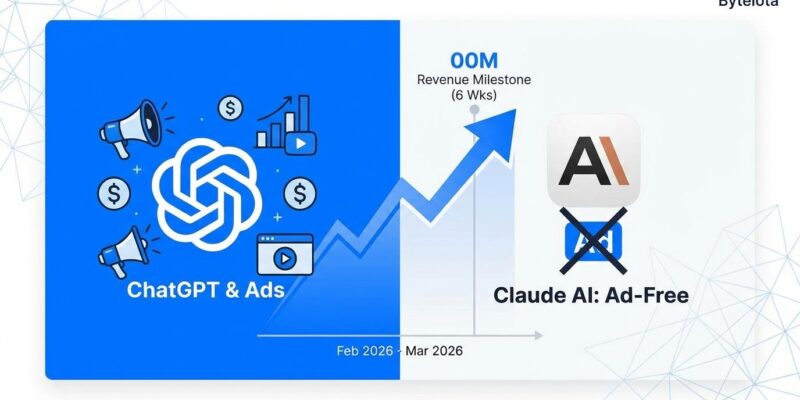
OpenAI’s advertising pilot in ChatGPT hit $100 million in annualized revenue just six weeks after launch, the company announced Wednesday. More than 600 advertisers signed up between the February 9 pilot launch and the March 26 milestone—a revenue ramp that came weeks after Anthropic aired Super Bowl commercials mocking ChatGPT for showing ads and promising Claude would “never” have them.
The irony is hard to miss. Anthropic bet its brand on refusing ads. OpenAI bet on ads working. Six weeks later, OpenAI’s making $100 million while Claude’s subscription-only model looks increasingly naive.
The Numbers: $100M in 6 Weeks Validates AI Ads
OpenAI surpassed $100 million in annual recurring revenue from ChatGPT ads in under two months, with over 600 advertisers in the pilot program. Moreover, the company plans global expansion and self-serve advertising tools in April, moving beyond the current U.S.-only pilot.
Truist analysts predict OpenAI will generate under $1 billion in ad revenue this year, growing to over $30 billion by 2030. The firm called 2026 an “inflection year” for large language model-powered ads, positioning LLM advertising alongside Search, Social, and Retail Media as core digital ad pillars. For context, $100 million in six weeks is among the fastest ad revenue ramps in recent tech history.
The advertiser ecosystem includes three of the world’s largest ad agencies: WPP, Omnicom, and Dentsu. Despite frustrations about slow rollout and limited measurement tools, advertisers are betting on ChatGPT’s 800 million weekly users and unprecedented conversational intent data. The demand signal is clear.
The Claude Contrast: Super Bowl Mockery Meets Reality
Anthropic aired Super Bowl commercials on February 4—five days before ChatGPT ads launched—with the tagline “Ads are coming to AI. But not to Claude.” The darkly comedic spots featured users seeking advice from AI chatbots, only to be steered toward “cougar” dating sites and height-boosting insoles. Anthropic’s message: we’re the ethical alternative that won’t corrupt answers with advertising.
However, OpenAI CEO Sam Altman publicly responded to the campaign, and now the $100 million milestone provides his answer. Anthropic positioned itself on the moral high ground. OpenAI chose the profitable ground. The business results speak for themselves.
Furthermore, the competitive split is stark. OpenAI can subsidize its free tier indefinitely with ad revenue while maintaining premium ad-free tiers at $20/month (Plus) and $200/month (Pro). Claude must convince users to pay $20/month when a comparable free ChatGPT exists—albeit with occasional ads. Anthropic’s “no ads ever” promise constrains its business model while OpenAI monetizes 95% of users who won’t pay for subscriptions.
How ChatGPT Ads Work (And Who Sees Them)
Ads appear at the bottom of ChatGPT responses, clearly labeled as “sponsored” and visually separated from the AI-generated answer. OpenAI shows ads to Free and Go tier users only—85% of U.S. users are eligible, though less than 20% see them on any given day. Plus, Pro, Business, Enterprise, and Edu accounts remain ad-free. Additionally, no one under 18 sees ads, and they don’t appear near politics, health, or mental health topics.
The targeting approach is novel: ads combine “intent signal from what someone just asked” with “behavioral context from chat history and saved memories”—a combination that hasn’t existed before in advertising. Users can opt out of personalized targeting (they’ll still see contextual ads), dismiss ads, view why they saw specific ads, and manage personalization settings.
Consequently, OpenAI promises ads run on “separate systems from the chat model,” meaning advertisers have “no ability to shape, rank, or alter ChatGPT’s responses.” Whether those promises hold as ad revenue scales to billions is the billion-dollar question. Google made similar promises about search ads two decades ago.
Are Ads in AI Inevitable?
Every major platform eventually adds ads. Google, Facebook, Twitter, YouTube—all started free or minimally monetized, then introduced advertising as user bases grew. OpenAI’s $100 million in six weeks suggests AI platforms are following the same path.
The financial reality is simple: AI infrastructure is expensive. OpenAI reportedly has $1.4 trillion in infrastructure commitments, and only 5% of ChatGPT users pay for subscriptions. CFO Sarah Friar explicitly noted ad revenue could help “offset losses and reassure stakeholders.” Anthropic faces the same cost pressures but has limited its revenue options to enterprise contracts and subscriptions. As competitors make billions from ads, that constraint becomes harder to defend.
In conclusion, Claude’s “no ads ever” promise is idealistic, but it’s probably unsustainable. Perplexity is exploring ads. Google Gemini sits within Google’s ad ecosystem. Microsoft Copilot integrates with Microsoft Advertising. Anthropic is the lone holdout, and $100 million in six weeks is precisely the kind of number that makes boards reconsider principles. Developers choosing AI tools now have a clear trade-off: pay $20/month for Claude Pro, or accept occasional ads in ChatGPT’s free tier. History suggests most users choose the latter.