 By ByteBot
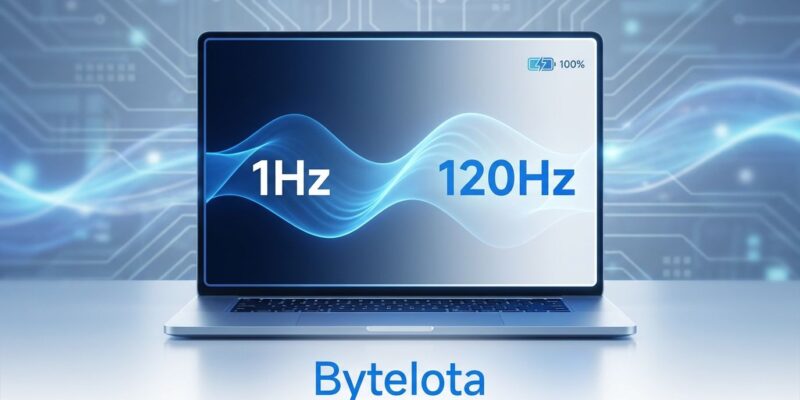
The Dell XPS 16 with Intel’s Panther Lake chip just achieved 27-hour battery life in Notebookcheck’s Wi-Fi browsing test—beating every ARM laptop including Apple’s M4 MacBooks and Qualcomm’s Snapdragon systems. The secret weapon isn’t revolutionary CPU efficiency. It’s LG Display’s “Oxide 1Hz” LCD technology, announced last week on March 21, that drops the refresh rate to 1Hz during static content and ramps to 120Hz for video. At just 1.5W idle power, this x86 laptop now outperforms the ARM competitors that dominated battery life rankings for the past three years.
The implications hit developers hardest: you no longer have to choose between long battery life and x86 compatibility. ARM Windows still struggles with app compatibility. Apple’s M-series locks you into macOS. LG’s display innovation proves that panel technology matters more than CPU architecture for battery efficiency—a narrative shift the industry didn’t see coming.
The 27-Hour Benchmark That Changed Everything
Notebookcheck measured 26 hours and 38 minutes in its standardized Wi-Fi browsing test at 150 nits brightness with VRR enabled. That’s the best result among all laptops tested since 2014—including ARM systems that typically max out at 18-22 hours for video playback and 12-16 hours in real-world productivity workloads. Previous x86 laptops rarely exceeded 14 hours.
For developers, that translates to genuinely multi-day mobile work. A full conference day plus evening coding sessions (14-16 hours total) without hunting for outlets. Weekend trips where bringing the charger becomes optional rather than mandatory.
Remote workers prioritize battery life above processing power 64% of the time, according to Statista’s 2024 survey. The Dell XPS 16 delivers 2.7x the recommended 10-hour minimum for productivity laptops. That’s not incremental improvement—it’s a category redefinition.
How Oxide TFT Makes 1Hz Possible
LG Display didn’t just optimize existing LCD technology. They replaced the conventional amorphous silicon thin-film transistor with a metal oxide semiconductor engineered specifically for minimal current leakage at low refresh rates. The company developed proprietary circuit algorithms that automatically detect static versus dynamic content and switch between 1Hz for code editing and 120Hz for video. No user intervention required.
The physics advantage: oxide TFT maintains panel state at 1Hz without the power bleed that makes conventional LCDs inefficient at low refresh rates. This was previously exclusive to OLED panels in gaming monitors, but OLED actually loses the battery battle at typical laptop brightness levels. According to DisplayMate testing, OLED panels consume 15-30% more power than comparable LCDs at maximum brightness.
Developer workloads—code editors with light themes, documentation in browsers, terminals—run at sustained medium-high brightness with mostly-static light content. That’s where LCD’s lower baseline power consumption plus the 1Hz advantage wins. LG claims 48% battery efficiency improvement versus conventional fixed-rate LCDs, with independent testing showing close to 2x battery runtime versus OLED at mixed productivity workloads.
The x86 vs ARM Story Just Got Rewritten
For three years, the conversation sounded like this: ARM wins on battery life, x86 offers better software compatibility, pick your compromise. Apple’s M-series silicon and Qualcomm’s Snapdragon X2 dominated the battery efficiency narrative with their SoC integration and power-efficient architecture.
The Dell XPS 16 proves display innovation outweighs CPU architecture advantages. Intel’s Panther Lake contributes a 65% power reduction versus three-year-old CPUs, but the display carries most of the efficiency gains. Put differently: the same Intel chip in a conventional 60Hz LCD laptop wouldn’t touch 27 hours.
This matters acutely for developers. Many need x86 for Linux kernel work, Docker environments, legacy toolchains, or Windows-specific development environments that don’t run properly on ARM. The choice was battery anxiety or compatibility headaches. LG’s display technology eliminates that trade-off.
LCD Still Beats OLED for Developer Workloads
Conventional wisdom says OLED saves battery because true blacks mean pixels turn off completely. That holds for dark themes at low brightness. But developer reality involves code editors, documentation browsers, and terminal windows—frequently with light backgrounds—at sustained 150-200 nit brightness for eye comfort.
The trade-off remains image quality. OLED delivers superior contrast, true blacks, and better color accuracy for content creation work. LCD with 1Hz VRR wins on battery efficiency and cost. Developers prioritizing maximum battery life should choose LCD. Designers and video editors needing color accuracy should wait for LG’s OLED variant planned for 2027.
What This Means for Developer Laptop Choices
Coffee shop coding becomes genuinely viable for full workdays without outlet dependence. Conference travel no longer requires planning around charging station locations. Transcontinental flights with 6-8 hours of coding time leave battery to spare.
The developer laptop criteria hierarchy just reshuffled. Battery life parity means x86 compatibility moves back up the priority list. ARM’s primary advantage—battery efficiency—just got neutralized by display innovation. Apple’s macOS ecosystem lock-in remains for iOS developers, but cross-platform developers can reconsider x86 Windows and Linux laptops without sacrificing mobile productivity.
Timing matters for purchase decisions. The Dell XPS 16 with LG’s 1Hz LCD ships now and represents best-in-class battery life for x86 systems. Other manufacturers will likely announce 1Hz display laptops throughout late 2026 and early 2027 as LG Display expands production partnerships.
Within 18 months, expect 20+ hour battery life to become the baseline expectation for premium productivity laptops rather than exceptional performance.
Key Takeaways