 By ByteBot
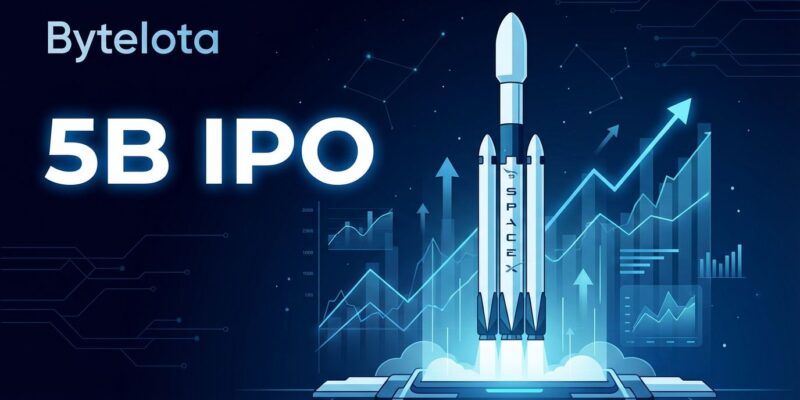
SpaceX is filing its IPO prospectus this week (March 25, 2026), targeting a $75+ billion raise at a $1.5-1.75 trillion valuation with a June public debut. That’s 2.5 times larger than Saudi Aramco’s $29.4 billion record from 2019—the largest IPO in human history. For the first time, retail investors will get access to Elon Musk’s space empire, but the question isn’t whether you can invest. It’s whether you should.
The Musk Paradox: From “Never” to $75 Billion
For 20 years, Musk swore SpaceX would stay private. In 2013, he told Twitter followers an IPO would only happen “after Mars Colonial Transporter is flying regularly.” In 2018, he tried taking Tesla private to escape quarterly earnings pressure, calling public markets a nightmare for long-term thinking. He kept Neuralink, xAI, and Boring Company private to avoid scrutiny.
However, capital reality intervened. Even Musk can’t fund a $100+ billion space infrastructure buildout from secondary markets. SpaceX’s valuation exploded from $210 billion in June 2024 to $800 billion by December 2025—8x growth in 20 months. The xAI merger in February 2026 pushed the combined entity to $1.25 trillion. At that scale, going public isn’t optional. It’s the only path forward.
What the $75 Billion SpaceX IPO Funds
This isn’t just about rockets anymore. SpaceX is building three wildly ambitious programs that make the IPO scale make sense—if you believe they’ll work.
Starship “Insane Flight Rate”: V3 Starship goes operational in June 2026, targeting rapid reusable orbital flights. The goal is dozens of launches per year, requiring massive manufacturing and infrastructure investment. Starship is the backbone of everything else.
Moreover, AI Data Centers in Space represent the revenue engine. After acquiring xAI in February, SpaceX filed with the FCC to launch 1 million AI compute satellites. The pitch? 100 gigawatts of AI compute annually, powered by solar energy, with no cooling costs and zero regulations. Each Starship can carry dozens of AI satellites. Early launches could start by late 2026. The revenue model is simple: space AI funds moon bases and Mars.
Finally, Moon Base & Mars Colony complete the vision. Starship’s cargo capacity enables what Musk calls “self-growing bases” on the Moon, with Mars as the ultimate goal. This was SpaceX’s original 2002 mission—going public is the only way to fund it.
The vision is coherent: AI in space generates revenue → funds lunar infrastructure → enables Mars colonization. But it’s also unproven, speculative, and dependent on regulatory approval for a million satellites.
Retail Investors: The SpaceX IPO Reality Check
If you’re hoping to buy SpaceX stock at IPO, here’s the bad news: traditional IPO processes favor institutional investors. Retail gets the “back of the line,” buying only after the IPO pop drives prices up. Bill Ackman proposed giving Tesla shareholders priority access, but that’s a limited solution.
Furthermore, pre-IPO access exists, but it’s expensive. Special Purpose Vehicles (SPVs) charge upfront fees, annual maintenance costs, and 10% carry on profits. Entry amounts start at $100,000+, and you need accredited investor status. Alternatives like Destiny Tech 100 (25% SpaceX exposure) or ARK Venture Fund offer indirect access but with their own fees and risks.
Then there’s the valuation question. SpaceX was already trading at $800 billion in secondary markets before this IPO announcement. Bulls argue it’s justified: SpaceX has a monopoly on heavy lift, Starlink is a cash cow, and AI upside is massive. Bears counter that there are no profits yet, execution risk is huge, Musk is distracted by Twitter and xAI, and a million satellites might never get approval.
Hacker News comments (716 responses) capture the split: “Finally getting SpaceX stock!” versus “$1.75T valuation is insane.” Both are probably right.
What Happens Next for SpaceX
The prospectus filing kicks off this week, with a June 2026 public debut expected. If successful, SpaceX validates commercial space as an investable asset class and opens the door for other mega-IPOs—OpenAI is rumored to be next. If it fails or underperforms, the entire space economy takes a hit.
The big question isn’t whether SpaceX will IPO. It’s whether a $1.75 trillion valuation holds up once public markets start asking hard questions about profitability, timelines, and regulatory risk. Starship needs to deliver. Space AI needs to work. And Musk needs to stay focused.
For retail investors, the advice is simple: don’t FOMO into this. If you believe in Musk’s vision and can afford the risk, wait for post-IPO volatility to settle before buying. If you’re chasing hype, you’re already too late.