 By ByteBot
Microsoft claims GitHub Copilot increases developer productivity by up to 55%, and enterprises are pouring billions into AI coding tools based on these promises. But a controlled study found experienced developers using AI took 19% longer to complete tasks while believing they were 20% faster—a 39-point perception gap between feeling productive and being productive. At the organizational level, the gains evaporate entirely. While individual developers complete 21% more tasks and merge 98% more pull requests, overall throughput—secure, production-ready code deployed—is stagnating. Six independent studies converge on just 10% organizational productivity gains, far below individual-level claims.
Executives are celebrating phantom wins. They measure lines of code and task completion, metrics where AI excels. Meanwhile, teams burn out fixing AI-generated bugs while deployment velocity stays flat.
What’s Being Measured vs. What Matters
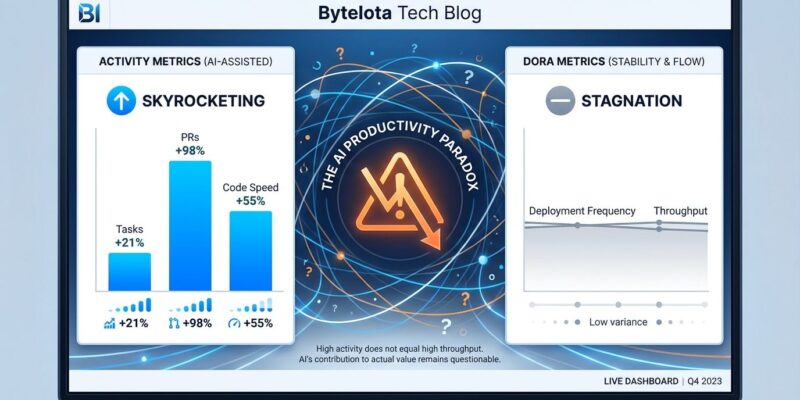
The measurement gap explains everything. Organizations track individual activity metrics: tasks completed (+21%), pull requests merged (+98%), code written faster (55% for certain tasks). These numbers look impressive on executive dashboards. However, they measure activity, not outcomes.
Team throughput metrics tell a different story. Pull request review time increases 91% because teams face 98% more PRs with 154% larger sizes. Bug rates increase 9% per developer. DORA metrics—deployment frequency, change failure rate, mean time to recovery—remain flat or worsen. As Faros AI’s research notes, “While individual productivity is soaring, overall throughput—the rate at which secure, stable, production-ready code is deployed—is stagnating or even declining.”
The industry is optimizing for stock prices, not shipping software. Consequently, executives report what makes quarterly earnings calls sound good. Developers experience the reality: more code written, same amount deployed, harder work fixing downstream issues.
The Security Bottleneck Killing Gains
AI-generated code contains 2.74 times more security vulnerabilities than human-written code. A comprehensive March 2026 study testing Claude, Codex, and Gemini coding agents found 87% of AI-generated pull requests contain at least one security issue. Broken access control appears in 100% of OAuth implementations across all three agents. Veracode tested over 100 LLMs across 80 coding tasks and found 45% of AI-generated code introduces OWASP Top 10 vulnerabilities.
This is where productivity gains die. AI writes code fast, but that code fails security scans, stalls CI/CD pipelines, and requires rework. Furthermore, security teams who previously reviewed 100 lines of code per hour now face 100,000 lines of AI-generated code. Time saved in writing is lost in remediation cycles. Organizations can’t deploy faster when security gates are overwhelmed and failing builds at record rates.
The bottleneck has shifted from coding to quality assurance. Moreover, teams didn’t budget for this.
The 39-Point Perception Gap
Developers genuinely believe AI tools make them faster. Additionally, Accenture’s survey found 90% of developers feel more productive using AI coding assistants. The perception is real, but it’s wrong.
A randomized controlled study measured actual performance and revealed the truth: experienced developers using AI took 19% longer to complete tasks while believing they were 20% faster. That’s a 39-point gap between perception and reality. As one analysis put it, “Executives are measuring—and reporting—what makes their stock price rise, not what’s actually happening on the ground.”
You can’t trust subjective productivity assessments from developers or executives. The perception gap is massive and consistent across studies. Therefore, organizations need objective instrumentation—DORA metrics, cycle time from commit to production, deployment frequency—to measure actual AI impact. Feelings don’t ship software.
The Hidden Cost Nobody’s Tracking
AI coding tools are driving cloud costs up 30% on average. The State of FinOps 2026 report, drawn from 1,200+ organizations representing $83 billion in annual cloud spend, found 72% of IT and financial leaders report GenAI cloud spending has become “unmanageable.” The report identifies “FinOps for AI” as the top priority, and “AI cost management” as the number one desired skillset across organizations of all sizes.
The costs compound in ways executives aren’t tracking. AI tool licenses are line items on the budget, visible and approved. However, cloud compute for AI inference runs continuously. CI/CD pipelines execute 98% more often due to PR volume increases. In addition, security scanning extends to handle vulnerability-heavy code. These downstream costs don’t appear in “AI productivity tool” budget categories, yet they’re direct consequences of adoption.
Organizations celebrating 10% productivity gains while absorbing 30% cost increases have an ROI problem. In fact, when you account for the full cost of ownership—licenses, cloud compute, extended review time, security tooling, rework cycles—the business case collapses for many teams.
Measure the Right Developer Productivity Metrics
The solution isn’t abandoning AI tools. It’s fixing measurement frameworks before making more investments. Organizations measuring lines of code and task completion will continue celebrating phantom gains while teams burn out. Conversely, those measuring deployment frequency, cycle time, and change failure rate will realize actual productivity improvements.
Modern productivity measurement combines DORA metrics with SPACE framework dimensions (Satisfaction, Performance, Activity, Communication, Efficiency) and adds AI-specific metrics: AI-touched pull request cycle time, AI code rework ratio, and AI-generated bug rates. These frameworks measure what matters—how much value a team delivers sustainably—not how much code gets written.
The industry needs to acknowledge that AI tools change where developers spend their time, not necessarily reduce total time spent. Code writing accelerates, but review, security scanning, and debugging require more time. Ultimately, organizations that invest in the entire delivery pipeline—review processes, security automation, quality gates—will see genuine throughput improvements. Those that only buy AI coding tools will discover bottlenecks have simply moved downstream.
Key Takeaways
- Stop measuring activity metrics like tasks completed and pull requests merged; measure outcome metrics like deployment frequency and change failure rate to understand actual productivity.
- Account for full costs: AI tool licenses plus cloud compute increases plus extended security scanning plus review time—30% cost increases need to deliver more than 10% productivity gains to justify ROI.
- The bottleneck has shifted from writing code to reviewing and securing code; AI generates 98% more PRs with 2.74x more vulnerabilities, overwhelming review and security processes.
- Perception doesn’t match reality—developers feel 20% faster while being 19% slower; objective instrumentation is mandatory, not optional.
- Organizations that fix measurement frameworks and invest in the entire delivery pipeline will realize genuine AI productivity gains; those that only measure lines of code will burn out teams while celebrating phantom wins.