 By ByteBot
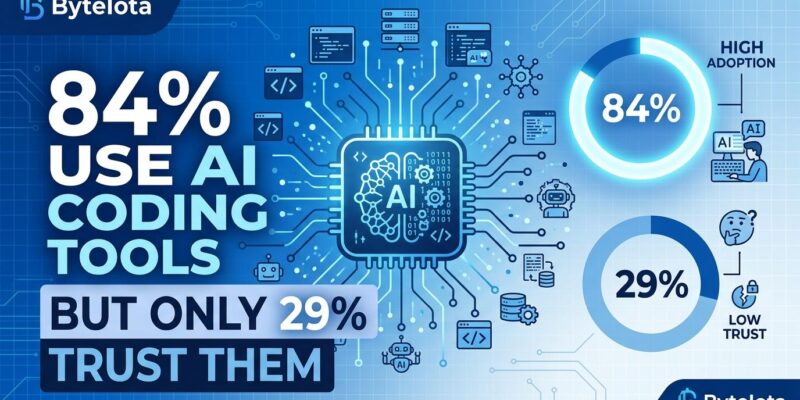
The 2025 Stack Overflow and JetBrains developer surveys reveal a striking paradox: 84% of developers now use AI coding tools (up from 76% in 2024), with 51% using them daily, yet trust in AI accuracy has plummeted to just 29%—down from 40% the previous year. Even more dramatic is Claude Code’s meteoric rise from virtually zero market share in May 2025 to overtaking GitHub Copilot as the #1 choice by early 2026. GitHub reports that over 51% of all code committed to its platform in early 2026 was AI-generated or AI-assisted, marking a tipping point where AI-authored code now exceeds human-written code.
The Trust Paradox: 84% Adoption Despite 46% Distrust
Developers are making a calculated tradeoff. Stack Overflow’s 2025 survey shows that while 84% use AI coding tools, only 29% trust their accuracy—a 28% decline in trust from 2024’s 40%. The gap is even starker when looking at active distrust: 46% of developers explicitly distrust AI outputs, nearly double the 33% who trust them. Only 3% report “high trust” in AI results.
This cognitive dissonance reveals something important about the industry’s priorities. Developers know AI produces buggy code but use it anyway for productivity gains. In fact, 61% of developers surveyed agree that AI often generates code that “looks correct but isn’t reliable”—yet they continue integrating these tools into their daily workflows. Positive sentiment for AI tools dropped from over 70% (2023-2024) to 60% in 2025, even as adoption accelerated.
The 16% who aren’t using AI tools may be protecting code quality, but they risk falling behind competitively. AI tool proficiency is rapidly becoming a job requirement rather than a nice-to-have skill. Teams must navigate this tension carefully—productivity gains are real, but blind adoption leads to technical debt.
Claude Code’s Meteoric Rise: Zero to #1 in Nine Months
Claude Code launched in May 2025 with roughly 4% market share and became the #1 AI coding choice by early 2026, overtaking both GitHub Copilot (68% adoption) and dominating agentic coding use cases. By early 2026, 71% of developers who use AI agents chose Claude Code, and it reached a $2.5 billion run-rate within nine months—the fastest growth trajectory in AI tool history.
The surge wasn’t random. Developers prioritized agentic capabilities—multi-file planning, iteration, and context management—over simple code completion. GitHub Copilot offers a 46% code completion rate, but only 30-31% of those suggestions are actually accepted after developer review. Claude Code’s ability to work across entire codebases and understand complex requirements won developers over. ChatGPT maintains 82% adoption for general chat assistance, but Claude Code captured the specialized agentic coding market almost overnight.
This proves the AI coding tool market remains volatile. Dominance can shift in months, not years. For teams evaluating tools, market share today doesn’t guarantee dominance tomorrow. The tools that best integrate with existing workflows and deliver consistent multi-file capabilities will win.
Related: Cursor Composer 2 Beats Claude 86% Cheaper: What Changed
Productivity Gains Are Real But Come With Quality Costs
DX research shows developers save an average of 3.6 hours per week using AI coding tools, with daily users merging 60% more pull requests than non-users. JPMorgan Chase deployed AI tools to over 60,000 developers and saw 10-20% efficiency gains while maintaining regulatory compliance. Controlled studies from GitHub, Google, and Microsoft report 20-55% faster task completion, and developers report average productivity improvements of 25-39%.
However, bug density in projects with unreviewed AI code is 23% higher than human-written code. CodeRabbit’s analysis found that AI-generated pull requests contain 1.7 times more issues than human code, with 75% more logic and correctness errors—the most critical bug categories. Security vulnerabilities increased 23.7% in AI-assisted code. Worse, 45% of developers report that debugging AI-generated code takes longer than writing it themselves, erasing the initial time savings.
The tradeoff is stark: accept 20-55% speed improvements but tolerate 23% higher bug density. McKinsey surveyed 4,500 developers and found a 46% reduction in time spent on routine tasks, but that productivity gain disappears if review time doubles or triples. Only 30-31% of AI suggestions are accepted after developer review, meaning 70% of AI output is rejected—a massive hidden cost in evaluation overhead.
JPMorgan’s success shows enterprise-scale deployment is possible, but it requires rigorous code review processes and quality gates. Teams must decide whether speed or quality matters more for their specific context. The answer isn’t universal—financial services demand compliance, but rapid prototyping projects may tolerate higher bug rates for faster iteration.
Related: AI Productivity Paradox: Code Output Up, Stability Down 7%
GitHub’s 51% Tipping Point: AI Code Now Exceeds Human Code
GitHub reports that over 51% of all code committed to its platform in early 2026 was AI-generated or substantially AI-assisted. This is a historical inflection point: for the first time, machines are writing more code than humans. GitHub Copilot alone contributes 46% of all code written by users, with Java developers seeing up to 61% AI contribution rates. 90% of developers have committed Copilot-generated code to repositories.
This raises critical questions about sustainability. Are we building maintainable codebases or accumulating AI-generated technical debt? What happens when the majority of code is written by tools that 46% of developers don’t trust? The 90% commit rate shows most developers aren’t rigorously reviewing AI code before merging, which explains the 23% higher bug density and 1.7x issue rate.
The 51% tipping point isn’t just a statistic—it’s a warning. Code quality platforms like CodeRabbit found that AI increases “code smells” (subtle maintainability issues) that account for over 90% of problems in AI-generated code. These issues compound over time, creating technical debt that becomes progressively harder to refactor. The industry is writing code faster than it can review it.
2026 Pivot: From Speed Year to Quality Year
Industry analysts are declaring that “2025 was the year of AI speed. 2026 will be the year of AI quality.” Companies are beginning to formally track AI-related defect metrics instead of treating AI bugs as anecdotal edge cases. Code review processes are evolving to handle the volume saturation—the sheer amount of AI-generated code is overwhelming midlevel engineers’ review capacity.
Trust declining from 40% to 29% in a single year while adoption rises from 76% to 84% is unsustainable. Something has to give. DX recommends a 3-6 month learning curve before drawing definitive conclusions about AI tool impact, emphasizing quality metrics over quick productivity wins. Hacker News discussions on “maintaining code quality with widespread AI tools” reveal growing developer anxiety about long-term sustainability.
The organizations that win in 2026 won’t be the fastest to adopt AI—they’ll be the ones who balance speed with quality. Rigorous review gates, formal defect tracking, and measuring success beyond lines of code generated will separate sustainable AI adoption from short-term productivity theater. The race for speed is over. Quality wins now.
Key Takeaways
- 84% of developers use AI coding tools but only 29% trust them—this cognitive dissonance defines 2026 development, revealing developers accept lower quality for higher speed
- Claude Code surged from 4% to 63% market share in nine months by dominating agentic coding, proving AI tool dominance can shift overnight in a volatile market
- Productivity gains are real (3.6 hrs/week saved, 60% more PRs, JPMorgan’s 10-20% efficiency bump) but quality costs are significant (23% higher bugs, 1.7x more issues, 45% say debugging takes longer)
- GitHub’s 51% tipping point marks a historic shift—AI now writes more code than humans, raising critical questions about technical debt accumulation and long-term codebase sustainability
- 2026 pivots from speed to quality as trust collapses (40% to 29%) despite rising adoption (76% to 84%)—teams that balance rigor with productivity will win, not those chasing fastest generation
The AI coding revolution isn’t slowing down, but the industry is course-correcting. Blind adoption creates more problems than it solves. The tools are powerful, but they’re not magic—and they’re definitely not trustworthy yet. Use them, but verify everything.