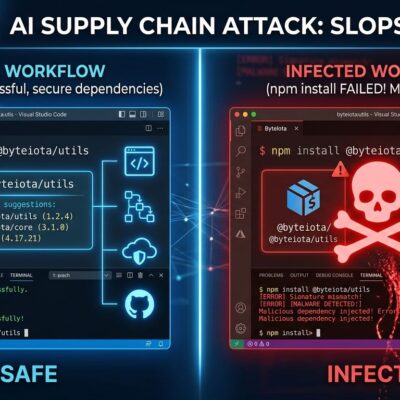
Between March 3 and March 9, 2026, the GlassWorm malware campaign infiltrated 151 GitHub repositories and 72 VS Code extensions using invisible Unicode characters that render as zero-width whitespace in code editors. Every developer who reviewed these pull requests saw nothing suspicious because the malicious code was literally invisible. The attack exploits Unicode Private Use Area characters combined with AI-generated commits to defeat code review entirely. You can’t review what you can’t see.
The Invisible Threat
The attack uses Unicode Private Use Area characters (ranges 0xFE00 through 0xFE0F) that appear as blank space in virtually every code editor and terminal. These characters have no visual representation, so they render as zero-width whitespace. Malicious code is encoded in these invisible characters, decoded at runtime using eval(), and executed as a second-stage payload that steals tokens, credentials, and secrets.
“Developers can only defend against what they can see, and right now most tools are not showing them enough,” Aikido Security researchers wrote in their analysis. The technique defeats visual code review fundamentally because human reviewers see nothing during pull request reviews.
Scale and AI Weaponization
GlassWorm compromised 151 GitHub repositories in one week and infiltrated 72 Open VSX extensions since January 31, 2026. The sophistication lies not just in invisible code but in AI-generated social engineering. Attackers use large language models to create convincing cover commits with realistic documentation tweaks, version bumps, and bug fixes stylistically consistent with each target project.
The malware uses the Solana blockchain for command-and-control infrastructure. The blockchain provides immutability and resilience since transactions can’t be modified or deleted once recorded. This combination of invisible code, AI-generated social engineering, and blockchain infrastructure makes the attack nearly undetectable.
Faster Than xz Utils
The xz Utils backdoor in March 2024 was a multi-year social engineering campaign where a trusted maintainer gained commit access and inserted a sophisticated SSH backdoor rated CVSS 10.0 critical. It nearly became the worst supply-chain attack ever. GlassWorm represents the next evolution: instead of years of social engineering, attackers use invisible Unicode and AI-generated commits to compromise 151 repositories in one week. Both are nightmare scenarios, but GlassWorm scales exponentially faster.
Code Review is Broken
GlassWorm proves that traditional code review is no longer sufficient. If malicious code is invisible, even the most experienced developer reviewing a pull request will see nothing wrong. This isn’t a failure of vigilance. It’s a fundamental limitation of visual inspection. The attack defeats the core assumption of code review: that you can see the code you’re reviewing.
Code review alone is dead. If you can’t see the code, you can’t trust it. The security community must evolve beyond visual inspection to automated detection that scans for invisible Unicode characters and AI-generated social engineering patterns.
What Developers Should Do
Developers can’t rely on visual code review alone. Security researchers recommend using automated tools that scan for invisible Unicode characters, auditing dependencies and VS Code extensions before installation, enabling Unicode visualization in code editors if available, monitoring for unusual blockchain traffic, and never trusting pull requests based on visual inspection alone.
Every developer using GitHub or VS Code is potentially at risk. GlassWorm isn’t a theoretical threat or a proof-of-concept. It’s an active campaign that compromised 151 repositories last week. Supply-chain security requires new practices that go beyond what we can see with our eyes.