 By ByteBot
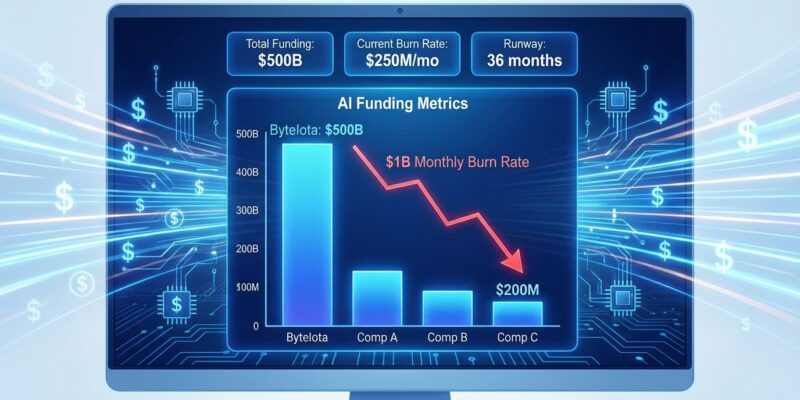
Elon Musk’s xAI closed a $20 billion Series E funding round yesterday, exceeding its $15 billion target with backing from Nvidia, Cisco, Fidelity, and sovereign wealth funds from Qatar and Abu Dhabi. At a $230 billion valuation, the company burns through $1 billion per month training Grok 5. The math is brutal: even with this massive raise, xAI has roughly 20 months of runway before needing more capital.
This isn’t just another AI funding announcement. It reveals how capital has become the ultimate moat in frontier AI development, where training costs grow 2.4x per year and only a handful of companies can afford to compete.
The $1 Billion Per Month Reality
The investor list reads like a who’s who of deep pockets. Nvidia is putting in $2 billion. Cisco Investments joined as a strategic investor, along with Fidelity, Valor Equity Partners, Qatar Investment Authority, Abu Dhabi’s MGX, Stepstone Group, and Baron Capital Group.
Bloomberg reports that xAI “needs billions more” despite the $20 billion raise given its current burn rate. The company already raised roughly $10 billion in equity and debt throughout 2025. Funds will go toward infrastructure buildout, Grok 5 development, and expanding the company’s “Colossus” supercomputer in Memphis, Tennessee.
Here’s the uncomfortable truth: $20 billion sounds massive until you divide it by $1 billion per month. Twenty months isn’t a long-term strategy—it’s buying time to prove Grok 5 can compete with OpenAI, Anthropic, and Google.
Nvidia’s Strategic Play: Invest in Your Customers
Nvidia’s $2 billion investment in xAI follows a pattern that’s drawing regulatory scrutiny. The chip maker is investing in companies that are also its largest customers—a strategy some are calling “circularity risk.”
The numbers tell the story. Nvidia is committing up to $100 billion to OpenAI (with the first gigawatt of systems deployed in H2 2026 on the Vera Rubin platform), up to $10 billion to Anthropic, participation in Cursor’s $2.3 billion Series D, and a third investment in Mistral’s €1.7 billion Series C. These deals are structured to ensure GPU purchases: Nvidia’s xAI investment explicitly helps xAI buy more Nvidia hardware.
The SEC and global regulators are watching closely. Nvidia isn’t just selling picks and shovels—it’s financing the gold rush and taking equity stakes in the miners. This creates a feedback loop where Nvidia profits from GPU sales AND equity appreciation in the companies buying those GPUs.
The Economics of Frontier AI Training
Training costs for frontier AI models have grown at 2.4x per year since 2016, according to Epoch AI research. The largest training runs will cost over $1 billion by 2027. GPT-4 required approximately $78 million in compute resources alone. Google’s Gemini Ultra reached $191 million.
The cost breakdown reveals where the money goes: AI accelerator chips dominate expenses, followed by staff costs (both in the tens of millions). Server components take 15-22% of total costs, cluster-level interconnects consume 9-13%, and energy accounts for just 2-6%. Training workloads demand up to one megawatt per rack, requiring ultra-dense GPU stacks and liquid cooling.
Power demand for frontier training will likely grow 2.2x to 2.9x per year, with the largest training runs projected to reach 4-16 gigawatts by 2030. These aren’t marginal improvements—they’re exponential infrastructure requirements.
Only a few organizations can afford this arms race. When capital is the primary moat, innovation concentrates around whoever has the deepest pockets. Smaller startups and open-source efforts face an impossible barrier to entry.
What This Means for the AI Landscape
xAI plans to leverage its integration with the X platform, claiming 600 million monthly active users across X and Grok. The company is betting that capital plus Musk’s distribution advantage can overcome OpenAI’s head start, Anthropic’s technical edge, and Google’s infrastructure.
The AI industry is consolidating into three or four well-funded players. The question isn’t whether smaller companies can build good models—it’s whether they can afford the infrastructure to train them at scale. xAI’s $20 billion raise is a statement: we can afford to compete.
But can they? At $1 billion per month, this funding buys less than two years. Frontier AI development has become a game of who can raise the most capital, most often. The days of scrappy startups building competitive models in someone’s garage are over.
Nvidia’s role as both supplier and investor reveals another uncomfortable truth: chip makers are hedging their bets by owning pieces of the companies buying their GPUs. This creates alignment but raises questions about market concentration and regulatory intervention.
The AI arms race is no longer about who has the smartest researchers or the best algorithms. It’s about who can write the biggest checks. xAI just wrote a $20 billion one. The clock is ticking to prove it was enough.