
 By ByteBot
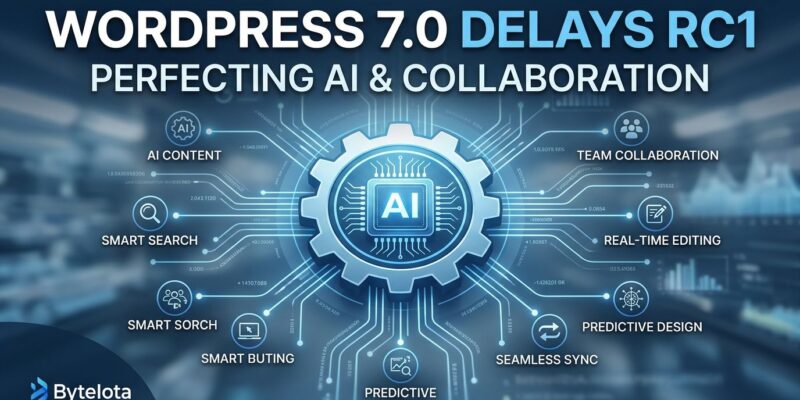
WordPress delayed its 7.0 Release Candidate from March 19 to March 24, 2026, citing concerns over real-time collaboration performance, client-side media optimization, and package size. The final April 9 release date remains unchanged. This isn’t a red flag. It’s WordPress choosing quality over shipping broken features to 501 million websites. Version 7.0 brings the platform’s first centralized AI API and Google Docs-style collaboration. The delay shows the core team is taking these foundational changes seriously.
The AI API Changes the Game
WordPress 7.0 introduces the Connectors API, a centralized interface for accessing OpenAI, Google AI (Gemini), and Anthropic (Claude) models. This is platform-level infrastructure, not a plugin feature. It’s the first major CMS with centralized AI infrastructure.
Developers write AI features once and swap providers through configuration. No more managing API keys per plugin. The platform handles credentials, provider selection, and graceful degradation.
AI_Client::prompt( 'Summarize this article for SEO.' )->generate_text();That’s it. The complexity lives in the platform, not your code.
For plugin developers, this is transformative. Build AI-powered content generation, smart search, translation, or accessibility features. The Connectors API gives you the infrastructure.
At 43.6% of all websites globally, WordPress is bringing centralized AI infrastructure to more sites than any competitor could reach. Notion and Webflow have slick AI features, but they’re locked to proprietary platforms. WordPress runs everywhere, self-hosted, with no vendor lock-in.
Real-Time Collaboration Comes to 43% of the Web
Multiple users can now edit the same post simultaneously using Yjs, a conflict-free replicated data type framework. Think Google Docs, but for WordPress. Initially limited to two simultaneous users client-side, though hosts can adjust that via wp-config.
The technical choice here is smart: HTTP polling instead of WebSockets. Why? Most shared hosting doesn’t support persistent WebSocket connections. WordPress chose universal compatibility over cutting-edge performance. That’s the right trade-off for a platform running on everything from premium VPS to budget shared hosting.
But there’s a performance problem. When real-time collaboration is enabled and a user has the editor open, WordPress effectively disables its persistent post query caches. The proposed fix was a dedicated database table for sync data.
The team shelved that fix. Too risky to add a database migration late in the release cycle. Core committer David Baumwald put it bluntly: “The schedule of the release was dictating shipping a worse implementation rather than feature readiness.”
So WordPress is shipping real-time collaboration with known performance trade-offs rather than rushing a database change. That’s responsible, not reckless.
Why the Delay is Actually Good News
Release coordinator Amy Kamala cited three concerns: real-time collaboration performance, client-side media optimization, and package size. The response? Client-side media processing got pulled entirely from 7.0. Scope cut, not buggy code shipped.
The core team is prioritizing quality over arbitrary deadlines. Better to delay five days than ship performance problems to 501 million websites. Proprietary platforms hide these delays. Open-source WordPress announces them.
RC1 on March 24 gives developers 16 days to test plugins and themes. Tight, but workable.
Breaking Changes: The Migration Tax
Progress has a price. WordPress 7.0 pays down years of technical debt with breaking changes.
The block editor is now always iframed. That breaks CSS and JavaScript assumptions themes and plugins have been making for years. The Interactivity API deprecated state.navigation in favor of state.url. DataViews replaces WP_List_Table on core admin screens.
PHP 7.2 and 7.3 support is gone. PHP 7.4 is the minimum, but you should target 8.2 or 8.3. Sites still running 7.2 or 7.3 won’t get the 7.0 update. They’ll stay on the 6.9 branch with security patches.
Developers have priorities for the next 16 days: test Interactivity API changes, check iframed editor compatibility, review DataViews and DataForm usage, and ensure PHP 7.4+ support.
Breaking changes are the price of progress. WordPress carried technical debt for years to maintain backwards compatibility. Now it’s modernizing.
WordPress vs the Modern Platforms
WordPress powers 43.6% of all websites and owns 68.7% of the CMS market. But the real competition isn’t other CMSes. It’s Notion, Webflow, and Google Docs.
Those platforms have smoother UX and native collaboration features. But they’re proprietary SaaS platforms with vendor lock-in. WordPress runs anywhere, self-hosted, with provider-agnostic AI integration. You can swap OpenAI for Claude for Gemini with a configuration change.
The WordPress bet: open-source can beat proprietary on modern features. As one contributor put it: “No competitor can possibly keep up with the scale and speed of innovation in the WordPress ecosystem.”
What’s Next
RC1 drops March 24. Final release April 9. Developers should test plugins and themes now. Check Interactivity API changes, iframed editor assumptions, and PHP version support.
Client-side media processing will return in WordPress 7.1, along with further real-time collaboration improvements. The always-iframed post editor, deferred from 7.0, will also land later.
WordPress 7.0 is a platform shift. AI infrastructure and real-time collaboration aren’t plugin features. They’re platform fundamentals. The delay shows the team is treating them that way.


