
 By
By Windsurf just escalated the AI coding tools pricing war. On December 24, 2025, the company released Wave 13, making the SWE-1.5 model—a near-frontier coding AI achieving 950 tokens per second—completely free for three months. The update introduces first-class parallel multi-agent sessions, enabling developers to run five separate Cascade agents on five different bugs simultaneously through Git worktrees integration. This positions Windsurf directly against Google Antigravity’s entirely free offering and undercuts Cursor’s $20/month and GitHub Copilot’s $10/month subscriptions. With 95% of developers using AI coding tools according to the DORA 2025 report, the free tier war signals rapid commoditization of AI coding assistants.
SWE-1.5 Goes Free: Near-Frontier Performance at Zero Cost
SWE-1.5, developed by Cognition (the makers of Devin AI), delivers near-frontier coding performance matching Claude Sonnet 4.5. At full throttle, the model achieves 950 tokens per second—six times faster than Haiku 4.5 and 13 times faster than Sonnet 4.5. Windsurf’s free tier maintains full intelligence and coding performance on the SWE-Bench-Pro benchmark but delivers standard throughput speeds instead of the paid tier’s maximum velocity.
The model replaces SWE-1 as Windsurf’s default and remains free for all users through March 2026. Trained on real-world task environments using end-to-end reinforcement learning, SWE-1.5 was beta-tested as “Penguin Alpha” before public launch. The hundreds-of-billions-of-parameters model represents a direct attack on competitors still charging for frontier models.
The competitive pressure is clear. Google Antigravity offers completely free access to Gemini 3 models during public preview. Cursor charges $20/month for 500 fast requests. GitHub Copilot runs $10/month for individuals and $19/month for business users. Windsurf’s $15/month Pro tier now looks expensive when SWE-1.5 delivers frontier performance for free.
Parallel Agents: The Workflow Paradigm Shift
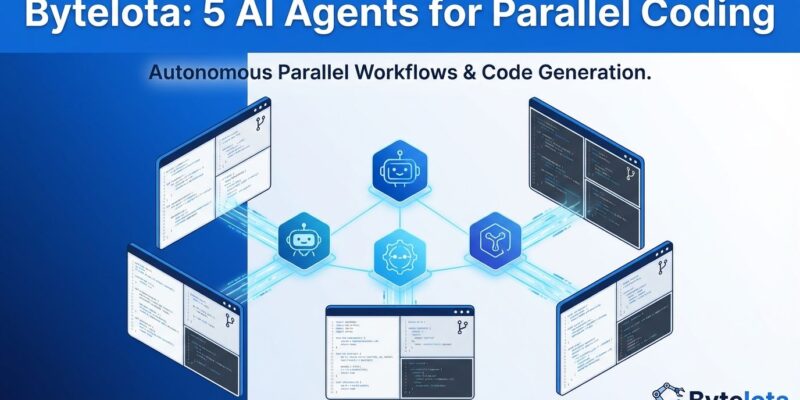
Wave 13’s headline feature is first-class support for running multiple Cascade AI agents simultaneously without conflicts. Developers can spawn five different agents working on five separate bugs at once, monitoring them side-by-side through a multi-pane interface. Git worktrees integration enables each agent to work on a different branch in separate directories while sharing Git history.
The workflow pattern is already validated. Companies like incident.io run four to five Claude Code agents in parallel using Git worktrees. Simon Willison and The Pragmatic Engineer documented the trend in October 2025, identifying “programming by kicking off parallel AI agents” as an emerging practice among senior engineers.
Git worktrees—a feature since Git 2.5 that was previously niche—suddenly became critical infrastructure. The technology enables multiple working directories from a single repository, each checking out a different branch while sharing the same .git folder. This eliminates duplication and solves the conflict problem that previously blocked parallel agent workflows. Each worktree gets a dedicated agent, and developers can cd between directories without stashing or committing incomplete work.
Windsurf’s implementation includes a multi-pane Cascade interface for side-by-side agent monitoring, a dedicated zsh terminal for reliable agent execution with environment variable inheritance, and support for concurrent sessions within the same repository. The technical execution is solid. The workflow potential is significant. But there’s a catch.
The Review Bottleneck: More Code Does Not Mean Better Code
PR review time increased 91% according to the DORA 2025 report ByteIota covered previously. While parallel agents multiply code generation speed, human review capacity doesn’t scale proportionally. The bottleneck shifted from “how fast can we write code” to “how fast can we review AI-generated code.”
AI-generated code requires review. Quality assurance matters. It’s difficult to keep up with even a single AI agent’s output velocity. Parallel agents amplify the review burden fivefold. The DORA 2025 data shows individual developer productivity increased 21% and PR merges jumped 98%, yet organizational delivery metrics remained completely flat. The review bottleneck absorbed the gains.
Thoughtworks engineering leader Chris Westerhold warned: “AI will help you build the wrong thing, faster.” More code volume does not guarantee better architecture. Technical debt accelerates if reviews are rushed or superficial. So far, only senior engineers are successfully managing parallel agent workflows. The expertise barrier is real—junior developers struggle with the cognitive overhead of coordinating multiple agents and ensuring they don’t conflict or duplicate work.
Parallel agents are the future of AI-assisted development, but review capacity is the real constraint, not coding speed.
The Commoditization Thesis: Free is the New Normal
AI coding tools are commoditizing faster than most predicted. Windsurf’s free SWE-1.5 follows Google Antigravity’s entirely free offering, putting sustained pressure on Cursor and GitHub Copilot to justify subscription costs. Free tiers have expanded fivefold—Windsurf increased from 5 to 25 monthly credits in April 2025. Subscription prices dropped 20-30% across the board during Q3-Q4 2025.
The economic reality is becoming clear. Augment revealed one $250/month user was costing them $15,000/month to serve, forcing a switch to usage-based credits in October 2025. “Unlimited” AI coding is economically unsustainable. Flat-rate pricing fails to cover operational costs when frontier models burn through compute at scale.
Chinese models closed the performance gap while undercutting US providers by 70-95%. Gemini’s 6,000 daily requests for free is unprecedented. Budget options multiplied—Poe at $5/month, Copilot at $10/month. The market shifted dramatically in late 2025, and the competition is benefiting developers in the short term with more generous free tiers and lower prices.
The question is sustainability. Current free tier economics appear to be VC-subsidized land grabs to capture developer mindshare. OpenAI and Anthropic are forced to match Google’s generous free offerings or risk losing developers. The industry is betting that in a world where every AI company offers similar tools, success comes from having the best models, the cheapest infrastructure, and the richest ecosystem—not from the interface layer.
Features are converging. Parallel agents, code completion, and chat interfaces are becoming table stakes, like autocomplete before them. Differentiation is shifting from features to model quality, reliability, and ecosystem integration. The interface layer is commoditizing.
What This Means for Developers
Windsurf Wave 13 signals where the market is heading. Free tiers will continue expanding through 2026. Parallel agents will become standard across all AI IDEs—Cursor, Copilot, and others will add equivalent features. Pricing pressure will persist as Chinese models and open-source alternatives force costs down further.
For developers, the short-term wins are clear: better tools at lower prices. Access to frontier models without $20/month subscriptions. Parallel workflows that multiply throughput when tasks are independent. Git worktrees transitioning from obscure Git feature to essential tool.
The long-term questions remain unanswered. Which free tier economics are sustainable? Will usage-based pricing replace flat-rate subscriptions? Which companies will survive when VC subsidies end? The AI Native IDE war is still in early phases, with no clear winner emerging yet.
What’s certain is that free is the new normal, parallel agents are the new workflow, and review bottlenecks are the new constraint. Developers win as the market commoditizes, at least until the economics force a reckoning.


