 By ByteBot
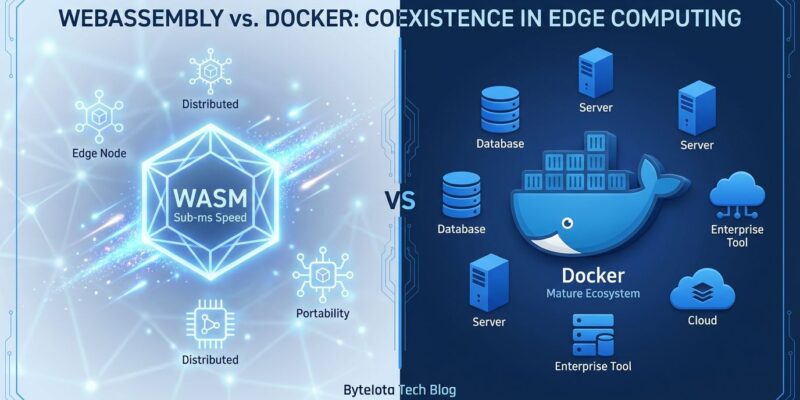
WebAssembly advocates declared December 2025 “the year WASM replaces Docker.” The technical case seems compelling: 50× smaller containers, sub-millisecond cold starts, and 20× lower memory footprint. Akamai just acquired Fermyon to bet on WASM edge computing. Docker itself added native WASM support. But here’s the contrarian take: Docker isn’t going anywhere, and the “replacement” narrative misses the point entirely.
This isn’t another hot take about which technology “wins.” It’s about understanding when each technology actually matters—and why binary thinking hurts developers more than it helps.
WebAssembly’s Real (But Narrow) Strengths
The performance numbers are legitimate. WebAssembly with WASI delivers 50-75× smaller packages (2-5MB versus Docker’s typical 100-200MB images), cold starts under 1 millisecond versus Docker’s 100ms+, and idle memory footprint under 1MB versus Docker’s 20MB+. These aren’t marketing claims—production deployments validate them.
Fermyon Spin achieves sub-0.5ms cold starts for media stream authentication at scale. Cloudflare Workers runs millions of WASM functions globally with instant scaling. When Akamai acquired Fermyon in December 2025, it signaled enterprise confidence that WASM edge computing solves real problems. A 2025 benchmark from the Wasm.Performance project showed 40% lower memory footprint versus Docker containers.
For edge computing and high-frequency serverless functions, these characteristics change economics. If cold starts cost you money—and AWS Lambda charges per invocation—100× faster startup genuinely matters. However, here’s the critical qualification: only for those specific use cases. Stateless edge functions, multi-architecture portability, security-critical sandboxing—that’s WASM’s sweet spot. Everything else? Docker’s still winning.
Docker’s Unfair Advantage
Docker has 13 years of ecosystem maturity that WebAssembly won’t replicate quickly. Stack Overflow has thousands of Docker debugging threads. CI/CD pipelines integrate seamlessly. Kubernetes orchestration is battle-tested. Enterprise teams have deep Docker expertise. More critically, Docker handles I/O-heavy workloads better—an ACM study found “significant overhead” in WASM containers for system-intensive applications.
Zero WASI APIs have reached Phase 5 standardization. All remain stuck at Phase 2-3. The standardization process is ongoing and incomplete. Meanwhile, 58% of simple C programs fail to compile to stable WASM binaries (only 12,000 of 29,000 survived without unexpected behaviors). Hacker News developers accurately summarize: “WASM/WASI requires recompiling, runs 2× as slow for some workloads, changes runtime environment.”
Most developers aren’t building new edge functions from scratch—they’re maintaining complex, stateful applications that depend on mature Docker tooling. Rewriting for WASM means recompiling, dealing with WASI’s incomplete APIs, and rebuilding CI/CD integrations. That’s a multi-month project with uncertain ROI, not a weekend upgrade driven by hype.
The Specialization Reality
Docker officially states “Wasm is complementary, not a replacement,” and Docker Desktop 2025 now natively supports running WASM containers via --runtime=io.containerd.wasmtime.v1 alongside traditional containers:
# Run WASM container alongside traditional Docker containers
docker run --runtime=io.containerd.wasmtime.v1 \
  --platform=wasi/wasm \
  myapp:latest
This isn’t capitulation—it’s pragmatism. WASM wins for edge functions and multi-architecture portability. Docker wins for databases, message queues, complex applications, and anything I/O-heavy.
The production pattern emerging mirrors this split: WASM at the edge for latency-sensitive functions, Docker in the cloud for stateful services. Historical precedent supports this. VMs didn’t die when containers emerged—they coexist based on use case (isolation versus efficiency). Monoliths didn’t die when microservices arrived. SQL didn’t die when NoSQL arrived.
The binary question (“Should I use WASM or Docker?”) is wrong. The right question: “Is my workload stateless and edge-deployed? WASM. Is it stateful with heavy I/O? Docker.” Hybrid architectures—WASM for public-facing edge logic, Docker for internal services—give you the best of both technologies without forcing false choices.
Why “X Replaces Y” Narratives Always Fail
Tech history teaches this lesson repeatedly. VMs didn’t die when containers arrived. Monoliths didn’t die when microservices arrived. SQL didn’t die when NoSQL arrived. Technologies specialize—they rarely replace. Yet every few years, a new “Docker killer” emerges. Remember rkt? Remember LXD? WebAssembly is different—it solves real problems Docker doesn’t—but that makes it complementary, not competitive.
WASM is approaching “Peak of Inflated Expectations” in a classic Gartner hype cycle. Bold replacement claims precede reality checks. ByteIota recently covered microservices consolidation—42% returning to monoliths—showing how hype cycles overshoot. Consequently, ecosystem inertia matters. Retraining costs, tooling integrations, and thousands of Stack Overflow answers favor incumbents.
Developers waste time chasing “next big thing” replacements when pragmatic coexistence serves better. If you’re building new edge functions, explore WASM. If you’re maintaining Docker-based applications, there’s zero urgency to migrate. Evaluate your requirements, not the hype cycle.
Match Technology to Use Case
Use WASM for serverless functions with high cold start frequency, edge computing requiring sub-10ms latency, multi-architecture targets (one binary for x86/ARM/RISC-V), and untrusted code execution requiring security sandboxing. Use Docker for databases, caches, message queues, complex multi-service applications, heavy file or network I/O, production stability requirements, and existing team expertise.
The hype will fade. Both technologies will thrive in their respective niches. Stop asking which one wins. Start asking which one fits your use case.