
 By
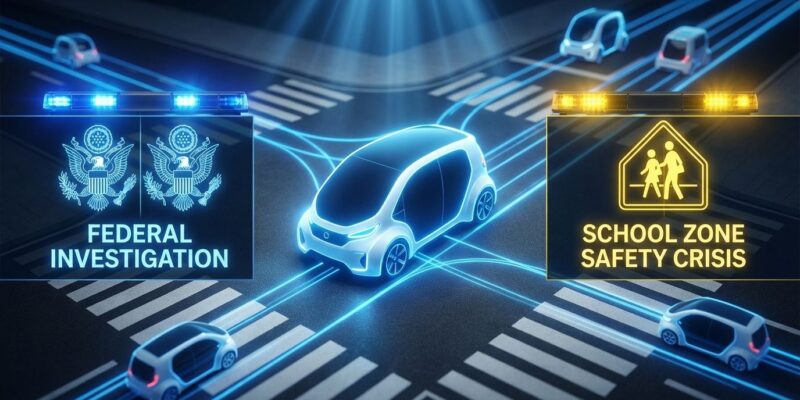
By A Waymo autonomous vehicle struck a child running across the street near Grant Elementary School in Santa Monica on January 23, during morning drop-off hours. The vehicle braked from 17 mph to under 6 mph before contact; the child sustained minor injuries. Federal investigators opened an NHTSA probe announced January 29. This is the second federal investigation into Waymo in one week. On the same day as the child incident, the NTSB announced it’s investigating 24 documented violations of Waymo vehicles illegally passing stopped Austin school buses—including five violations after a December software recall. Both probes share a common thread: Waymo’s systems consistently fail around children and schools.
The Pattern Self-Certification Can’t Hide
Waymo’s chief safety officer claimed the company “safely navigates thousands of school bus encounters weekly across the United States” with “no collisions in the events in question.” However, the documented reality tells a different story. Austin Independent School District has video evidence of 24 illegal bus passings since August 2025, including five violations that occurred after Waymo’s December 10 voluntary software recall. Moreover, the most recent violations happened on January 12—one month after the fix.
This contradiction exposes the core problem with self-certification: manufacturers can’t objectively assess their own safety. The timing couldn’t be worse for the industry. Congress is debating the SELF DRIVE Act right now—introduced January 8, with House hearings held January 13—which would allow automakers to self-certify their autonomous systems and submit “safety cases” to NHTSA without independent verification. Furthermore, Consumer Reports testified against the bill, warning it establishes an “inadequate federal regulatory baseline” that limits public access to safety data and broadly preempts state authority.
This week’s incidents provide real-world evidence for safety advocates’ arguments. If Waymo can’t prevent repeated school bus violations despite voluntary recalls, how can self-certification work for an entire industry?
Why School Zones Expose Autonomous Vehicle Limits
School drop-off environments represent the hardest edge case in autonomous driving: chaotic, unpredictable, high-stakes scenarios where failure has the highest human cost. The Santa Monica incident fits a classic pattern—a child ran from behind a double-parked SUV, creating an “occluded pedestrian” scenario. Additionally, double-parked cars block sight lines, children dart unpredictably, crossing guards gesture, and multiple simultaneous movements happen at once.
These aren’t theoretical edge cases. They’re daily reality. Atlanta and Austin school districts requested Waymo avoid school hours entirely after repeated safety incidents. Research on deploying autonomous vehicles near schools identifies five distinct technical challenges that current systems struggle to handle. School drop-off chaos fundamentally differs from the typical traffic patterns AVs train on, and the gap shows in failure rates.
The counter-argument that “Waymo would have hit the child at 6 mph vs a human’s 14 mph” misses the point. Consequently, human drivers don’t illegally pass school buses 24 times in a single school district. The issue isn’t reaction time in isolated incidents—it’s pattern recognition failure across an entire category of scenarios.
The Statistical Safety Paradox
Here’s the uncomfortable truth: Waymo’s overall safety record is statistically excellent. Data from 56.7 million miles through January 2025 shows 90 percent fewer serious injury crashes, 82 percent fewer airbag deployments, and 81 percent fewer injury-causing crashes compared to human drivers in the same cities. Moreover, Waymo has driven 127 million rider-only miles with no human driver.
However, people don’t think in statistics—they think in stories. One child hit during school drop-off erodes public trust more than 127 million safe miles builds it. Public trust in autonomous vehicles remains low at 37 out of 100, with over 70 percent concerned about security risks. The paradox is real: AVs can be safer overall while failing catastrophically in scenarios that matter most emotionally.
School zones expose a fundamental AI deployment challenge developers should recognize: excellence in common patterns doesn’t guarantee safety in rare critical edge cases. Therefore, production environments differ fundamentally from controlled tests. Safety-critical systems need 100 percent reliability in high-stakes scenarios, not 99.9 percent.
What Happens Next
These incidents arrive at a critical regulatory moment that will likely influence the first federal AV safety law and potentially delay Waymo’s 2026 expansion plans to Dallas, Miami, and Nashville. The NTSB school bus investigation will take 12 to 14 months to complete, with a preliminary report due within 30 days. Meanwhile, cities considering AV approvals may pause pending investigation outcomes.
California passed new laws effective 2026 allowing cities to lower school zone speed limits to 20 mph and enabling law enforcement to issue “notices of noncompliance” to AV manufacturers for traffic violations. The federal SELF DRIVE Act would preempt this local authority, prohibiting states and cities from regulating vehicles with approved safety cases. Real-world incidents influence policy more than theoretical debates—and this timing matters.
The central question these investigations raise isn’t whether autonomous vehicles can eventually be safer than humans. The data suggests they already are, on average. Instead, the question is whether self-certification is sufficient for safety-critical AI systems when edge case failures carry the highest stakes. Boeing’s 737 MAX self-certified the MCAS system. The FAA delegated oversight to Boeing. 346 people died. The precedent is clear: when lives are at stake, independent verification isn’t optional.
Key Takeaways
- Waymo faces two federal investigations launched within one week, both involving school-zone safety failures (NHTSA for child incident Jan 23-29, NTSB for school bus violations Jan 23)
- Pattern shows systematic failure in specific scenarios: 24 documented school bus violations since August 2025, including five violations after Waymo’s December 10 software recall
- Self-certification claims contradicted by documented reality—Waymo claimed “thousands of safe encounters weekly” while video evidence shows repeated illegal bus passings in single school district
- School drop-off environments expose fundamental AV limits: chaotic conditions, unpredictable children, social cues requiring human judgment—scenarios where AI training on typical traffic patterns fails
- Congressional timing is critical—incidents provide real-world evidence as House debates SELF DRIVE Act (introduced Jan 8, hearing Jan 13) allowing manufacturer self-certification without independent verification
- Developer parallel for all safety-critical AI deployment: production edge cases fundamentally differ from controlled testing environments, and self-assessment can’t replace independent verification when failure costs lives







[…] crash unfolded near Grant Elementary School in Santa Monica during the morning rush, when families were walking and driving kids to class. A […]