 By ByteBot
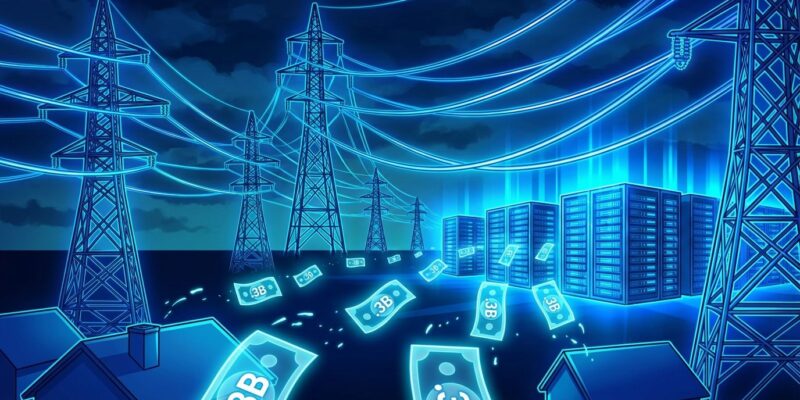
On December 16, 2025, Senators Elizabeth Warren (D-Mass.), Chris Van Hollen (D-Md.), and Richard Blumenthal (D-Conn.) launched a formal investigation into Big Tech data centers, demanding Google, Microsoft, Amazon, Meta, and three data center operators explain how they’re driving up residential electricity bills by hundreds of percent. The investigation targets a staggering 500% surge in electricity capacity costs—from $2.2 billion to $14.7 billion in a single year—with data centers responsible for 63% ($9.3 billion) of the increase. Companies have until January 12, 2026 to respond.
The $9.3 Billion Question: Who Pays for AI Infrastructure?
The PJM Interconnection, the largest US electricity grid serving 13 states plus Washington D.C. (65 million people), saw capacity auction costs explode from $2.2 billion (2024-2025) to $14.7 billion (2025-2026). That’s nearly a 500% increase in a single year. Data center demand, both actual and forecast, accounts for $9.3 billion—63% of the total spike. Per-megawatt capacity prices jumped from $28.92/MW-day to $269.92/MW-day, nearly a 10x increase.
Moreover, this isn’t projected future pain. Residents are already paying. Washington D.C. Pepco customers saw bills jump $21/month starting in June 2025, with $10/month directly attributable to capacity price increases driven by data centers. Bloomberg’s analysis found electricity costs increased up to 267% over five years in data center-heavy regions. Virginia saw +13% year-over-year, Illinois +16%, Ohio +12%, and New Jersey +20%.
This is the hidden infrastructure cost of AI. ChatGPT, Gemini, and Copilot don’t run on magic—they run on massive data centers consuming electricity equivalent to hundreds of thousands of homes. The AI boom isn’t free. American families are paying for it through electricity bills whether they use AI tools or not.
Related: Serverless Cold Start Tax: The Hidden $47K AWS Bill
Shell Companies and Secret Contracts: The Transparency Problem
The senators revealed that Big Tech uses NDAs, shell companies, and confidential utility contracts to hide the true costs from the public. In Virginia alone, 25 out of 31 localities (81%) signed non-disclosure agreements with data center companies. Meta operated through a front company called “Jimnist LLC” to mask its involvement until late in the development process. Furthermore, Microsoft fought to keep its 8+ million gallon annual water usage hidden in Wisconsin.
The pattern extends beyond Virginia. A review of 30+ data center proposals across 14 states found most involved NDAs and shell companies. The senators wrote that companies “ask public officials to sign non-disclosure agreements preventing them from sharing information with their constituents” and “operate through what appear to be shell companies to mask the real owner.” NDAs exist at all levels: water utilities, energy providers, localities, and state government. Companies tell landowners only that a “Fortune 100 company” is planning “industrial development.”
Public infrastructure decisions are being made in secret. Consequently, local officials can’t warn constituents about water or electricity impacts because they’re legally gagged. This isn’t protecting trade secrets—it’s hiding the public costs of private AI infrastructure. For an industry that preaches transparency, Big Tech operates like intelligence agencies when it comes to infrastructure costs.
Public Promises, Private Lobbying: The Hypocrisy
The senators accused tech companies of “publicly pledged to protect consumers from higher energy costs while quietly avoiding financial responsibility for grid expansion.” Amazon publicly claims it will “make sure” costs won’t be passed to customers, yet belongs to the Data Center Coalition that has “opposed state regulatory decisions requiring data center companies to pay a higher percentage of costs upfront.” Google has opposed proposals to create separate utility rate classes for data centers. Companies say one thing publicly, lobby for the opposite privately.
The senators characterized the behavior as “paying lip service to shielding residents from price hikes even as they lobby regulators to shift billions of dollars in infrastructure costs onto local communities.” It’s a question of who pays: should Big Tech pay upfront for the grid expansion their data centers require, or should American families subsidize AI infrastructure through higher bills? The current answer, revealed through lobbying records and utility filings, is clear—consumers are paying.
The Scale Problem: 12% of US Electricity by 2028
The Department of Energy’s 2024 report, produced by Lawrence Berkeley National Laboratory, found data centers consumed 4.4% of total US electricity in 2023 and projects they could consume 6.7% to 12% by 2028. Data center electricity usage could nearly triple in five years. Total consumption grew from 176 TWh in 2023 to a projected 325-580 TWh by 2028. For context, a single hyperscale data center uses enough electricity to power hundreds of thousands of homes.
This explains why electricity costs are spiking. However, it’s not just one company building one data center. It’s a systemic shift in how America generates and consumes electricity, driven almost entirely by AI. The 12% projection means data centers could consume more electricity than entire economic sectors. PJM forecasts peak demand will grow by 32 GW from 2024 to 2030, with 30 GW (94%) coming from data centers.
Related: Fusion Power Races to Solve AI Data Center Energy Crisis
What Happens Next: January 12 Deadline
The seven companies—Google, Microsoft, Amazon, Meta, CoreWeave, Digital Realty, and Equinix—must respond by January 12, 2026 with detailed answers about electricity arrangements, energy projections through 2030, and steps to prevent cost-shifting to consumers. If responses are unsatisfactory, Senate hearings will likely follow in Q1 2026.
Meanwhile, political pressure is mounting. Over 100 protesters rallied at Michigan’s state capitol against data centers. Minnesota and Virginia communities are organizing opposition. Multiple data center projects have been blocked or delayed due to local pushback. States including Virginia and Illinois are considering separate utility rate classes that would require data centers to pay higher upfront infrastructure costs, similar to requirements for renewable energy developers.
This is the beginning, not the end. If companies can’t justify their cost-shifting, expect federal or state mandates requiring upfront infrastructure payments. For anyone in infrastructure, cloud, or data center engineering, regulatory changes could reshape how projects are planned and funded. For everyone else, your electricity bills might depend on whether these companies provide satisfactory answers by January 12.
Key Takeaways
- PJM electricity capacity costs surged 500% from $2.2 billion to $14.7 billion in one year, with data centers responsible for 63% ($9.3 billion) of the increase
- Big Tech uses NDAs and shell companies to hide infrastructure costs—81% of Virginia localities signed NDAs with data center companies
- Companies publicly claim to pay their fair share while the Data Center Coalition lobbies against upfront cost requirements
- DOE projects data centers could consume 12% of US electricity by 2028, up from 4.4% in 2023—a near-tripling in five years
- Seven companies (Google, Microsoft, Amazon, Meta, CoreWeave, Digital Realty, Equinix) have until January 12, 2026 to explain how they’ll stop shifting costs to consumers