 By ByteBot
Developers using Claude Code, Cursor, and Codex face agent chaos. Run two agents on the same project and they overwrite each other. Wait for one to finish and burn hours. Vibe Kanban, an open-source tool from BloopAI, solves this with parallel execution—agents run in isolated git worktrees without conflicts. With 9.4k GitHub stars, it’s becoming the standard for orchestrating AI coding workflows.
The Parallel Execution Problem
AI coding agents changed development, but they brought new pain. Running multiple agents simultaneously creates merge conflicts. Running them sequentially wastes time—one agent sits idle while another grinds through tasks. The industry calls this “agent chaos.”
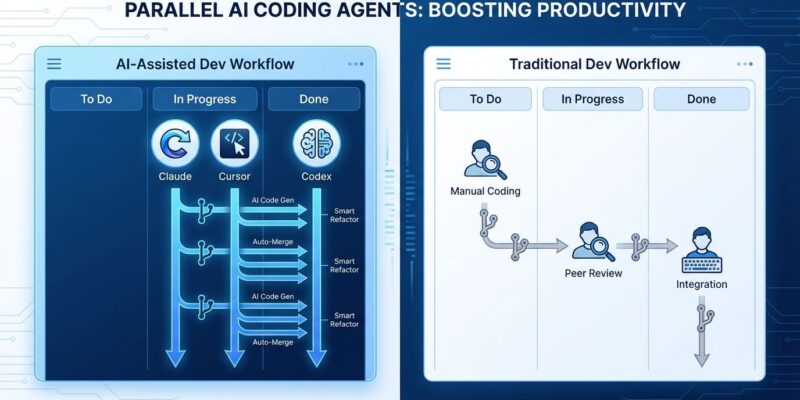
Parallel execution collapses latency instead of accumulating it. Instead of waiting 30 minutes for three sequential tasks, run them simultaneously and finish in 10. The challenge is coordination—how do you let agents work without stepping on each other?
What Vibe Kanban Does
Vibe Kanban is a kanban board for AI coding agents. The innovation is git worktrees—each agent works in a separate branch and workspace. Agent 1 fixes a bug in worktree A. Agent 2 builds a feature in worktree B. All three run simultaneously. No conflicts. No overwrites.
Installation takes one command:
npx vibe-kanbanRequires Node.js 18 or later. Authenticate your agents first (Claude Code, Codex, Cursor CLI, Gemini CLI, Amp). Vibe Kanban works with all major coding agents. It’s free, open-source (Apache 2.0), and backed by Y Combinator-funded BloopAI.
The interface splits into two sections. Left: kanban board tracking tasks across planning, in progress, in review, and done. Right: live agent interaction where you guide the AI and watch execution. No terminal juggling. One unified workflow.
How the Workflow Works
Create a task. Vibe Kanban spins up a git worktree and assigns an agent. The agent executes the task while you move to the next one. Drag another task to “in progress,” assign a different agent, and now two run in parallel.
When agents finish, review their work in the built-in diff viewer. It looks like a GitHub pull request—you see exactly what changed, line by line. Approve it or request changes. Merge the worktree back to your main branch with one click.
Task templates let you standardize workflows. Define a “bug fix” template with specific steps and agent instructions. Reuse it every time. BloopAI’s founders say over 50% of their code is now written by agents—this is how they manage it.
Why This Matters: The Vibe Coding Trend
Vibe coding—the term Andrej Karpathy coined in February 2025—became Collins Dictionary’s Word of the Year. Developers describe tasks to LLMs, LLMs write code, developers evaluate by running it. No manual review. Just vibes.
The trend exploded. Stack Overflow’s 2025 survey found 65% of developers use AI coding tools weekly. Y Combinator’s Winter 2025 batch included 25% of startups with codebases that were 95% AI-generated.
Then came the backlash. Fast Company reported the “vibe coding hangover”—senior engineers calling it “development hell.” A survey of 18 CTOs found 16 experienced production disasters from AI-generated code. Security researchers discovered vulnerabilities in 170 out of 1,645 AI-created apps.
MIT Technology Review called 2025 the shift “from vibe coding to context engineering.” The industry realized loose, vibes-based approaches don’t scale. You need systematic management and orchestration tools that enforce review and prevent agent chaos.
Orchestration as Productivity Multiplier
“Orchestration, not bigger models, is the real AI productivity multiplier,” argues a recent analysis. Sequential execution accumulates latency—task 1 takes 10 minutes, task 2 takes 10 minutes, task 3 takes 10 minutes, total is 30. Parallel execution collapses it—all three run simultaneously, total is 10.
Luke Harries, Growth Lead at Eleven Labs, called Vibe Kanban his “biggest increase in productivity since Cursor.” The productivity claims aren’t just marketing. When you stop waiting for agents and start orchestrating them, the math works.
The developer role is shifting. You’re planning tasks, reviewing agent output, and deciding what to build next. OpenAI launched AgentKit. Anthropic released Claude Agent SDK. Google shipped Agent Development Kit. The Model Context Protocol (MCP) is everywhere. Major companies recognize agents as infrastructure.
Gartner predicts 33% of enterprise software will depend on agentic AI by 2028. Developers who master orchestration tools like Vibe Kanban will outpace those who don’t.
Open Source Advantage
Vibe Kanban is Apache 2.0 licensed. No vendor lock-in. No subscriptions. You pay for the underlying AI services (Claude, OpenAI, Google), but the orchestration layer is free. The project has 146 releases, 33 contributors, and active development.
Closed-source tools control your workflow. Open-source tools let you customize, extend, and own the process. For coding agents—where you’re entrusting significant portions of your codebase to automation—that matters.
Who Should Use Vibe Kanban
If you’re using Claude Code, Cursor, Codex, or any AI coding agent, and you’ve hit the sequential execution bottleneck, try Vibe Kanban. If you’re managing multiple tasks and wasting time switching contexts, try it. If you want a systematic review process for agent-generated code instead of trusting vibes, try it.
It’s not for everyone. If you run one agent on one project occasionally, the overhead isn’t worth it. But if you’re serious about context engineering and want to do it right, Vibe Kanban is the tool to master.
The question isn’t whether agents will write code. They already do. The question is whether you’ll manage them systematically or drown in agent chaos. Vibe Kanban is the answer.