 By ByteBot
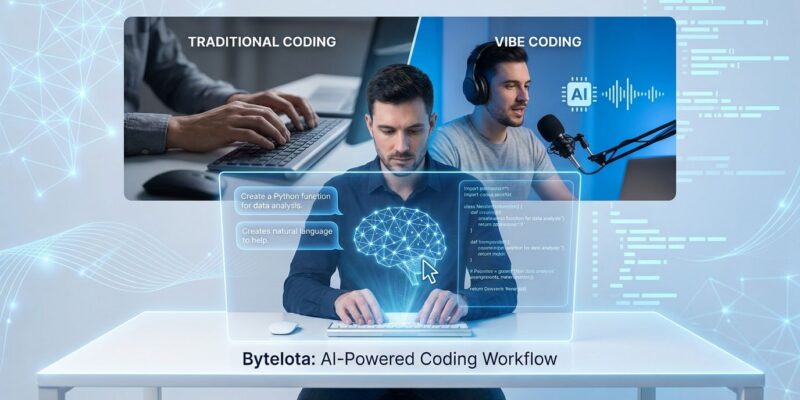
Vibe coding—a term coined by OpenAI co-founder Andrej Karpathy in February 2025—is transforming how developers write software. Instead of typing code line-by-line, developers describe what they want in natural language and AI assistants handle the implementation. This isn’t theoretical: Y Combinator reports 25% of their Winter 2025 startup batch has codebases that are 95% AI-generated, and these startups are growing 10% per week—the fastest in Y Combinator history.
However, the reality is more nuanced than the hype. Andrew Ng (Google Brain founder) calls the term “misleading,” emphasizing that vibe coding is “a deeply intellectual exercise” that leaves him “exhausted by the end of the day.” Security researchers found 10% of apps from one vibe coding tool had exploitable vulnerabilities, and critics warn of “development hell” from AI-generated technical debt. Yet Stack Overflow’s 2025 survey shows 84% of developers using or planning to use AI tools, with senior engineers leveraging these tools shipping code 2.5x faster.
What Vibe Coding Actually Is
Karpathy’s original definition captures the vision: “fully give in to the vibes, embrace exponentials, and forget that the code even exists.” The workflow shifts from “write → debug → test” to “prompt → generate → review → refine.” Furthermore, tools like Cursor Composer can run 8 parallel AI agents working on different parts of a codebase simultaneously, completing complex tasks in under 30 seconds.
Nevertheless, Ng provides the necessary reality check. “When I’m coding for a day with AI coding assistance, I’m frankly exhausted by the end of the day,” he said, calling vibe coding an “unfortunate” term that “misleads people into thinking engineers just ‘go with the vibes.'” The truth: this approach requires prompt engineering skills, architectural understanding, and rigorous code review—it’s not autopilot.
IBM’s technical assessment aligns with Ng’s perspective: vibe coding is “the practice of prompting AI tools to generate code rather than writing code manually,” but it demands that “true creativity, goal alignment and out-of-the-box thinking remain uniquely human.” Consequently, developers who understand this nuance will succeed. Those who treat it as magic will create unmaintainable codebases.
Who’s Actually Using AI Coding Tools
The adoption data tells a remarkable story. Y Combinator’s Winter 2025 batch—comprising highly technical founders who would have built products from scratch a year ago—now has 25% of startups with codebases that are 95% AI-generated. Moreover, “You don’t need a team of 50 or 100 engineers,” said Jared Friedman, YC Managing Partner. “You don’t have to raise as much. The capital goes much longer.”
Additionally, this isn’t just startups experimenting. Microsoft CEO Satya Nadella and Google CEO Sundar Pichai both estimate 20-30% of their companies’ code is now AI-generated. Stack Overflow’s 2025 Developer Survey found 84% of developers using or planning to use AI tools, while JetBrains reports 85% regular usage with 62% relying on at least one AI coding assistant.
The productivity gains are real for experienced developers. Specifically, those with 10+ years of experience are 2x more likely to use AI for over half their code and ship 2.5x faster than without AI. However, some research suggests developers think they’re 20% faster but are actually 19% slower—a reminder that perception doesn’t always match reality.
Vibe Coding Tools Comparison
The vibe coding ecosystem has matured rapidly, with tools serving distinct workflows. Cursor dominates the professional desktop IDE space with its Composer model that spawns up to 8 parallel agents working in isolated git worktrees, completing most tasks in under 30 seconds—a claimed 4x speed boost over “similarly intelligent systems.”
Moreover, Replit Ghostwriter exemplifies the market opportunity: the company’s revenue exploded from $10M to $100M ARR in just 9 months following their AI Agent release. Its cloud-based approach offers real-time collaboration and instant deployment, though some users find it “less sophisticated than Cursor or GitHub Copilot” for complex professional work.
In contrast, Windsurf Cascade focuses on context understanding with “memories” across sessions and the ability to understand file relationships without opening them. Its “Fast Context” feature retrieves relevant code 10x faster using parallel tool calls, while “Codemaps” provides AI-annotated visual codebase maps. Meanwhile, Bolt.new takes a different approach entirely: rapid web app generation for indie hackers and consultants who need to validate concepts in minutes, not hours.
GitHub Copilot remains valuable but serves a different purpose—it’s a code completion tool, not a vibe coding platform. For developers who want subtle AI assistance while primarily coding themselves, Copilot fits the bill. For “describe and build” workflows, you need Cursor, Replit, or Bolt.
Security Risks and Technical Debt
The security picture is concerning. In May 2025, researchers found 170 out of 1,645 web applications (10.3%) created by the Lovable vibe coding tool had security vulnerabilities allowing unauthorized access to personal information. Furthermore, IBM warns that “developers may use AI-generated code without fully comprehending its functionality, leading to undetected bugs, errors, or security vulnerabilities.”
Technical debt accumulation is another real risk. A PayPal senior engineer noted that “code created by AI coding agents can become development hell”—while these tools generate features quickly, they often create maintenance burdens that must be addressed with significant developer time and effort. Fast Company’s “The vibe coding hangover is upon us” article documents growing concerns about long-term code quality.
Additionally, junior developers face particular risks. Critics warn that over-reliance on AI creates “unemployable pseudo-developers” who struggle with debugging and maintaining legacy systems without AI assistance. Auto-generated tests typically cover “obvious happy paths” but miss edge cases, race conditions, and performance hotspots—areas where experienced developers add the most value.
Best Practices for Effective Vibe Coding
Success requires engineering discipline, not just vibes. Structured prompt engineering makes the difference between productive workflows and frustrating iterations. Compare these approaches:
❌ Bad prompt: "Make a todo app"

✅ Good prompt:
Context: Building a productivity app for developers
Task: Create a todo list component with:
- React TypeScript
- Drag-and-drop reordering
- Local storage persistence
- Filter by status (all/active/completed)
Guidelines: Use Tailwind CSS, follow React hooks best practices
Constraints: Don't use external state management libraries, keep under 200 lines
The structured approach—breaking prompts into Context, Task, Guidelines, and Constraints—consistently yields better results. As practitioners emphasize: “Clear prompts yield clear results. Vague prompts produce vague outputs.”
Iterative building matters too. Specifically, build one feature at a time rather than batching unrelated changes. Test with realistic data, not the toy examples AI generates. Moreover, keep context tight by indexing only relevant files—overwhelming AI with your entire codebase degrades performance. Use tools like Cursor’s Plan Mode to generate reviewable architectural plans before implementation, preventing wasted effort on misguided approaches.
Consequently, treat AI as an active collaborator, not just a code generator. Prompt it to critique solutions, optimize algorithms, and propose alternatives. This collaborative approach “can uncover more efficient methods” that you might not discover through traditional development alone.
Career Implications for Developers
Vibe coding is reshaping developer careers with diverging outcomes. Senior developers (10+ years experience) thrive by using AI for 50%+ of their code while maintaining architectural oversight. In contrast, junior developers risk skill erosion by becoming dependent without building fundamental knowledge.
Andrew Ng tackles this head-on with blunt career advice. Regarding suggestions that people shouldn’t learn to code because AI will handle it, he said: “I think we’ll look back at some of the worst career advice ever given.” Learning to code remains essential, but developers must now add prompt engineering, AI interaction skills, output evaluation, and debugging AI-generated code to their toolkit.
The job market reality is stark: developer job openings have declined 70%, with 94,000+ tech layoffs in 2025 alone. Moreover, JetBrains data shows 9 out of 10 developers save at least 1 hour per week using AI tools—the new normal requires AI fluency. As YC’s Friedman put it: “This is the dominant way to code. And if you are not doing it, you might just be left behind.”
Vibe coding isn’t replacing developers—it’s evolving the role. Humans remain essential for system architecture, security decisions, creative problem-solving, and code review. However, the developers who adapt by learning AI-assisted workflows while maintaining engineering fundamentals will have significant advantages in a contracting market. Those who don’t risk career stagnation.
Key Takeaways
- Vibe coding is real: 25% of YC Winter 2025 startups have 95% AI-generated codebases, growing 10% weekly
- It’s not autopilot: Andrew Ng calls it “a deeply intellectual exercise,” not “going with the vibes”
- Choose tools wisely: Cursor for professional work, Replit for collaboration, Bolt for rapid prototyping
- Security matters: 10% of one tool’s apps had vulnerabilities; rigorous review is essential
- Structure your prompts: Context + Task + Guidelines + Constraints yields better results
- Career adaptation required: Learn AI workflows while maintaining engineering fundamentals or risk obsolescence