By ByteBot
“Software engineering is dead” articles flooded tech media in late 2025. Collins Dictionary crowned “vibe coding” Word of the Year in November. By September, Fast Company reported senior engineers citing “development hell.” The tech world is at war over a simple question: Is letting AI write code without reviewing it revolutionary or reckless?
The numbers tell a startling story. Twenty-five percent of Y Combinator startups now have codebases that are 95% AI-generated. Google’s AI writes 30% of new code. Meanwhile, according to Stack Overflow’s December 2025 survey, 46% of developers actively distrust AI accuracy. Something fundamental is shifting in what it means to write software.
The Trust Paradox Nobody’s Talking About
Eighty-four percent of developers use AI coding tools, but trust in AI accuracy plummeted from 40% to 29% in just one year. More developers actively distrust AI than trust it. Only 3% report “highly trusting” the output.
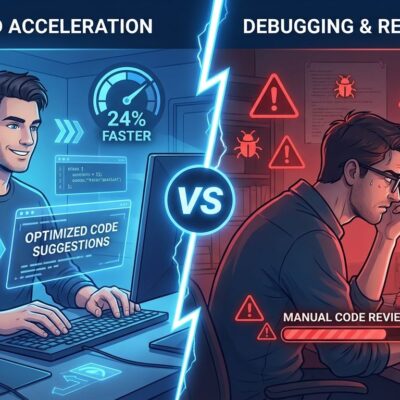
The disconnect is stark. Developers are adopting AI out of necessity – everyone else is doing it – not confidence. They’re using tools they don’t trust. The top frustration? Sixty-six percent cite “AI solutions that are almost right, but not quite.” Forty-five percent say debugging AI code is more time-consuming than writing it manually.
Even Andrew Ng, a vocal AI advocate, admitted at a May 2025 conference: “When I’m coding for a day with AI coding assistance, I’m frankly exhausted by the end of the day.” This isn’t effortless automation. It’s a different kind of work – one most developers haven’t figured out yet.
The Security Catastrophe No One Saw Coming
Researchers analyzed 5,600 vibe-coded applications and found 2,000+ vulnerabilities, 400+ exposed secrets, and 175 instances of exposed PII including medical records and bank accounts. When you don’t review code, you ship vulnerabilities you don’t know exist.
The poster child for this disaster? Lovable, the Swedish vibe coding startup that hit $100M ARR in eight months – potentially the fastest-growing startup in history. In March 2025, security researchers discovered CVE-2025-48757, a critical Row Level Security flaw affecting 170 out of 1,645 Lovable apps. One engineer infiltrated multiple “top launched” sites in 47 minutes, extracting personal debt amounts, home addresses, and API keys.
Lovable failed to fix the flaw despite being notified months prior. Their eventual “security scanner” only checks for the existence of security policies, not their correctness – providing a false sense of security while real vulnerabilities remain.
The Economics Don’t Add Up
A new job category emerged on LinkedIn in late 2025: “Vibe Coding Cleanup Specialist.” They’re being called “superhero janitors of the programming world,” charging upwards of $200 per hour to fix AI-generated messes. Demand increased 300% in six months.
The pattern is predictable. Companies “save money” by letting anyone vibe code their projects, then pay twice as much for experienced developers to untangle the chaos. Inconsistent code, security vulnerabilities, performance bottlenecks, broken UX – cleanup specialists fix them all.
Here’s what’s interesting: Those Y Combinator startups with 95% AI-generated codebases? Their founders are still highly technical. As YC CEO Garry Tan noted, “These weren’t non-technical founders – every one of these people is highly technical, completely capable of building their own products from scratch, but now 95% of it is built by an AI.”
The cleanup specialist boom proves what the hype misses: Expertise didn’t become obsolete. It became more valuable.
What Vibe Coding Actually Exposes
Here’s the uncomfortable truth nobody’s saying: Vibe coding isn’t killing software engineering. It’s exposing who never understood it in the first place.
The engineers panicking about “development hell” are often the same ones who relied on Stack Overflow copy-paste patterns for years. They never learned systems design, just recipe following. AI automated that – and now they’re lost.
The engineers succeeding with AI? They’re the ones who always understood architecture, tradeoffs, and context. They use AI to handle implementation while they focus on the judgment calls AI can’t make. They review the generated code, spot the edge cases, catch the security flaws.
Simon Willison nailed the distinction: “If an LLM wrote every line of your code, but you’ve reviewed, tested, and understood it all, that’s not vibe coding – that’s using an LLM as a typing assistant.” Real engineers never stopped reviewing.
Andrej Karpathy, who coined the term “vibe coding” in February 2025, described it as “fully giving in to the vibes, forgetting the code even exists.” His use case? “Throwaway weekend projects.” Not production systems. Not customer-facing applications. Weekend experiments where code quality doesn’t matter.
But 25% of YC startups are betting their companies on code their founders never reviewed. That’s not engineering. That’s rolling the dice.
The Bar Is Rising, Not Falling
Code review skills matter more now, not less. If you can’t review AI-generated code and spot the security flaw, the missing edge case, the performance bottleneck – you weren’t an engineer. You were a typist.
The future isn’t “engineers versus AI.” It’s engineers as architects and orchestrators. AI handles implementation. Humans handle judgment. But you must understand what the code does. Quality engineering requires understanding code flow, even if AI wrote it.
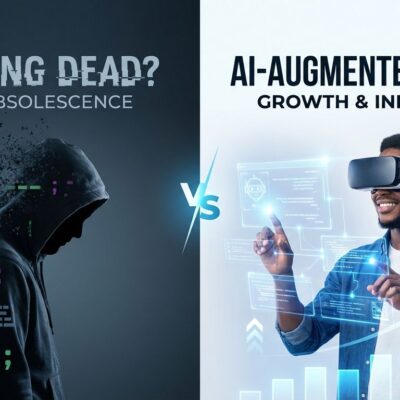
Vibe coding is a litmus test. If AI threatens your job, you were doing the wrong job. Real software engineering was always about judgment, not syntax. The engineers who survive are the ones who always understood that.
The trust paradox, security disasters, and cleanup specialist boom all point to the same conclusion: Expertise is more valuable than ever. The difference is what counts as expertise. Pattern matching is dead. Systems thinking survived. Choose which engineer you want to be.