 By ByteBot
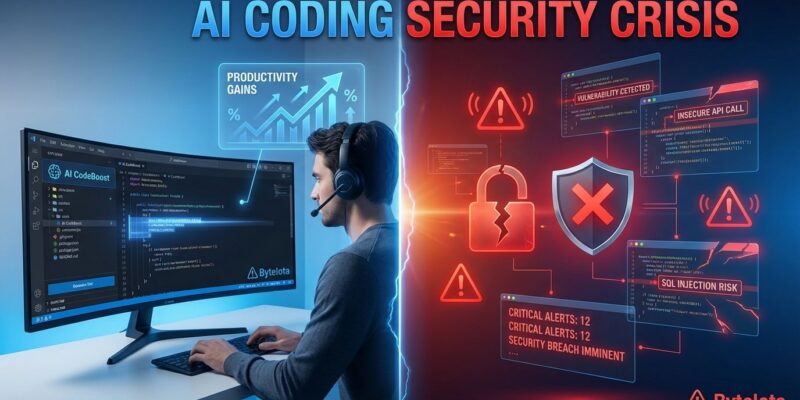
The vibe coding revolution has arrived. 92% of US developers now use AI coding tools daily, 87% of Fortune 500 companies have rushed to adopt these platforms, and the market has exploded to $4.7 billion in 2026. However, there’s a critical problem nobody wants to talk about: 45% of AI-generated code contains security vulnerabilities. We’re building a security time bomb while celebrating productivity gains.
The Productivity Promise That Drove Adoption
The appeal of vibe coding is obvious—describe what you want in plain language, AI writes the code. The productivity gains are real and measurable. Developers report 3-5x speed increases for common tasks, 74% see productivity boosts, and teams complete tasks 51% faster. Early studies from GitHub, Google, and Microsoft show 20-55% faster task completion across the board.
The numbers explain the explosive adoption. 41% of all global code is now AI-generated—that’s 256 billion lines written by AI in 2024 alone. Tools like Cursor (best for multi-file editing), GitHub Copilot ($10/month), and Windsurf (free option) have become essential parts of developers’ workflows. Steven Webb, CTO of Capgemini UK, calls it: “AI-native engineering goes mainstream” in 2026.
Moreover, startups are all-in. 21% of Y Combinator Winter 2025 companies have codebases that are 91% AI-generated, and startups are shipping 95% of their code via AI. This isn’t hype—it’s a fundamental shift in how software gets built.
The Security Crisis Everyone’s Ignoring
While developers celebrate speed gains, they’re flooding codebases with vulnerabilities. 45% of AI-generated code contains security flaws, according to Veracode’s 2026 research. Academic studies confirm over 40% of AI solutions have security vulnerabilities. Even the best AI model—Claude Opus 4.5 Thinking—only produces secure code 56% of the time without security prompting.
The specific vulnerabilities are alarming. AI tools fail to defend against cross-site scripting (XSS) in 86% of relevant code samples and log injection in 88% of cases. Consequently, AI-generated code is 2.74x more likely to introduce XSS vulnerabilities than human-written code, 1.88x more likely to implement improper password handling, and 1.82x more likely to add insecure deserialization.
Missing input sanitization is the most common security flaw across all languages and models. Java is the riskiest language for AI-generated code, with a security failure rate over 70%. Python, C#, and JavaScript still present significant risk, with failure rates between 38% and 45%. Furthermore, the root cause is straightforward: LLMs train on open-source code via pattern matching—if unsafe patterns appear frequently in training data, AI reproduces them.
Here’s the kicker: 57% of AI-generated APIs are publicly accessible, and 89% rely on insecure authentication methods. We’re not talking about minor bugs—these are critical security vulnerabilities that expose user data, enable injection attacks, and create compliance nightmares.
Quality Degradation Nobody Measures
Beyond security, AI coding is degrading overall code quality in ways developers aren’t tracking. Google’s 2024 DORA report found a 7.2% decrease in delivery stability with AI use, a 4x increase in code duplication, and rising short-term code churn. These aren’t trivial metrics—they’re indicators of technical debt accumulating at scale.
The acceptance numbers tell the real story. GitHub Copilot offers a 46% code completion rate, but only 30% of that code actually gets accepted by developers. In fact, 75% of developers won’t merge AI-generated code without manual review, even when accuracy appears high. The problem is clear: AI generates code faster than developers can verify it’s safe.
Hacker News discussions reflect growing concerns. Developers report “fairly obvious drops in the quality of their work” when using Copilot and similar tools. Others describe it as “challenging to consistently get reliable, production-quality results in a responsible way.” Additionally, the PR review bottleneck is real—AI increases code production rate, but review capacity now controls safe delivery rate.
The enterprise problem is what one GitHub repository calls “comprehension debt”: areas of codebases that no human understands because they were written by AI and reviewed by AI. This creates long-term maintainability nightmares that won’t show up in quarterly velocity metrics.
We’re Doing This Wrong
Vibe coding’s 92% adoption rate proves developers love it. The 45% security flaw rate proves we’re not ready for it at scale. Therefore, the industry is celebrating productivity gains while ignoring a security crisis, and that’s reckless engineering.
The governance gap is massive. 87% of Fortune 500 companies adopted vibe coding platforms before establishing formal review processes or approved tool lists. Most organizations haven’t developed policies for AI-generated code—they’re just letting developers use whatever tools boost velocity metrics. Consequently, Shadow AI (unmonitored agents operating outside IT governance) is creating IP leakage and security risks nobody’s tracking.
Even with security-focused prompts, Claude Opus 4.5 only produces secure code 66-69% of the time. That means 1 in 3 code outputs are insecure—unacceptable at the scale we’re deploying these tools. The fundamental problem is that AI tools are trained on historical code repositories and lack real-time CVE awareness. They “will happily draw from vulnerable libraries” because they don’t know those libraries are compromised.
We’re optimizing for the wrong metrics. Velocity looks great on dashboards, but delivery stability is down 7.2%, code duplication is up 4x, and security vulnerabilities are rampant. This is technical debt at enterprise scale.
What Needs to Happen Now
The industry needs to slow down and fix security before scaling further. Here’s the minimum baseline every organization should implement today:
Treat AI-generated code as untrusted. Every line requires the same security validation you’d apply to code from an unknown contractor. Run comprehensive testing—SAST, SCA, DAST—on all AI-generated code. Moreover, use security-focused prompts with every AI request (this improves Claude Opus 4.5’s security from 56% to 66-69%, though that’s still insufficient).
Mandate human oversight for all AI code. Both automated security tools and expert review are required. Additionally, implement CI/CD security gates that automatically block deployments containing high-severity vulnerabilities or non-compliant code patterns. Establish strict dependency management—popularity doesn’t guarantee security, and AI tools will suggest vulnerable packages if they appear frequently in training data.
The 2026 predictions offer a glimpse of better solutions. Self-healing software will monitor apps in production and fix bugs in real-time without human prompting. Guardrail agents—secondary AI whose only job is auditing vibe-coded output for security and efficiency—will provide automated safety checks. Real-time CVE awareness integrated into AI coding tools will prevent vulnerable library suggestions.
However, these solutions are coming later. Right now, organizations need to implement basic security hygiene before they scale AI coding further.
The Bottom Line
Vibe coding adoption outpaced security readiness. The productivity gains are real—3-5x faster for common tasks. However, the quality degradation is also real—7.2% stability drop, 4x code duplication, and 45% of code contains security flaws. At 92% adoption and 41% of global code AI-generated, this is a systemic problem.
The path forward is clear: treat AI code as untrusted, mandate security gates, require human oversight, and slow down scaling until these basics are in place. The industry chose speed over security. That needs to change before the security time bomb goes off.