 By ByteBot
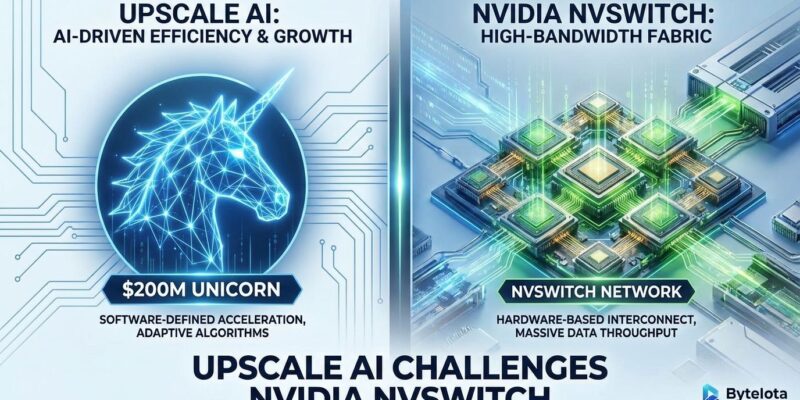
Upscale AI closed a $200 million Series A on January 21, achieving unicorn status just months after its $100 million seed round. Led by Tiger Global with backing from Intel Capital, Qualcomm Ventures, and AMD—all Nvidia GPU competitors—the startup is building SkyHammer, an open-standard AI networking chip designed to break Nvidia’s NVSwitch monopoly. The target: a $600 billion AI infrastructure market where interconnects, not GPUs, have become the bottleneck.
Here’s what actually matters: Nvidia doesn’t just sell GPUs. Its real lock-in comes from NVSwitch interconnects that cost more than the GPUs themselves and only work with Nvidia hardware. Upscale represents the first pure-play challenger with Fortune 500 pedigree—founders from Palo Alto Networks, Innovium, and Cavium—backed by strategic investors who profit from Nvidia’s downfall.
Interconnects Are the Real Monopoly
The AI infrastructure bottleneck has shifted from compute to interconnects, and Nvidia owns both sides of the equation. NVSwitch enables up to 576 GPUs to communicate at 900 GB/s, but it only works with Nvidia’s SXM-form-factor GPUs like the A100, H100, and B100. Want to mix AMD Instinct or Intel Gaudi accelerators in your cluster? Replace the entire networking stack. A single DGX H100 system costs $300,000 to $500,000—and scaling to 256 GPUs requires millions. Moreover, the GB200 NVL72 needs 5,000+ cables totaling over 2 miles, creating infrastructure nightmares hyperscalers can’t escape.
Here’s the dirty secret: hyperscalers spend $4 to $5 per hour to rent an H100 GPU, and that rental cost includes the NVSwitch tax. Interconnect profit margins exceed GPU margins, making this Nvidia’s most lucrative segment. Consequently, the vendor lock-in isn’t accidental—it’s the business model.
SkyHammer’s Technical Bet
Upscale’s approach is fundamentally different. SkyHammer uses a memory semantic-based load-store network architecture where CPUs, GPUs, and accelerators share data through native load/store access at nanosecond latency. Instead of Nvidia’s proprietary protocol, it treats the network like memory. Furthermore, the chip supports UALink, the open standard backed by AMD, Intel, Google, Meta, and Microsoft—a consortium formed explicitly to break Nvidia’s ecosystem.
UALink can connect up to 1,024 accelerators, compared to Nvidia’s 256, with 200 GT/s per lane bidirectional bandwidth. Additionally, SkyHammer includes deterministic latency—predictable data travel times between rack components—plus real-time telemetry, adaptive load handling, and hardware-level resiliency. It ships Q4 2026 as a standalone ASIC or integrated rack solution.
The promise: build multi-vendor AI clusters. Train on Nvidia H100s, run inference on AMD MI300s, prototype on Intel Gaudi 3s—all in the same cluster. If SkyHammer matches NVSwitch performance, the cost savings could hit 40-60%.
Strategic Investors Reveal the Stakes
When Intel, AMD, and Qualcomm—Nvidia’s GPU competitors—collectively invest $300 million in an interconnect startup, it’s not a bet. It’s strategic warfare. They’re funding the infrastructure that could dethrone Nvidia’s vertical integration. Tiger Global led the Series A with Premji Invest and Xora Innovation, validating the market opportunity.
The founders bring serious pedigree. Barun Kar (CEO) was a founding member at Palo Alto Networks and built the first 10Gbs NextGen Firewall. Rajiv Khemani (Executive Chairman) founded Innovium, which challenged Broadcom’s switch monopoly before Marvell acquired it in 2021 for disrupting an entrenched incumbent. The team includes veterans from Cisco, AWS, Microsoft, Google, and Juniper Networks—people who’ve scaled infrastructure companies from zero to billions.
This isn’t a speculative play. The UALink Consortium has 80+ members, including every major hyperscaler. Open standards are the industry’s response to Nvidia’s closed ecosystem.
The CUDA Moat Problem
Let’s be honest: breaking Nvidia’s interconnect monopoly is the easy part. The hard part is the CUDA moat. AI frameworks like PyTorch, JAX, and TensorFlow are deeply optimized for Nvidia GPUs. Even if SkyHammer matches NVSwitch’s 900 GB/s bandwidth, will developers rewrite kernels for UALink? Will hyperscalers risk production workloads on unproven silicon?
Nvidia isn’t standing still. The company announced its Rubin/Vera architecture at CES on January 5, promising 10x lower inference costs and 4x fewer GPUs for mixture-of-experts models compared to Blackwell. Upscale hasn’t shipped silicon yet—Q4 2026 is the target. If they miss the window or underperform, hyperscalers will stick with proven NVSwitch despite the vendor lock-in costs.
The real question isn’t whether SkyHammer can match NVSwitch performance. It’s whether the software ecosystem will follow. Hardware is replaceable. CUDA is sticky.
Market Timing and the 2026-2027 Window
Global hyperscalers are spending $500 to $600 billion on AI infrastructure in 2026, and interconnects are becoming a larger spend than GPUs. The AI infrastructure market hit $182 billion in 2025 and projects to $197 billion+ by 2030. Meanwhile, Upscale’s window of opportunity is 2026-2027—ship on time, secure 2-3 hyperscaler design wins, and capture 5-10% market share by 2028.
AWS, Microsoft, Google, and Oracle are all deploying Nvidia’s Rubin platform in H2 2026, but they’re simultaneously investing in alternatives. UALink Consortium, internal interconnects, anything that gives them leverage against Nvidia’s pricing power. In fact, cloud providers dropped H100 rental prices 44% in mid-2025 due to competition—they need more vendors to maintain pressure.
If Upscale delivers on Q4 2026, they’re positioned to ride the hyperscaler demand wave. However, if they miss, or if Nvidia cuts NVSwitch pricing aggressively to defend market share, the $1 billion valuation becomes speculative. Silicon photonics startups like Ayar Labs could leapfrog both NVSwitch and UALink with >100 Tb/s bandwidth by 2028.
What This Means for AI Infrastructure
Upscale AI achieved unicorn status by targeting the right chokepoint: Nvidia’s interconnect monopoly costs hyperscalers billions annually. Open-standard networking (UALink) could enable multi-vendor AI clusters and break vendor lock-in. Nevertheless, the challenge isn’t hardware—it’s software ecosystem stickiness and the CUDA moat.
Strategic investors (Intel, AMD, Qualcomm) signal an industry shift toward breaking Nvidia’s vertical integration. SkyHammer ships Q4 2026. Therefore, the next 12 months will determine if open standards can crack AI infrastructure dominance, or if Nvidia’s ecosystem proves too entrenched to disrupt.
Key Takeaways
- Upscale AI closed $200M Series A (Jan 21, 2026), reaching unicorn status in months
- SkyHammer targets Nvidia NVSwitch monopoly with UALink open-standard networking
- Intel, AMD, Qualcomm backing signals strategic shift toward multi-vendor AI clusters
- Q4 2026 ship date is critical—hyperscalers spending $600B on AI infrastructure
- CUDA ecosystem stickiness remains Nvidia’s strongest competitive advantage